The most common reason homeowners search fairy ring in cool season grass is because they spotted something they have never seen before — a near-perfect circle of dark green turf, a ring of dead grass, or a row of mushrooms curving across the lawn. Before you do anything, you need to know which type of fairy ring you are dealing with. Treating the wrong type wastes time and money. Ignoring the right type lets real damage get worse. If you are unsure whether fairy ring is even your problem, the What’s Wrong With My Lawn? Complete Diagnosis Guide can help you rule out other causes before you proceed.
Here is how to diagnose it correctly and what to actually do about it.
Disclosure: This article contains affiliate links. If you purchase through these links, I may earn a small commission at no extra cost to you. As an Amazon Associate, I earn from qualifying purchases.
What Fairy Ring in Cool Season Grass Actually Is and Why It Appears
Fairy ring is not a foliar disease. It does not attack the grass blade the way dollar spot or brown patch does. It originates underground.
The cause is soil-dwelling fungi that break down buried organic matter — old tree stumps, buried wood debris, decomposing thatch, or any organic material left in the soil. The fungal threads, called mycelium, grow outward in all directions from that central food source. Because growth is radial and roughly even, the pattern on the surface always appears as a circle or arc.
Cool season grasses — Kentucky bluegrass, tall fescue, fine fescue, and perennial ryegrass — are particularly vulnerable in spring and early fall. Moderate soil temperatures combined with adequate moisture create ideal conditions for fungal activity underground. That timing overlap with the active growing season for cool season turf is why homeowners notice fairy ring in cool season grass most often in April, May, September, and October. Following a Cool Season Lawn Care Schedule Month by Month Guide can help you stay ahead of these seasonal conditions and catch early signs of fairy ring before damage sets in.
One thing worth understanding: fairy ring does not spread the way a contagious lawn disease spreads. It only expands as far as the underground food source allows. It is not going to jump to your neighbor’s lawn. The circle stops growing when the organic matter runs out.
The Three Types of Fairy Ring in Cool Season Grass and Which One Is Harming Your Lawn
This is the key diagnostic step. There are three recognized types of fairy ring in cool season grass, and they have very different implications for your turf.
Quick reference before you read further: Type I kills grass (dead ring zone), Type II only discolors it (dark green ring, no dead turf), and Type III produces mushrooms with no effect on turf health. Identify your type first — the fix depends entirely on which one you have.
Type I — The Damaging One
Type I fairy ring is the most serious form and the one homeowners usually panic about. These rings develop a band of stressed, drought-like turf that eventually turns brown and dies. In severe cases, the soil beneath the ring becomes water-repellent, preventing moisture from reaching the roots even after irrigation or rain. The grass may wilt rapidly during hot weather and feel dry despite wet surrounding soil. Kentucky bluegrass lawns commonly show this pattern most aggressively.
Type II — The Cosmetic One
Type II produces only a dark green ring. No dead turf, no dying zones. The grass inside and outside the ring looks perfectly healthy. The green band you see is caused by nitrogen released as the fungi break down organic matter underground. Tall fescue and perennial ryegrass lawns most often show this pattern.
Type III — Mushrooms Only
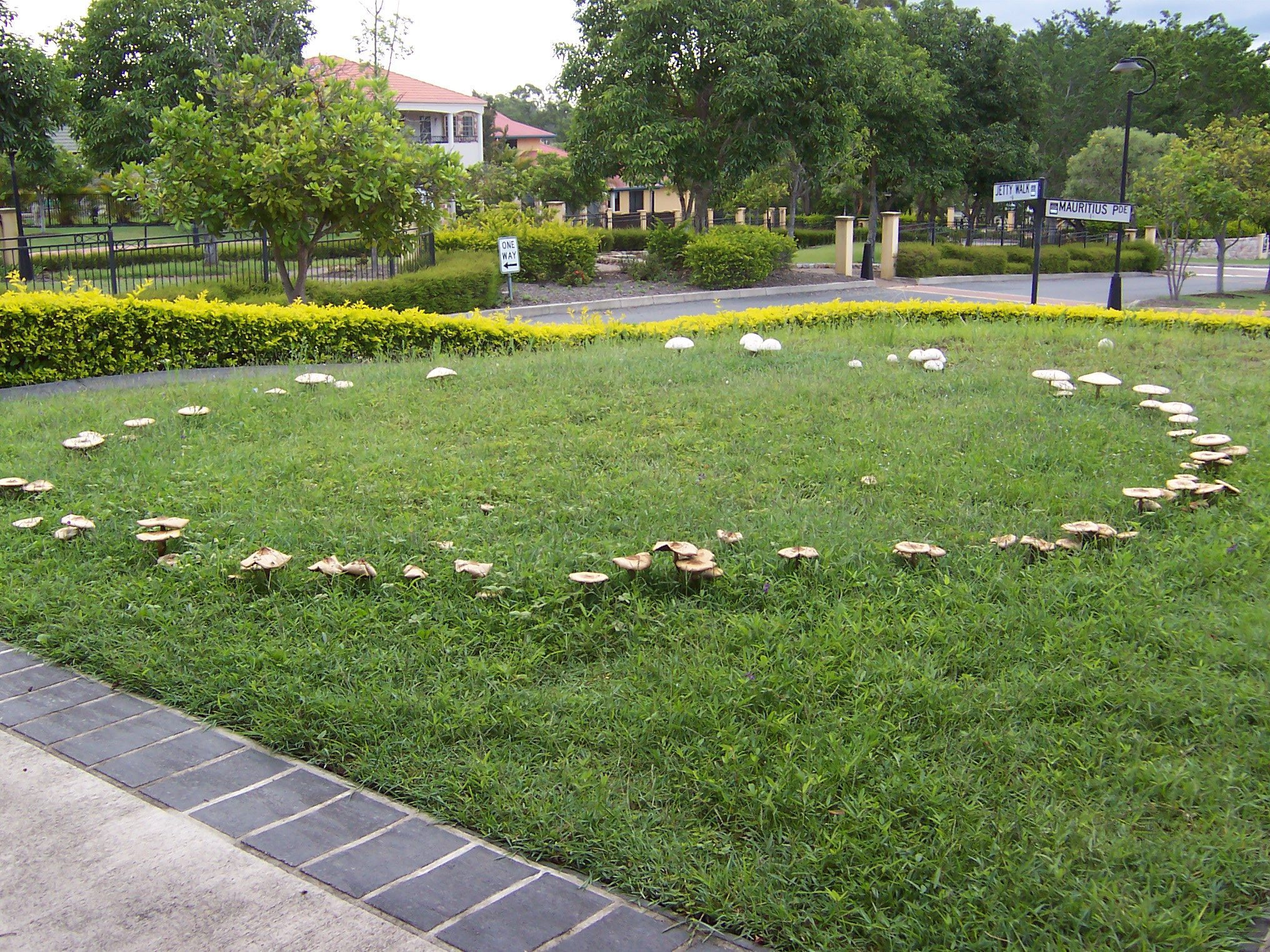
Type III shows up as mushrooms or puffballs arranged in a ring or arc, with no visible effect on the turf color or health. The ring itself may not even be visible without the mushrooms present.
Identify your type before reading any further. The fix depends entirely on which type you have.
Is Fairy Ring in Cool Season Turf Dangerous or Just Ugly?
- Type I: Actively harmful. The hydrophobic soil layer blocks water uptake and the grass dies from drought stress. This one requires action.
- Type II: Not harmful to turf. It is a purely visual problem. The dark green ring can persist for years but causes no injury.
- Type III: Not harmful. Remove mushrooms before mowing if you have children or pets — some mushroom species are toxic if eaten — but the grass itself is fine.
Honest take: most fairy ring in cool season grass is Type II or III. Type I is less common, but it is the case where doing nothing makes things worse. If you have a dead ring forming and the soil nearby is bone dry, do not wait.
How to Diagnose Fairy Ring in Cool Season Turf vs. Other Lawn Diseases
The most important distinction to make is between fairy ring and necrotic ring spot, which also creates ring patterns in cool season turf — particularly Kentucky bluegrass. If you are working through an unfamiliar symptom pattern and want a broader reference, the Common Cool Season Lawn Diseases by Symptom: A Visual Diagnosis Guide can help you rule out other possibilities alongside the steps below.
Fairy ring in cool season grass is always circular or arc-shaped. Dollar spot creates small, irregular patches. Brown patch creates rough circles with a smoky gray border at the edge.
Step 2: Look for mushrooms or puffballs
No other common cool season lawn disease produces mushrooms. If you see them in a ring or arc, fairy ring is confirmed.
Step 3: Probe the soil inside the brown zone
Push a screwdriver into the soil in the dead or stressed ring area. If it hits resistance or the soil feels bone dry despite recent rain, that is the hydrophobic layer characteristic of Type I fairy ring. Soil that looks dead but accepts water easily points elsewhere.
Step 4: Look at the green band
Fairy ring — especially Type II — produces a clear, darker green band from nitrogen release. Necrotic ring spot does not. Instead, necrotic ring spot produces a tan or straw-colored center with a frog-eye appearance: dead center patch, sometimes green in the middle, with a ring of dead tissue around it.
Step 5: Check the timing
Fairy ring in cool season grass is most active in spring and early fall, which aligns directly with cool season grass growth windows. Brown patch peaks during hot, humid summer nights — outside the typical stress window for northern cool season lawns. If brown irregular patches are appearing during summer heat, check out Cool Season Lawn Looks Dead or Brown in Late Summer — Is It Dormant or Dying? for additional context on distinguishing stress patterns.
If you are still unsure after these five steps, a university extension office can confirm from a soil sample or photos. They can identify fairy ring fungi from mycelium samples and rule out necrotic ring spot.
How to Treat Fairy Ring in Your Cool Season Lawn
Type I Treatment: Break Up the Hydrophobic Layer
The goal here is not to kill the fungus. The goal is to get water back into the soil.
- Core aerate the affected area thoroughly. This is the most effective mechanical step. Pull plugs directly through the dead ring zone and the surrounding area. Aeration punches through the hydrophobic mycelium layer and creates pathways for water to penetrate.
- Water deeply immediately after aeration. The plugs left behind open channels — take advantage of them right away. Saturate the ring zone.
- Apply a soil surfactant (wetting agent) to the ring zone. This is the product category that actually moves the needle on Type I fairy ring in cool season grass. Look for liquid wetting agent formulations sold for lawn use. Apply with a refillable hose sprayer and water in deeply after application. The surfactant reduces the water-repelling property of the mycelium-coated soil particles and helps moisture penetrate to the root zone.
- Overseed dead zones once soil is rehydrated. If turf has died in the ring, overseed with the appropriate species — tall fescue or Kentucky bluegrass depending on your existing lawn. Recovery is possible but expect it to take most of a full growing season.
What does not work for Type I: Granular or spray fungicide. The problem is physical — hydrophobic soil — not an active infection attacking the grass blade. Fungicide does not dissolve a hydrophobic layer. It is not cost-effective and will not fix the dead ring.
Type II Treatment: Reduce Visual Contrast
No treatment is needed for turf health. If the dark green ring bothers you aesthetically, the fix is simple.
Fertilize the entire lawn uniformly with a slow-release fertilizer. When the surrounding turf receives consistent nitrogen feeding, the color difference between the ring and the rest of the lawn narrows noticeably. You are not eliminating the ring — you are raising the baseline color of the whole lawn to match it.
The ring will persist as long as the underground organic matter continues feeding the fungi. When that food source is exhausted, the ring stops expanding and eventually fades. There is no way to speed that up from the surface.
Type III Treatment: Remove the Mushrooms
Knock down mushrooms manually or mow over them before they spread spores further. That is all.
No fungicide needed. No aeration needed. The underground mycelium is active but causing no harm to the grass. Removing the visible mushrooms solves the aesthetic problem and the safety concern if you have pets or young children around.
What Not to Do About Lawn Fungus Rings — and Why Common Fixes Fail
Do not apply systemic fungicide expecting to eliminate fairy ring. Fungicide does not penetrate to the depth where fairy ring mycelium lives and feeds. It may suppress some surface activity temporarily, but it will not resolve a Type I hydrophobic layer and provides no benefit for Type II or III. This is the mistake most people make — they buy a granular fungicide, apply it to the ring, and wonder why nothing changes six weeks later.
Do not attempt partial excavation. If you decide to dig out a fairy ring, you need to remove all affected soil to a minimum of 12 inches deep and at least 24 inches beyond the visible ring perimeter. Anything less and the mycelium regrows from what was left behind. Partial digging almost always leads to regrowth and a lot of wasted effort.
Do not ignore Type I. The hydrophobic layer worsens as more mycelium accumulates. What starts as a narrow stressed ring can expand and leave a larger dead zone season after season without intervention. Type II and III you can safely leave alone. Type I you cannot.
Prevention: How to Reduce the Chances of Fairy Ring Returning in Cool Season Turf
Fairy ring needs an underground food source to survive. Remove the food source and you remove the problem.
- Before establishing or renovating a lawn: Remove all buried wood debris, old stumps, and large organic material from the soil. This is the single most effective prevention step. Fairy ring in cool season grass that recurs in the same spot year after year means the food source is still there.
- Control thatch depth: Deep thatch — anything over half an inch — provides ongoing organic material for soil fungi to colonize. Annual fall aeration keeps thatch from accumulating and reduces the fuel fairy ring fungi need. It also keeps your soil structure healthier overall.
- Mow at the correct height: Scalping cool season grass promotes thatch buildup and weakens turf, making it more susceptible to stress from Type I hydrophobic soil conditions.
If fairy ring keeps returning in the same location despite all of this, the buried organic matter is still present. Excavation and soil replacement is the only permanent solution — but that is a significant job and only worth considering if the ring is large and in a highly visible area.
When to Call It a Win and Stop Treating
- Type I: Success is a ring zone that accepts water normally and re-greens with overseeding. Give it a full growing season after aeration and wetting agent treatment before evaluating.
- Type II: If the dark green ring no longer stands out after consistent fertilization, you are done. Expect it to return the following season if the underground organic matter is still present.
- Type III: Mushrooms removed, turf unaffected. Done.
Fairy ring in cool season grass sounds alarming when you first see it. But once you know the type you are dealing with, the path forward is straightforward. Most homeowners have Type II or III and need to do nothing beyond managing how it looks. If you have Type I and a dead ring is forming, get a core aerator on it and apply a wetting agent — that combination gives you the best chance of recovering the turf without wasting money on products that do not address the real problem.
Frequently Asked Questions About Fairy Ring in Cool Season Grass
Why does fairy ring keep coming back in the same spot?
Because the underground food source — buried wood, an old stump, decomposing organic matter — is still there. Fairy ring in cool season grass persists as long as that material gives the fungi something to break down. If the ring recurs in exactly the same location every season, the only permanent fix is excavating the organic matter and replacing the soil.
Will fairy ring spread to my neighbor’s lawn?
No. Fairy ring is not a contagious disease. It does not travel through air or water the way foliar pathogens do. The mycelium expands outward underground from a fixed central point and stops when the organic matter runs out. It cannot jump to an adjacent lawn.
Does overseeding work where fairy ring killed the grass?
Yes, but only after you address the hydrophobic soil layer first. If you overseed a Type I dead zone without aerating and applying a wetting agent, the new seed will struggle to establish in soil that repels water. Once the soil is properly rehydrated and accepting moisture normally, overseeding with certified tall fescue seed or Kentucky bluegrass or perennial ryegrass — depending on your existing lawn — gives you a good chance of recovering the zone over one growing season.
What is the difference between fairy ring and necrotic ring spot?
Both create ring patterns in cool season turf, and both are most common in Kentucky bluegrass. The key differences: fairy ring in cool season grass — especially Type II — produces a dark green band from nitrogen release, while necrotic ring spot creates a straw-colored or tan ring with a frog-eye appearance and no corresponding green band. Mushrooms confirm fairy ring immediately; necrotic ring spot never produces mushrooms. Probing the soil also helps — a bone-dry, water-repelling soil zone points to Type I fairy ring, not necrotic ring spot.
How long does fairy ring last if I do not treat it?
It depends on the type and the size of the underground food source. Type II and III rings can persist for years and slowly expand season by season, then stop and fade when the organic matter is depleted. Some rings last a decade or more. Type I rings can cause ongoing and worsening damage if left untreated, because the hydrophobic layer deepens over time. If you have Type I fairy ring in cool season grass, do not wait it out.

Subscribe to our Newsletter for Weekly updates!