Something goes wrong with a cool-season lawn fast. A patch appears overnight. A ring spreads across the turf by morning. The grass takes on a color you’ve never seen before. Cool season lawn disease identification is the step most homeowners skip — they grab a product and spray before they know what they’re treating. That’s an expensive mistake, and it often doesn’t work.
This guide to cool season lawn disease identification teaches you to read your lawn’s symptoms first. Most cool-season diseases respond better to fixing the conditions that caused them than to chemistry. But knowing which correction to make — or whether fungicide is even necessary — depends entirely on getting the ID right.
Disclosure: This article contains affiliate links. If you purchase through these links, I may earn a small commission at no extra cost to you. As an Amazon Associate, I earn from qualifying purchases.
Why Cool Season Grasses Are Disease-Prone
Cool-season grasses grow in spring and fall. Those same seasons favor fungal pathogens. Cool temperatures, humidity, and moisture on leaf blades overnight create near-perfect conditions for disease. This overlap isn’t coincidence. It’s biology working against you.
Several factors you directly control raise disease risk:
- Evening or overnight watering keeps blades wet for hours, giving fungi time to infect tissue
- Excess nitrogen in summer produces soft growth that’s highly vulnerable to pathogens
- Thatch above ½ inch traps moisture, harbors fungal inoculum, and restricts airflow
- Compacted or poorly draining soil keeps roots waterlogged and stressed
- Mowing too short stresses the plant and removes its disease buffer
The morning-watering rule directly reduces fungal disease risk. Best Time of Day to Water Cool Season Grass (And Why It Actually Matters) covers the reasoning in full.
Brown Patches and Rings: Dollar Spot, Brown Patch, and Necrotic Ring Spot
These three diseases all produce brown or dead-looking areas. The shape, size, and detail patterns are distinct enough to separate them with a close look.
Dollar Spot
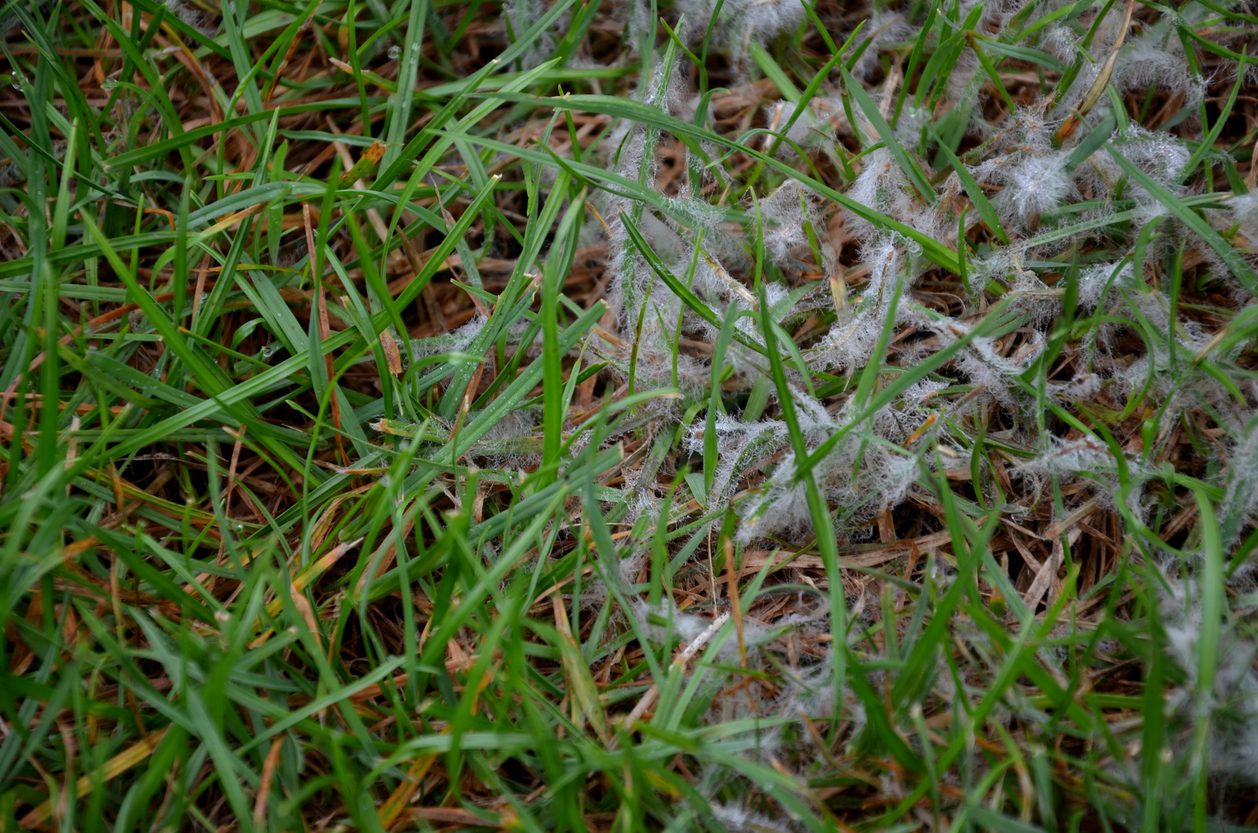
Dollar spot produces small, circular dead spots roughly 2–6 inches across. Individual blades show tan lesions with a reddish-brown border crossing the blade. The most reliable identifier: look for cobweb-like white mycelium on the grass in early morning when dew is present. It disappears as the day warms. Dollar spot is common in Kentucky bluegrass and fine fescue. Multiple spots can merge into larger patches if left uncorrected.
Brown Patch (Rhizoctonia)
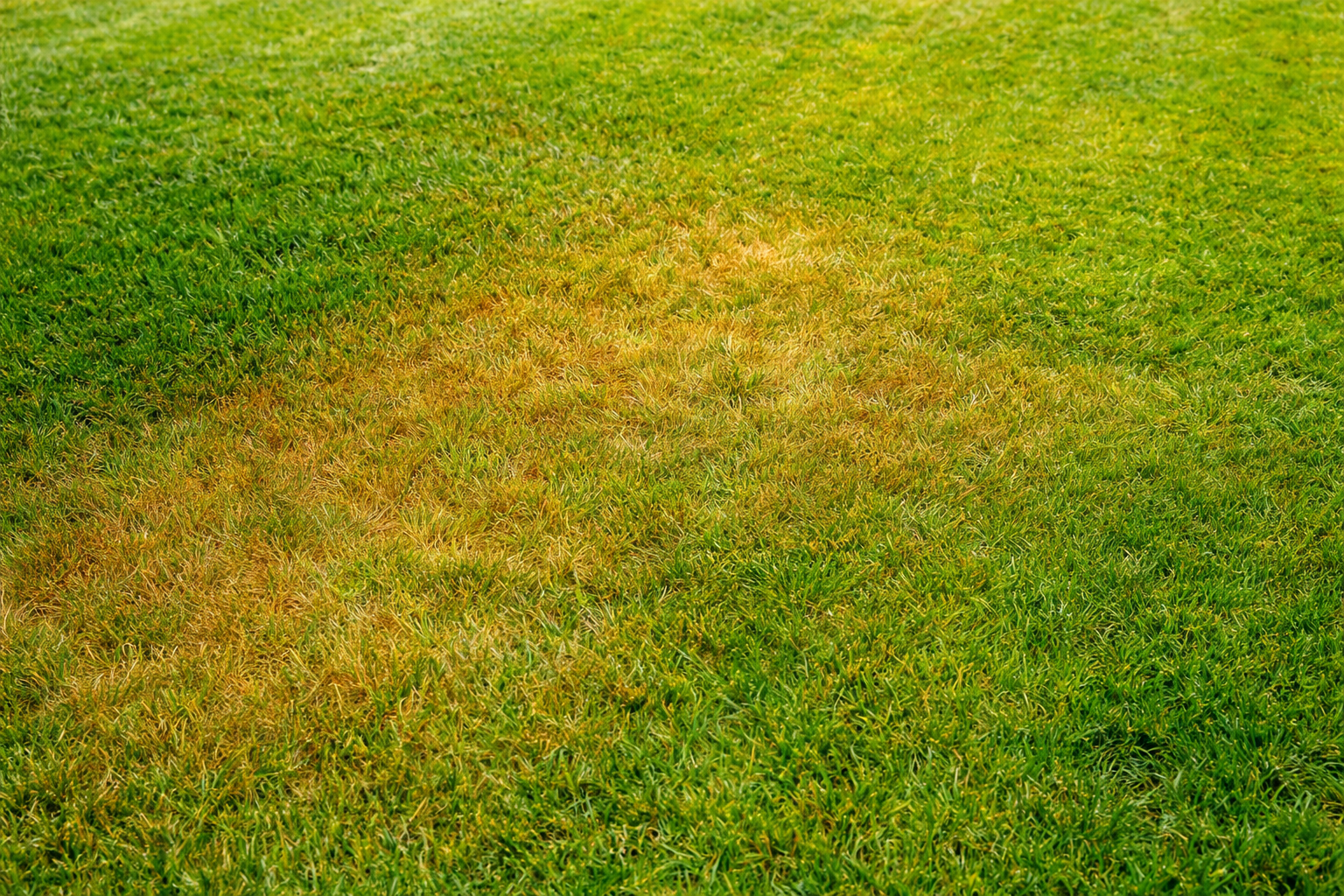
Brown patch (Rhizoctonia solani) creates large circular or irregular tan-brown areas — often 1–3 feet across, sometimes spreading much farther. The key identifier is the “smoke ring”: a dark, water-soaked border at the patch edge visible in early morning. It fades as temperatures rise. Brown patch attacks leaf blades and sheaths, but crowns and roots usually survive, so recovery is possible. It’s most common in tall fescue during hot, humid nights when temperatures stay above 70°F. Brown patch looks different in cool-season turf than it does on warm-season grasses — same pathogen, different expression.
Necrotic Ring Spot
Necrotic ring spot attacks roots and crowns, not just surface tissue. It appears as circular dead rings from 6 inches to several feet across. Healthy grass sometimes survives in the center, creating a “frog-eye” pattern. Pull grass from the ring margin and check the roots — dark brown or black roots confirm the diagnosis. It’s especially damaging to Kentucky bluegrass and often requires reseeding to fully recover.
White, Gray, or Powdery Coatings: Powdery Mildew and Gray Leaf Spot
Powdery Mildew
Powdery mildew produces a white or grayish powdery coating on the upper surface of grass blades. It looks like the lawn was dusted with flour. There are no wet lesions. The coating is dry and attached — unlike fertilizer residue, it won’t blow off.
It’s most common on Kentucky bluegrass in shaded areas with poor airflow. Temperatures between 60–72°F favor it. The primary fix is cultural: improve light, increase airflow, and avoid excess nitrogen in shaded areas. If powdery mildew keeps coming back, you may have a grass selection issue. Best Cool Season Grass for Shade: What Actually Grows Under Trees covers which species tolerate low-light conditions better.
Gray Leaf Spot
Gray leaf spot produces small gray or tan lesions with a darker border. Early-stage lesions look water-soaked. Affected blades twist or wither, and a gray fuzzy coating appears in high humidity. It favors warm, humid conditions above 80°F with high nitrogen and wet foliage. It primarily damages perennial ryegrass during summer heat spikes. Severe outbreaks typically require fungicide.
Thin, Faded, or Melting-Out Areas: Red Thread, Leaf Spot, and Pythium Blight
These diseases cause different forms of turf thinning — from slow fading to rapid collapse.
Red Thread
Red thread is easy to identify up close. Look for pink or red thread-like strands at the tips of grass blades. These are fungal structures called sclerotia. From a distance, affected areas look tan or bleached. Crouch down for the visual confirmation.
Red thread thrives in cool, wet weather (40–70°F) with low nitrogen. It’s common in fine fescue and perennial ryegrass in spring and fall. Correcting nitrogen deficiency often reduces outbreak severity. A cool season fertilizer — such as a granular product with controlled-release nitrogen — addresses the nitrogen deficit without pushing lush growth that invites other diseases.
Leaf Spot and Melting Out
This is a two-stage disease. In the leaf spot phase, small oval lesions appear on blades — dark purple-brown border, tan center. The melting out phase follows when infection reaches crowns and roots. Large irregular areas of grass thin out and appear to dissolve into pale, sparse patches. Kentucky bluegrass is more susceptible than tall fescue. By the time melting out appears, damage is significant and harder to correct without overseeding.
Pythium Blight
Pythium blight is the most urgent disease on this list. It can spread across a lawn in 24–48 hours. Affected areas look water-soaked and greasy before collapsing quickly. White cottony mycelium appears in early morning. A faint rotting smell is a useful field identifier. It develops when nighttime temps exceed 65°F, daytime temps exceed 85°F, and drainage is poor.
This is one case where cultural correction alone is not enough once the disease is active. A systemic fungicide labeled for Pythium — mefenoxam or phosphonate-based — should be applied immediately. Delay increases loss.
How to Tell Lawn Disease Apart from Drought, Shade, and Fertilizer Problems
This is a critical part of cool season lawn disease identification. Many disease diagnoses are false positives. Rule out non-disease causes first.
Drought Stress vs. Disease
Drought stress causes uniform thinning across exposed areas — slopes, edges near pavement, south-facing sections. Grass blades fold lengthwise along the midrib, and footprints remain visible long after you walk through. Disease produces irregular or circular patterns with lesions on individual blades.
Test: water a drought-suspect area deeply for 3–4 days. If it greens up, it was drought. Disease damage doesn’t recover with water alone.
Shade Damage vs. Disease
Shade damage causes gradual thinning under tree canopy that worsens over years. No lesions appear on blades, and the pattern doesn’t change after rain events. Disease in shaded areas produces coatings or spots even in low-light conditions. Both can coexist — a shaded, stressed lawn is more vulnerable to powdery mildew and red thread.
Fertilizer Burn vs. Disease
Fertilizer burn follows a clear pattern: parallel stripes where the spreader traveled, or pooled spots where product sat. No lesions appear, and symptoms appear 2–5 days after application. Disease patterns are irregular or circular and produce visible lesions regardless of fertilization timing.
Other Look-Alikes
- Dog urine spots: circular patch with a green outer ring and dead center; no lesions
- Grub damage: turf lifts up like a loose mat; roots are severed below the surface
- Thatch smothering: uniform thinning, spongy feel underfoot, no lesions
What to Do After You Identify the Disease
Most cool-season lawn diseases are fueled by conditions you control. Fixing those conditions often stops the disease without fungicide.
Cultural Corrections First
- Watering: Switch to early morning and reduce frequency while increasing depth. Best Time of Day to Water Cool Season Grass (And Why It Actually Matters) explains why this matters for disease prevention.
- Nitrogen: Correct deficiency for red thread with a light feeding. Withhold excess nitrogen in summer to reduce brown patch and gray leaf spot risk.
- Mowing: Raise mowing height to reduce stress. Keep blades sharp. Never remove more than one-third of the blade in a single cut. Clean your mower deck between sessions during active disease — blades spread fungal spores.
- Thatch: Core aerate if thatch exceeds ½ inch. This directly improves conditions for necrotic ring spot and leaf spot recovery.
- Drainage: Persistent poor drainage is a Pythium precondition. Topdressing and core aeration help over time.
When Fungicide Is the Right Call
- An active, fast-spreading outbreak (Pythium, severe brown patch)
- Cultural corrections are in place and disease keeps spreading
- High-value areas where turf loss is not acceptable
Choose fungicide by disease. Contact fungicides — chlorothalonil-based products available at most hardware stores — are appropriate for surface diseases like dollar spot, brown patch, and red thread. They require repeat applications. Systemic fungicides (propiconazole or myclobutanil) penetrate tissue and are the right tool for necrotic ring spot. For Pythium, use a mefenoxam or phosphonate-based systemic product.
When to Reseed
Necrotic ring spot and severe melting out damage the root system enough that reseeding is often the only path to full recovery. Time your recovery fertilization alongside reseeding — When to Fertilize Your Lawn: A Season-by-Season Timing Guide That Actually Works covers seasonal timing in detail.
Frequently Asked Questions About Cool Season Lawn Disease Identification
What does lawn disease look like vs. drought damage?
Lawn disease usually shows circular or irregular patterns with visible lesions on individual blades. Drought damage causes uniform thinning in exposed areas, and grass blades fold lengthwise. The clearest test: water deeply for 3–4 days. Drought recovers; disease doesn’t.
Can I treat cool season lawn disease without fungicide?
In most cases, yes. Dollar spot, red thread, powdery mildew, and early-stage leaf spot all respond well to cultural corrections — adjusting watering, mowing height, nitrogen levels, and thatch. Fungicide is best reserved for fast-spreading outbreaks like Pythium or when cultural fixes are already in place and disease continues to spread.
What causes brown circles in my lawn?
Brown circles are one of the most common symptoms in cool season lawn disease identification. Dollar spot makes small silver-dollar-sized circles. Necrotic ring spot creates larger rings with living grass in the center. Brown patch forms large irregular circles with a dark outer border in the morning. Dog urine and grub damage can also produce circular patterns — check for lesions on blades to distinguish disease from non-disease causes.
Why does my grass have red threads on it?
Those are fungal structures called sclerotia — a sure sign of red thread disease. It’s common in fine fescue and perennial ryegrass during cool, wet weather with low nitrogen. The threads extend from blade tips and are pink to red in color. A light application of balanced slow-release fertilizer often reduces the outbreak.
Is brown patch the same in cool season grass as in St. Augustine?
It’s caused by the same pathogen (Rhizoctonia solani), but the expression and timing differ. In cool-season turf, brown patch peaks during hot, humid summer nights when temperatures stay above 70°F. In St. Augustine and zoysia, it behaves differently and follows a different seasonal pattern. Cool season brown patch typically spares the crowns and roots, so recovery is more likely without reseeding.
What’s the white powder on my Kentucky bluegrass?
That’s powdery mildew. It appears as a dry, white-to-gray coating on the upper surface of grass blades. It’s most common in shaded areas with poor airflow. It won’t blow off the blade the way fertilizer residue does. The fix is cultural: improve light, increase airflow, and reduce nitrogen in affected areas.
How fast does Pythium blight spread?
Very fast. Pythium blight can move across a lawn in 24–48 hours under the right conditions — high humidity, nighttime temps above 65°F, daytime temps above 85°F, and poor drainage. It’s one of the few cool season lawn diseases where immediate fungicide application is necessary. Do not wait to see if cultural corrections slow it down.
Does aerating help with lawn disease?
Yes. Core aeration reduces thatch, improves drainage, and increases airflow at the soil surface — all of which reduce disease pressure. It’s especially helpful for necrotic ring spot and leaf spot, which thrive in thatch-heavy, poorly draining conditions. Aeration won’t cure an active outbreak but addresses the underlying conditions that caused it.
Should I overseed after necrotic ring spot?
Often, yes. Necrotic ring spot infects and kills roots and crowns. The grass doesn’t recover from within the ring the way it might with surface-only diseases. After correcting the cultural conditions — thatch, drainage, watering timing — overseeding is usually the most reliable way to restore the damaged areas.
Can I mow a lawn with an active fungal disease?
You can, but take precautions. Keep mowing height high to reduce plant stress. Make sure mower blades are sharp to avoid tearing tissue. Clean your mower deck between uses — fungal spores travel on equipment and can spread disease to healthy areas of the lawn.
Conclusion
Cool season lawn disease identification comes down to three steps: read the symptom pattern first (shape, size, color, texture), match it to the conditions present (temperature, moisture, timing), then rule out non-disease causes before you reach for anything.
The framework here — brown patches and rings, powdery coatings, thinning and melting areas, and non-disease look-alikes — gives you enough to make a confident call in most situations. Most diseases are telling you something about how the lawn is being managed. Correct the conditions, and the disease often corrects itself.
When fungicide is necessary, choosing the right one matters more than acting fast. A contact fungicide handles surface diseases. A systemic is required when roots are involved.
For related reading: review the watering timing guide to reduce overnight leaf wetness, check the winterizer timing guide to keep your fall fertilization on track, explore shade-tolerant grass options if powdery mildew keeps returning in low-light areas, and use the seasonal fertilization guide to time your recovery feeding after disease damage.
Knowing what you’re dealing with is worth more than any product. Start with the symptom.
Subscribe to our Newsletter for Weekly updates!