Choosing between slow release vs fast release fertilizer is one of the most consequential decisions you’ll make for your lawn. Pick the wrong type at the wrong time and you’ll either burn your grass, waste money, or miss the window when your lawn needed feeding most. This guide explains how each type works, which situations call for each, and how to read a bag label to confirm what you’re actually buying before you apply anything.
Disclosure: This article contains affiliate links. If you purchase through these links, I may earn a small commission at no extra cost to you. As an Amazon Associate, I earn from qualifying purchases.
How Slow Release vs Fast Release Fertilizer Actually Works
The difference between these two fertilizer types comes down to one thing: how quickly nitrogen becomes available to your grass after application.
Fast-Release (Quick-Release) Nitrogen
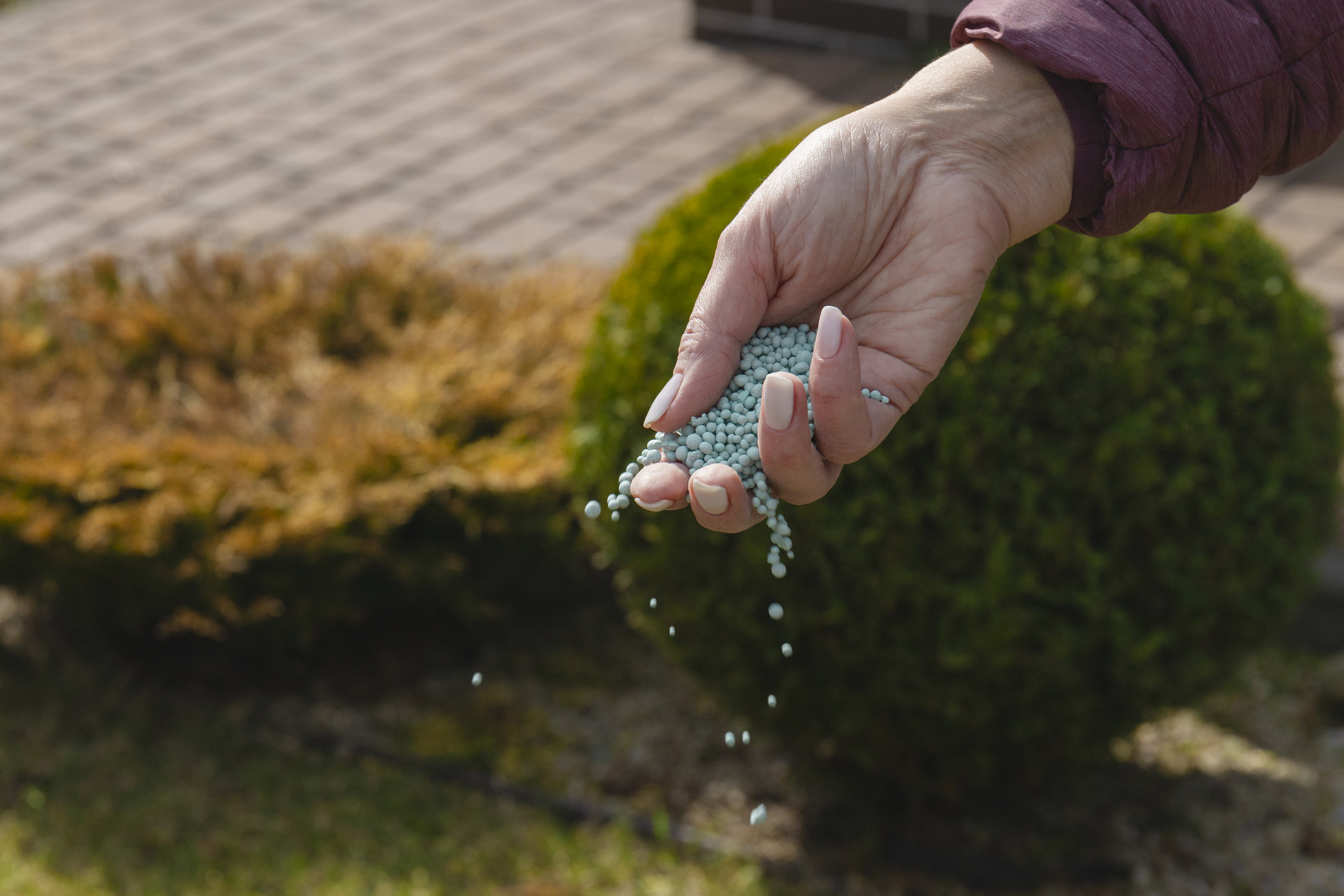
Fast-release fertilizers contain water-soluble nitrogen. It dissolves the moment it gets wet and moves into the soil immediately. Common forms include urea, ammonium sulfate, and ammonium nitrate — all inexpensive and widely available.
Results are visible fast. Most lawns show a color change and growth surge within 3–7 days. That speed comes with trade-offs:
- Short window of effectiveness: Fast-release nitrogen stays active for 2–4 weeks before it leaches through the soil or volatilizes into the air
- Higher burn risk: Too much, or application during heat stress, can damage or kill grass
- Weather-dependent: Rain or irrigation right after application helps. Heat and drought amplify burn risk.
Slow-release fertilizers deliver nitrogen gradually over weeks or months. The nitrogen is coated or chemically bound. It releases through microbial activity, soil moisture, or temperature changes.
The most common form homeowners encounter is polymer-coated urea (PCU). These are urea granules wrapped in a thin plastic shell. Nitrogen slowly diffuses out as temperature and moisture trigger it. Other forms include sulfur-coated urea (SCU), IBDU, and natural organics like feather meal or blood meal.
Key characteristics:
- Grass responds more slowly — greening typically takes 1–2 weeks — but the effect lasts 6–12+ weeks depending on the product
- Lower burn risk because nitrogen concentration in the soil stays low at any given moment
- Costs more per bag but requires fewer applications across a season
The slower response isn’t a weakness. It’s a feature when you need steady feeding rather than a short burst.
When to Use Fast-Release Fertilizer for Your Lawn
Fast-release fertilizer earns its place in specific situations where speed genuinely matters.
Spring green-up on warm-season grasses. When soil temperatures push past 65°F and bermuda, zoysia, or St. Augustine comes out of dormancy, a fast-release application gives an immediate nitrogen hit. The grass is actively growing and can take up the nitrogen before it leaches.
Correcting a visible deficiency mid-season. If you notice yellowing or stunted growth and need the lawn to respond within the week, fast-release nitrogen is the right tool.
Short growing windows. Late in the warm season, before warm-season grass goes dormant, there may not be enough time for slow-release nitrogen to fully deliver. Fast-release gets nutrients in while the grass can still use them.
Large-area coverage where cost matters. Fast-release products are less expensive. If you’re covering a large yard and can manage application rates carefully, they’re a cost-effective choice.
Application cautions:
- Never apply fast-release fertilizer when grass is heat-stressed or drought-stressed — burn risk is serious
- The maximum rate on the label is a ceiling, not a target — erring lower is safer
One important point on application technique: fast-release granular fertilizer applied unevenly causes streaking and hot spots. You’ll see green stripes where coverage was heavy and burned patches where granules piled up. A quality broadcast spreader helps you maintain a consistent spread pattern. That’s the single best mechanical way to prevent uneven burn. For a full walkthrough of technique and rate management, see How to Apply Granular Fertilizer Without Burning Your Grass.
When Slow-Release Fertilizer Is the Better Option
Slow-release fertilizer for lawns isn’t just a premium option. It’s genuinely the right tool in several common situations.
Summer feeding for cool-season grasses. Kentucky bluegrass, tall fescue, and ryegrass are under stress in summer heat. A slow-release product keeps nitrogen delivery low and steady. It avoids a growth surge that would put additional stress on already-struggling grass.
Fall feeding for cool-season grasses. A mid-fall application supports root development and carbohydrate storage heading into winter. It does this without pushing excessive leaf growth that would need mowing and would be vulnerable to early frost. For a detailed look at timing and strategy, see the full guide on fall feeding for cool-season grasses.
Fertilizing around seeding. Nitrogen spikes favor weeds and can overwhelm new seedlings. Slow-release keeps nutrient delivery gradual while seedlings establish.
Infrequent fertilizing schedules. If you fertilize three times a season rather than five or six, one slow-release application can carry the lawn for 8–12 weeks. That’s a practical advantage for busy homeowners.
Sandy or high-drainage soils. Fast-release nitrogen in sandy soil leaches through the root zone before grass roots can absorb it. Slow-release maintains availability long enough to actually be used.
When shopping for a slow-release granular fertilizer, look for products with a high WIN percentage (more on that below) or ones that list polymer-coated urea in their ingredients. These are the controlled-release forms that deliver the extended feeding window you’re paying for. To see how these fertilizer choices fit into a broader seasonal plan, the Cool Season Lawn Care Schedule Month by Month Guide walks through exactly when and how to apply each type across the year.
How to Identify Slow Release vs Fast Release Fertilizer on the Label
If you’re not yet familiar with what the three numbers on a fertilizer bag actually mean, start there — understanding the NPK ratio is the foundation for everything that follows.
Here’s what to look for:
Water Insoluble Nitrogen (WIN) or Slowly Available Nitrogen — these lines indicate slow-release content. If they appear, the product contains at least some slow-release nitrogen.
To calculate how much of the fertilizer is slow-release, divide WIN by total nitrogen:
Example: A bag shows 30% total nitrogen and 15% water insoluble nitrogen. That’s 50% slow-release content — half of the nitrogen is controlled-release, half is fast.
This matters because many products are blended. They contain both fast and slow nitrogen. A blended product isn’t bad, but it behaves differently than a pure slow-release product. You’ll get an initial fast response plus extended feeding — but you’re also accepting some burn risk from the quick-release fraction.
If no WIN line appears in the guaranteed analysis, the product is entirely fast-release. This is true regardless of what the front of the bag says.
Hypothetical label example:
Guaranteed Analysis
Total Nitrogen (N) ………… 28%
— 3.5% Ammoniacal Nitrogen
— 10.5% Urea Nitrogen
— 14% Water Insoluble Nitrogen
In this case, 14 out of 28% is slow-release — exactly 50% controlled-release content. The other 50% will behave like fast-release nitrogen.
For the full breakdown of fertilizer label math, NPK ratios, and how to calculate actual nitrogen per application, see the companion guide on reading the guaranteed analysis on every bag you buy.
Combining Both Types: How to Balance Speed and Longevity
The most effective lawn programs don’t treat slow release vs fast release fertilizer as an either/or decision. They use both types strategically across the season.
Many quality mid-grade granular fertilizers are already blended. You’re getting some fast response plus extended feeding in a single bag. That’s not a compromise — it’s often the right tool for transitional periods like early spring or early fall when you want quick green-up plus continued feeding.
For cool-season grass fall schedules:
- Early fall: fast-release or blended for a quick push into recovery
- Mid-fall: shift to slow-release for sustained root feeding before cold sets in
- Late fall: minimal nitrogen, prioritize potassium for winter hardiness
For warm-season lawns:
- Spring green-up: fast-release to jumpstart growth after dormancy
- Through summer: slow-release through summer to avoid heat stress while maintaining steady feeding
When buying a blended product, use the WIN calculation from the label section to understand your actual fast/slow ratio. A bag labeled “extended feeding” with only 20% WIN out of 40% total nitrogen is still delivering half its nitrogen as a fast hit. That changes how you should approach timing and rate. Knowing the split helps you decide whether you need a purer slow-release product or whether the blend matches what your lawn needs right now.
The underlying principle: match release speed to the grass’s ability to use nitrogen. Fast-release works when grass is actively growing. It also works when temperatures are moderate. In those conditions, roots can absorb nitrogen before it leaches or burns. Slow-release makes sense when growth is steady but not aggressive, stress is present, or you need feeding to extend well beyond a few weeks.
Common Mistakes Homeowners Make With Slow Release vs Fast Release Fertilizer
- Applying fast-release in summer heat or drought. Stressed grass can’t uptake nitrogen fast enough. Surface concentration builds and burns turf. Wait for cooler temps or switch to slow-release.
- Assuming slow-release always means slow results. In warm, moist soil, polymer-coated urea can begin releasing nitrogen within 1–2 weeks. Slow-release is about sustained delivery — not necessarily a long delay before anything happens.
- Treating a blended product as if it’s all slow-release. If 30% of the nitrogen is WIN, 70% is still fast. You’re getting a meaningful fast nitrogen hit with every application. Plan accordingly.
- Applying slow-release too late in the season. Most slow-release forms depend on soil microbial activity or temperature to work. Below 50°F, delivery slows dramatically. A late-season application on cold soil may not release until the following spring.
- Ignoring soil drainage when choosing type. Fast-release nitrogen in sandy, high-drainage soil is largely wasted. It leaches through before roots absorb it. Slow-release is the better investment in these situations.
- Relying on front-of-bag marketing. Check the guaranteed analysis every time. “Extended feeding” claims without WIN data are not verifiable.
- Fertilizing without knowing your baseline. If your soil already has adequate nitrogen, applying fast-release nitrogen compounds your burn risk and wastes money. A soil test kit is worth the small cost — it tells you what your soil already has so you can choose both the type and the rate of fertilizer that actually makes sense rather than guessing.
Frequently Asked Questions
What does “water insoluble nitrogen” mean on a fertilizer label? Water insoluble nitrogen (WIN) is the portion of a fertilizer’s total nitrogen that doesn’t dissolve in water right away. Instead, it releases slowly through soil microbial activity, temperature, and moisture. It’s the key indicator of slow-release content in the Guaranteed Analysis section of any fertilizer bag.
Can I use fast-release fertilizer in the summer? Generally, no — at least not for cool-season grasses. In summer heat, grass is already stressed. Fast-release nitrogen can burn turf that can’t uptake nutrients quickly enough. For warm-season grasses that are actively growing in summer, you can use fast-release carefully and at conservative rates, but slow-release is usually the safer choice.
How long does slow-release fertilizer last in the ground? It depends on the product and conditions. Polymer-coated urea typically delivers nitrogen over 6–12 weeks. Natural organics can take longer and are more variable. Warm, moist soil accelerates release. Cold soil (below 50°F) slows it significantly.
Is organic fertilizer the same as slow-release? Mostly, yes — but not always. Most organic fertilizers rely on microbial activity to break down nutrients, which makes them naturally slow-release. However, some organic products contain more immediately available nitrogen than others. Check the WIN line in the Guaranteed Analysis to confirm slow-release content, even on organic products.
What happens if I apply too much fast-release nitrogen? The result is fertilizer burn. You’ll see yellow or brown streaks and patches, often within a few days. In severe cases, grass roots are damaged and recovery takes weeks. The risk is highest in heat, drought, or when granules are applied unevenly. If you’ve already applied and notice discoloration starting, see My Lawn Is Yellow After Fertilizing: What Went Wrong for steps to diagnose and address the damage.
Do I need to water in slow-release fertilizer? Yes, but the urgency is lower than with fast-release. Watering activates the product and helps granules make contact with the soil. With polymer-coated urea specifically, moisture triggers the release process. Without irrigation or rainfall, granules can sit on the surface without doing much.
Can I mix slow-release and fast-release fertilizers together? You can, and many commercial fertilizer blends already do this. The practical result is a quick initial green-up from the fast-release fraction plus extended feeding from the slow-release portion. Just be aware that mixing increases the fast-release nitrogen load, which raises burn risk if you’re not careful about total application rate.
How do I know if my fertilizer is mostly fast or mostly slow release? Check the Guaranteed Analysis for the Water Insoluble Nitrogen (WIN) line. Divide WIN by total nitrogen to get the slow-release percentage. If no WIN line appears, the product is entirely fast-release. A product with WIN equal to 50% or more of total nitrogen behaves predominantly as slow-release.
Conclusion
The core distinction is simple. Fast-release fertilizer delivers nitrogen immediately with a short active window and higher burn risk. Slow-release delivers steadily with lower burn risk and longer coverage. Neither type is universally better.
The right choice depends on your timing, grass type, soil conditions, and what the lawn needs right now. In spring, fast-release often makes sense to push green-up. In summer, slow-release keeps stress low. In fall, both types have a role depending on which part of the season you’re in.
Most homeowners get the best results by using both types strategically across the season. Start by reading the guaranteed analysis on every bag you buy — specifically the WIN line — and that single habit will immediately improve every fertilizer decision you make.
From here, the logical next step is putting this knowledge into a broader seasonal schedule — see When to Fertilize Your Lawn: A Season-by-Season Timing Guide for your specific grass and region, so you know exactly when to apply each type and what to expect at every stage of the growing season.
Subscribe to our Newsletter for Weekly updates!