For cool season grass, fall lawn care is not just important — it’s the highest-leverage period of the entire year. The work you put in between September and November directly shapes how your lawn looks, how thick it grows, and how well it resists weeds and disease the following spring. Skip it or do it out of order, and you’ll spend the entire next season trying to recover ground you could have held.
This guide covers the full fall lawn care September October November arc — what to do, when to do it, and why it matters — for Kentucky bluegrass, tall fescue, fine fescue, perennial ryegrass, and other cool-season turf types common in northern and transitional U.S. climates. For a deeper look at the characteristics of each species, the Complete Guide to Cool Season Grasses (Fescue, Bluegrass, Rye) covers everything you need to know about identifying and selecting the right grass for your lawn.
Disclosure: This article contains affiliate links. If you purchase through these links, I may earn a small commission at no extra cost to you. As an Amazon Associate, I earn from qualifying purchases.
Why Fall Is the Most Important Season for Cool Season Grass
Cool-season grasses have a narrow temperature sweet spot for active growth: roughly 60–75°F. Summer is too hot, and deep winter is too cold. Fall is when the conditions align perfectly, and your lawn responds by pushing root and crown development more aggressively than at any other time of year.
Summer stress takes a real toll. Even a healthy lawn loses density, root mass, and vigor between June and August. Fall is when the grass begins to repair itself. When you apply the right inputs, you accelerate that recovery before dormancy sets in.
If you’re in a transitional zone — a region that can grow both cool and warm-season grasses — it’s worth understanding the contrast. Warm-season grasses like bermuda and zoysia slow down and begin browning in fall. For them, fall is shutdown season. For a full overview of how those grasses behave and what they need, the Complete Guide to Warm Season Grasses is a useful reference. For cool-season lawns, fall is the opposite: it’s the best time to renovate, fertilize, and strengthen.
Think of the three-month arc this way:
- September — active renovation: aeration, overseeding, first fertilizer
- October — nutrition and weed control: winterizer fertilizer, broadleaf herbicide
- November — preparation for shutdown: final mow, leaf cleanup, irrigation winterization
September Fall Lawn Care for Cool Season Grass: Aeration, Overseeding, and First Fertilizer
September is the most action-packed month of the fall lawn care cool season grass calendar. The soil is still warm from summer, air temperatures are falling, and weed competition is at its annual low. This combination makes September the ideal window for renovation work.
Core Aeration
Core aeration — pulling small plugs of soil out of the ground — reduces compaction and opens up the soil so water, oxygen, and nutrients can penetrate more deeply. Compacted soil is one of the most common and underappreciated reasons cool-season lawns thin out over time.
Aerate in early to mid-September while soil temperatures are still warm enough to support rapid grass recovery. A core aerator should pull plugs 2–3 inches deep. For heavily compacted areas, run the machine in two perpendicular passes for better coverage.
Leave the soil plugs on the surface. They look messy for a week or two, but they break down naturally and return organic matter to the lawn. There’s no need to rake them up.
One important note: spike aerators punch holes without removing soil. They are not a substitute for core aeration and can actually increase compaction around the hole edges. Rent or hire a core aerator if you don’t own one.
Overseeding
September is the best overseeding window of the year for cool-season turf. Soil is warm enough for quick germination, air temperatures favor seedling establishment, and you won’t be fighting the pre-emergent applications that conflict with spring seeding.
The sequence matters: aerate first, then seed immediately after. The holes left by aeration create direct seed-to-soil contact, which dramatically improves germination rates compared to seeding on an undisturbed surface.
For a full breakdown of germination timelines by grass species and how fall compares to spring for overseeding, see Best Time to Overseed Cool Season Grass: Fall vs. Spring Compared for timing and species-specific guidance.
When overseeding, apply a starter fertilizer rather than a standard lawn fertilizer. Starter fertilizers are phosphorus-forward — look for an N-P-K ratio like 10-18-10 or similar. The elevated phosphorus supports root development in young seedlings, which is more valuable at this stage than pushing top growth with nitrogen. A product like this starter fertilizer can help you find the right ratio at your local retailer or online.
First Fall Fertilizer
If you’re not overseeding, fall fertilizing for cool season grass in September is still the single most important application of the entire year. The lawn is actively rebuilding root mass and crown tissue, and nitrogen is the fuel that drives that process.
Target 0.9–1.0 lb of actual nitrogen per 1,000 sq ft. To calculate from a bag label: divide 100 by the nitrogen percentage (the first number on the N-P-K label). The result is the number of pounds of fertilizer needed to deliver 1 lb of actual nitrogen per 1,000 sq ft. For example, a 32-0-8 fertilizer requires about 3.1 lbs per 1,000 sq ft — a ratio commonly found on store shelves.
For a full-season view of nitrogen rates and how your fall application relates to spring feeding, see how much nitrogen to apply.
Use a cool season fertilizer here. The lawn needs sustained feeding going into fall, not a fast green flush that fades in two weeks.
This is also a good time to address soil pH correction if you haven’t done so recently. Cool-season grasses prefer a pH of 6.0–7.0. If your soil tests outside that range, fall is the right time to apply lime (to raise pH) or sulfur (to lower it).
October Fall Lawn Care for Cool Season Grass: Winterizer Fertilizer and Weed Control
By October, active renovation is behind you. The focus shifts to fortifying the lawn for winter and targeting weeds while conditions are still right.
Winterizer Fertilizer
Fall fertilizing for cool season grass has two distinct phases, and October’s winterizer application is the second. A winterizer is a fertilizer applied in late fall with moderate-to-high nitrogen and elevated potassium (the third number in N-P-K). Potassium strengthens cell walls, improves cold hardiness, and supports disease resistance — all critical functions heading into winter.
Apply winterizer after visible lawn growth has slowed but before the first hard frost. In most cool-season regions, that’s mid to late October. Look for a granular product with a K content close to or equal to N — ratios like 24-5-11 or 32-0-10 are common examples at hardware stores. A fall fertilizer like Scotts Turf Builder WinterGuard with elevated potassium is easy to find online or at most garden centers.
Apply at 0.5–1.0 lb of actual nitrogen per 1,000 sq ft, depending on how much you applied in September. If September’s application was at the high end of 1.0 lb, stay closer to 0.5 lb in October.
The most common mistake with winterizer is applying it too early — in September rather than October. When applied too early, the potassium benefit is wasted, and the nitrogen can push excessive top growth before frost. That stresses the plant rather than hardening it.
Fall Weed Control
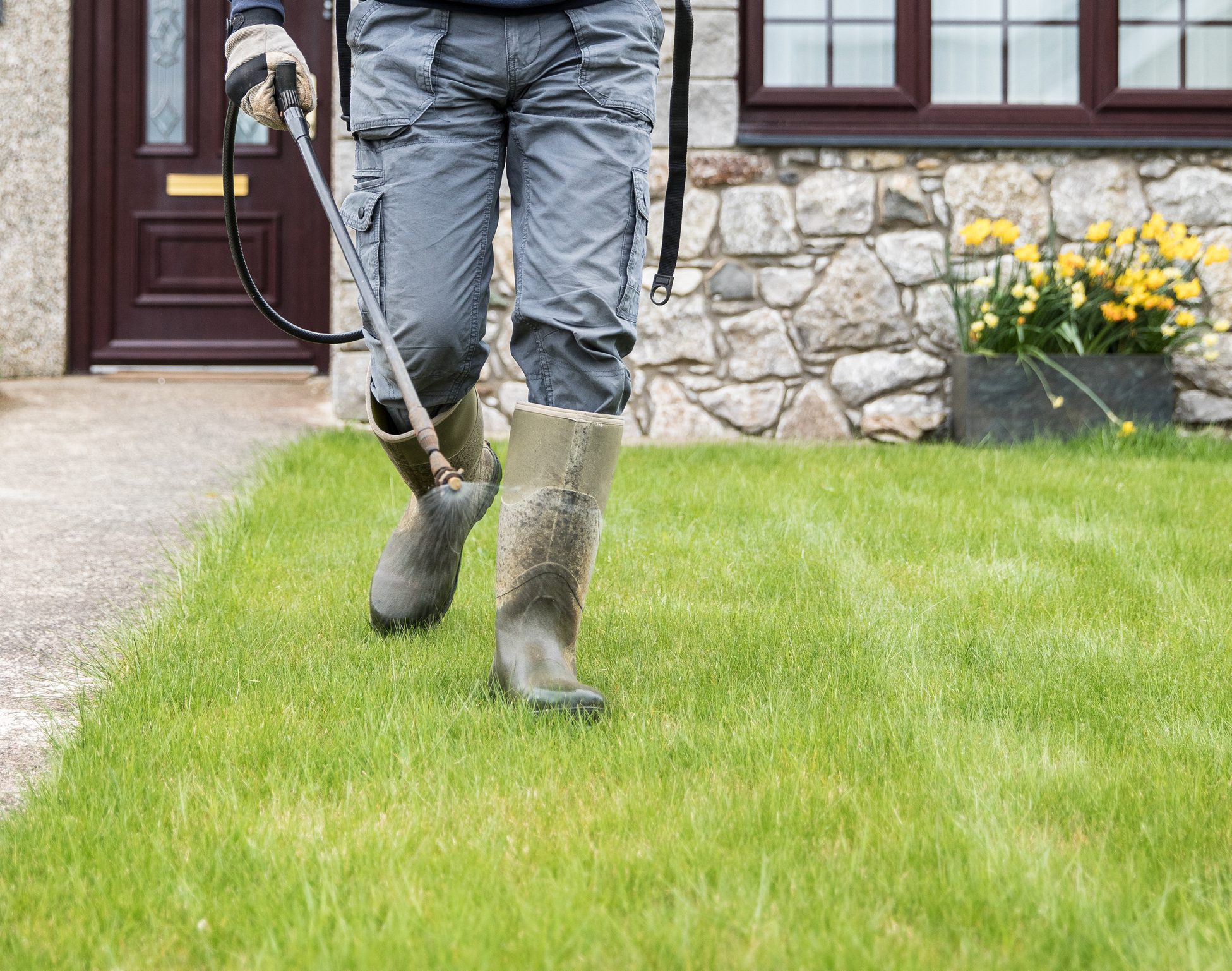
Fall is actually more effective for treating broadleaf weeds than spring. Dandelions, clover, ground ivy, and similar weeds are actively pulling energy down into their roots to prepare for winter. That downward translocation carries herbicide deep into the plant, making fall applications more lethal than spring ones.
Target the window from late September through mid-October, while soil temperatures remain above 50°F. The standard product type is a three-way broadleaf selective herbicide containing 2,4-D, MCPP (mecoprop), and dicamba — widely available at garden centers and hardware stores.
- Do not apply broadleaf herbicide within 3–4 weeks of overseeding. The herbicide will damage or kill young seedlings.
- Fall pre-emergent — a separate product applied in late August to early September — targets winter annual weeds like annual bluegrass (poa annua). This is distinct from broadleaf weed control and serves a different purpose.
November Fall Lawn Care for Cool Season Grass: Final Mow, Leaf Management, and Shutdown
November is about closing things down properly. The work here is simpler than September or October, but skipping it creates problems that won’t show up until spring.
Final Mow
Continue mowing as long as the grass is actively growing. Once growth slows to less than 1 inch per week, you’re approaching the final mow of the season.
For the last cut, reduce your mowing height by about half an inch from your normal height. This isn’t scalping — it’s a modest reduction that limits matting and reduces snow mold risk over winter. Snow mold is a fungal disease that develops under snow cover on longer grass blades.
Typical final mow heights by species:
-
- Tall fescue: 3–3.5 inches
- Kentucky bluegrass: 2.5 inches
- Fine fescue: 2.5–3 inches
Don’t cut lower than these minimums. Cutting too short going into winter stresses the crowns — the living tissue just above the soil surface — and weakens spring recovery.
Leaf Management
Leaves seem harmless, but a thick, matted layer left on the lawn through winter causes serious problems. It smothers grass, blocks light, traps moisture, and creates ideal conditions for snow mold and other fungal diseases.
The most efficient approach is to mulch mow leaves weekly throughout October and November rather than letting them accumulate for one large cleanup. A mulching mower blade or mulching kit chops leaves into small fragments that break down quickly and return organic matter to the soil. For homeowners already doing regular fall mowing, upgrading to a mulching blade is a practical improvement worth making.
If leaf volume is heavy, mulch first and then blow or rake off the excess. Going into the first hard freeze, you want no more than a thin, fragmented layer on the surface.
Irrigation Shutdown and Equipment Prep
Drain and winterize your irrigation system before the ground freezes. A single hard freeze can crack PVC lines and damage sprinkler heads. Repairs are expensive and avoidable.
For equipment:
-
-
- Drain fuel from your mower or run the tank dry before storage
- Clean your broadcast or drop spreader to prevent fertilizer residue from corroding it
- Store remaining fertilizer in a dry location
-
One final timing note: do not apply any fertilizer once the lawn has gone fully dormant. Nitrogen applied to dormant grass doesn’t absorb — it either volatilizes or runs off.
If you identified a soil pH problem earlier in fall but didn’t apply lime in September, November is the last practical window. Apply lime before freeze if your soil test showed pH below 6.0 and the ground hasn’t yet hardened.
Fall Lawn Care Mistakes That Set Cool Season Grass Back
These are the errors that show up as bare patches, weak green-up, or weed pressure the following spring:
-
-
- Aerating and seeding too late — Seeds need at least 6 weeks of soil temperatures above 50°F to establish. Miss that window and seedlings die before rooting in.
- Skipping the winterizer — This is the most commonly skipped fall step. The potassium hardening it provides has no spring equivalent.
- Applying winterizer too early — September winterizer pushes leaf growth instead of root hardening. Wait until mid-to-late October.
- Letting leaves sit all season — A light layer in October becomes a smothering mat by December. Mulch consistently.
- Mowing too short into winter — Scalped crowns are vulnerable crowns. Stay at recommended heights.
- Applying broadleaf herbicide near new seedlings — Wait the full 3–4 weeks after germination before treating weeds in overseeded areas.
-
Frequently Asked Questions: Fall Lawn Care for Cool Season Grass
When is it too late to overseed cool season grass in fall?
The cutoff isn’t a calendar date — it’s a soil temperature threshold. Cool season grass seed needs at least 6 weeks of soil temperatures at or above 50°F to germinate and establish before dormancy. In most cool-season regions, that means overseeding should be done by mid-September at the latest. If soil temperatures drop below 50°F too soon after seeding, germination may start but seedlings won’t root deeply enough to survive winter. When in doubt, use a soil thermometer rather than relying on the calendar.
Can I aerate and fertilize on the same day?
Yes. In fact, same-day application is efficient and effective. The order of operations matters: aerate first, then apply fertilizer or seed. Aeration opens channels in the soil that allow fertilizer granules and seed to make direct contact with the root zone. If you’re overseeding, the sequence is: core aerate → overseed → apply starter fertilizer → water in. If you’re not overseeding, aerate first and then broadcast your slow-release nitrogen fertilizer across the lawn.
Do I need to fertilize in both September and October?
Yes, and the two applications serve different purposes. September’s application is about fueling recovery and root growth — it’s the highest-nitrogen feeding of the year. October’s winterizer focuses on potassium, which strengthens cell walls and improves cold hardiness. Together, they make up a complete fall fertilizing program for cool season grass. The September application should be 0.9–1.0 lb of actual nitrogen per 1,000 sq ft. The October winterizer follows at 0.5–1.0 lb, depending on what you applied in September.
Should I apply a pre-emergent in fall for cool season lawns?
It depends on your weed pressure. Fall pre-emergent targets winter annual weeds — most importantly annual bluegrass (poa annua), which germinates in late summer and fall and is notoriously difficult to remove once established. If poa annua is a problem in your lawn, a fall pre-emergent applied in late August to early September can suppress it. The important caveat: fall pre-emergent will also prevent your grass seed from germinating. Do not apply it if you plan to overseed. It is a separate product and serves a different purpose than the broadleaf herbicides used in October for dandelion and clover control.
What if November was unusually warm — should I still stop fertilizing?
Stop fertilizing based on dormancy, not the calendar. If your lawn is still actively growing and showing green color in November due to warm weather, a light application of fertilizer is not harmful — but it’s also not the same as the winterizer you applied in October. The rule is simple: once the grass has stopped actively growing and the color has faded or gone flat, fertilizer won’t be absorbed and any nitrogen you apply will be wasted or run off. In a warm November, keep mowing as needed and hold off on any additional fertilizer inputs until you see active growth resume in spring.
Month-by-Month Fall Checklist: Quick Reference for Cool Season Lawns
Use this cool season grass fall checklist to stay on track across all three months without re-reading the full guide.
September
-
-
- Core aerate (early to mid-September)
- Overseed thin or bare areas immediately after aeration
- Apply starter fertilizer (high-phosphorus, e.g., 10-18-10) if overseeding
- Apply slow-release nitrogen fertilizer (0.9–1.0 lb N per 1,000 sq ft) if not overseeding
- Soil test if not done recently; address soil pH correction if pH is outside 6.0–7.0
-
October
-
-
- Apply winterizer fertilizer mid-to-late October (look for elevated K, e.g., 24-5-11 or 32-0-10)
- Treat broadleaf weeds with selective herbicide (early to mid-October; not if new seed is still establishing)
- Continue mowing at normal height while grass is actively growing
-
November
-
-
- Final mow — reduce height by ½ inch from normal
- Mulch or remove leaf accumulation before first hard freeze
- Drain and winterize irrigation system
- Clean and store fertilizer spreader; prep mower for storage
- Apply lime before freeze if pH correction is still needed and ground hasn’t frozen
-
Conclusion
The fall lawn care September October November window is a connected sequence, not a collection of separate tasks. September is for renovation — aeration, overseeding, and the first and most important nitrogen application of the year. October is for hardening — the winterizer fertilizer your lawn needs to survive cold and return strong, plus broadleaf weed control while it’s most effective. November is for closing properly — protecting what you’ve built with the right mow height, clean leaf removal, and equipment shutdown.
Get the sequence right and your cool-season lawn enters spring with denser turf, stronger roots, and far less weed pressure. That’s the payoff for doing fall lawn care for cool season grass the right way. For a year round look at managing your lawn, check out our cool season month-by-month guide.
When spring arrives and it’s time to pick up where fall left off, spring cool season lawn care covers everything you need from March through May — and helps you build on the foundation you’ve created here.
Subscribe to our Newsletter for Weekly updates!