Spring fertilizing cool season lawns is one of the most timing-sensitive tasks in the lawn care calendar. Apply too early and you’re feeding soil that can’t respond yet. Apply too late and you push growth into summer heat. Get it right and your lawn enters the growing season dense, green, and ready to handle whatever comes next.
This guide walks through why timing matters, how to identify the right window, how to calculate your nitrogen rate, and how to adjust your approach based on your specific grass type.
Disclosure: This article contains affiliate links. If you purchase through these links, I may earn a small commission at no extra cost to you. As an Amazon Associate, I earn from qualifying purchases.
Why Spring Fertilizing Timing Is Critical for Cool Season Grass
Cool season grasses — Kentucky bluegrass, tall fescue, fine fescue, and perennial ryegrass — have two natural growth peaks each year: spring and fall. Spring is the first big flush after winter dormancy, and it’s a window worth managing carefully.
The core problem with early fertilizing is simple: if the grass isn’t actively growing, the roots can’t absorb nitrogen. Nitrogen applied to a dormant or barely-waking lawn either sits in the soil and leaches away with rain or volatilizes into the air before roots have a chance to use it. Neither outcome is good for your lawn or your wallet.
Fertilizing too late creates the opposite problem. Pushing heavy nitrogen into a cool-season lawn in late May or June forces tender new growth during heat stress. That growth is more susceptible to fungal disease — particularly brown patch and dollar spot — and it draws down the plant’s energy reserves at exactly the wrong time.
One more framing note worth carrying through the season: fall is the more important fertilizing window for cool-season grass. Spring feeding supports the lawn’s natural growth surge, but the deep feeding that builds root reserves and sets up the lawn for next year happens in fall. Spring fertilizing is meaningful — it’s just not the main event.
When to Start Spring Fertilizing Cool Season Lawns: Soil Temperature vs. Calendar Date
Most homeowners default to a calendar date — a warm weekend in early April, or whenever the hardware store puts fertilizer on a front-of-store display. That instinct is understandable but unreliable.
The real trigger is soil temperature, not the date.
The Target Range
- Below 50°F: Grass isn’t actively growing. Nitrogen applied now will sit unused.
- 50–55°F: The growth window is open. This is the target range to apply.
- Above 65°F: Late window. Growth is accelerating, but so is crabgrass germination and disease pressure.
How to Check Soil Temperature
The most reliable method is a simple soil probe thermometer or an inexpensive instant-read thermometer with a long probe. Insert it 2–3 inches into the ground in a representative spot — away from pavement, which heats faster and skews readings. Any food-safe probe thermometer works, and purpose-built soil thermometers are widely available at garden centers for under $15. Take readings in the morning before the sun has warmed the surface.
Many state cooperative extension services also publish daily or weekly soil temperature maps during spring — search for your state’s extension service and “soil temperature map” to find them.
Regional Timing Approximations
These ranges are starting points. Actual timing shifts with elevation, local weather, and year-to-year variation. Always confirm with a soil temp reading.
| Region | Approximate Timing |
|---|---|
| Zone 5 (upper Midwest, New England) | Late April to early May |
| Zone 6 (mid-Atlantic, Ohio Valley) | Late March to mid-April |
| Zone 7 transitional (Virginia, Kansas) | Mid-March to early April |
If you’ve already applied a crabgrass pre-emergent, spring fertilizing is still compatible — the two products don’t conflict. The exception is if you’re overseeding, in which case pre-emergent timing and seeding timing require more careful coordination.
How Much Nitrogen to Apply When Spring Fertilizing Cool Season Lawns
The number that matters isn’t pounds of fertilizer product — it’s pounds of actual nitrogen per 1,000 square feet. Fertilizer bags list nitrogen as the first number in the N-P-K ratio (for example, the “30” in a 30-0-6 product means 30% nitrogen by weight). For a full breakdown of what the three numbers on a fertilizer bag actually mean, see that dedicated guide — this section focuses on the spring-specific rate decisions.
Spring Rate
For cool season lawns in spring, the target range is 0.5 to 1.0 lb of actual nitrogen per 1,000 sq ft. Where you land within that range depends on grass type, which is covered in the next section.
Why not more? Cool-season grasses are already primed to grow in spring. Heavy nitrogen doesn’t create a better lawn — it creates faster top growth at the expense of root depth, and that trade-off becomes a liability when summer heat arrives.
Quick Calculation Example
Take a 32-0-6 fertilizer. The nitrogen concentration is 32%, or 0.32 lbs of nitrogen per pound of product.
To deliver 1 lb of actual nitrogen per 1,000 sq ft:
-
- Divide 1 ÷ 0.32 = 3.1 lbs of product per 1,000 sq ft
To deliver 0.5 lb of actual nitrogen per 1,000 sq ft:
-
-
- Divide 0.5 ÷ 0.32 = 1.56 lbs of product per 1,000 sq ft
-
Run this math for any product before you fill a spreader. The bag’s application settings are a starting point, but they’re calibrated for a specific coverage rate — knowing the actual nitrogen delivery gives you control over your inputs.
Slow-Release vs. Fast-Release in Spring
Both have a place in spring, but with different trade-offs:
-
-
- Fast-release nitrogen (urea, ammonium sulfate): Delivers quicker green-up and is more effective at cooler soil temps. Higher burn risk if misapplied or not watered in. A reasonable choice in early spring when soil is still cool.
- Slow-release nitrogen (polymer-coated urea, PSCU): More forgiving timing-wise, releases gradually, better suited to variable spring weather. Slightly slower initial response.
-
Spring is the one season where a moderate fast-release product can be appropriate — soil temps are still cool enough to reduce burn risk, and you want the grass to respond while it’s in its prime growth window.
Choosing the Right Spring Lawn Fertilizer for Cool Season Grass
For an established cool-season lawn, look for a product with high nitrogen, low or zero phosphorus, and modest potassium. A ratio in the range of 30-0-6, 26-0-4, or 32-0-6 fits spring maintenance well.
Established lawns rarely need phosphorus additions, and many states restrict or prohibit phosphorus applications for environmental reasons. The exception is if a soil test specifically shows a deficiency, or if you’re overseeding bare spots, in which case a starter fertilizer with higher phosphorus supports new root establishment. A modest potassium level — 4 to 6% — supports stress tolerance as summer approaches. For the full explanation of what each nutrient number does, see what the three numbers on a fertilizer bag actually mean.
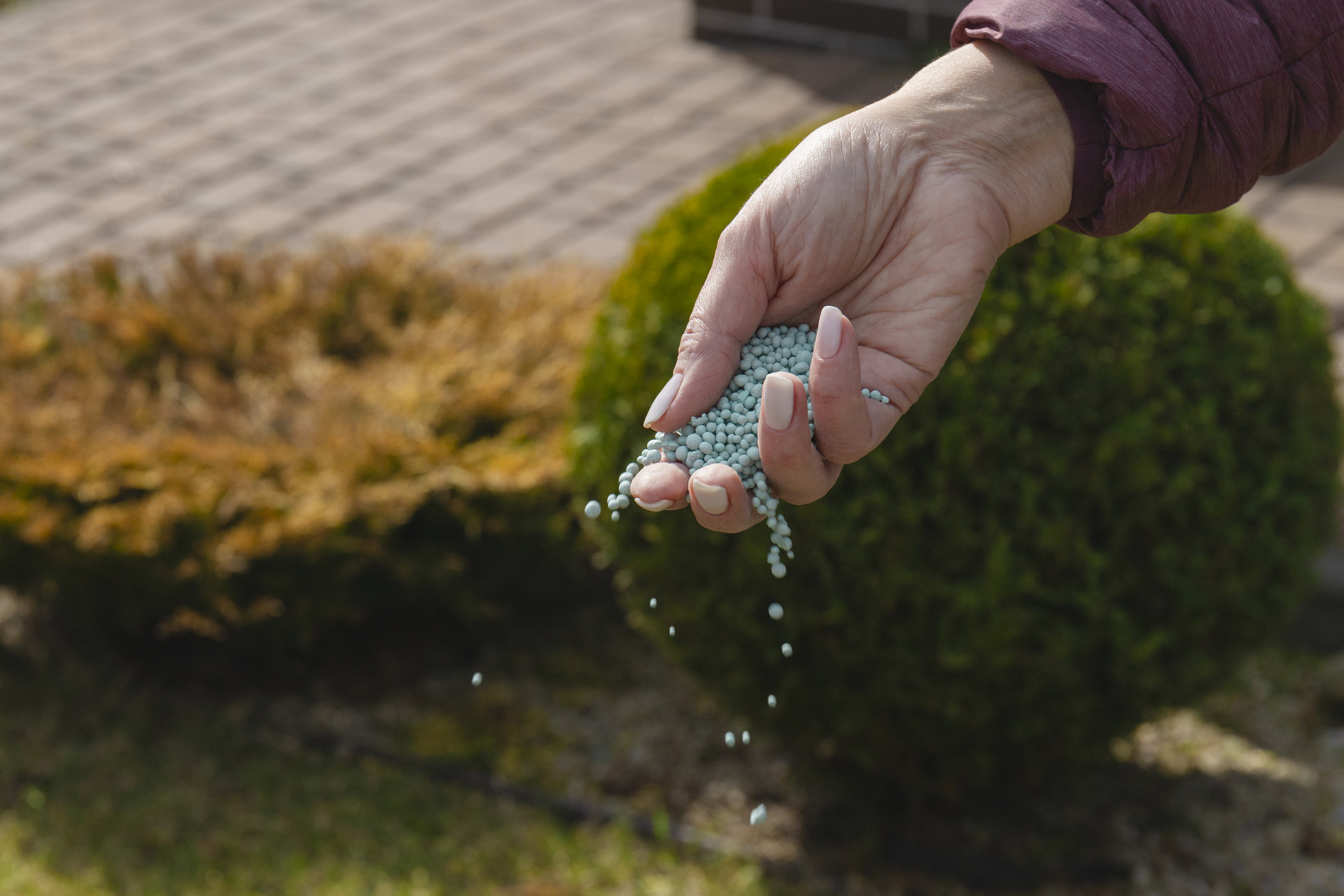
Granular vs. liquid: Granular fertilizer is the better choice for most homeowners. It’s easier to apply consistently with a broadcast spreader, gives better control over application rate, and is forgiving on timing since it doesn’t activate until watered in. Liquid fertilizers feed faster but require more precise calibration to avoid over-application. A well-regarded option is the Andersons Professional PGF Complete 16-4-8 cool season fertilizer, which combines a balanced nutrient profile with a granular formulation suited to the spring window — match the ratio description above and you’ll find suitable options from multiple brands.
Spring Fertilizing by Grass Type: Bluegrass, Fescue, and Ryegrass
The 0.5–1.0 lb nitrogen range gives you room to calibrate for your specific grass. Here’s how to approach spring fertilizing cool season lawns based on grass type.
Kentucky Bluegrass
Bluegrass is an aggressive spring grower. It spreads by rhizomes (underground stems) and fills in bare spots naturally in spring. Apply at the lower end of the range — 0.5 lb N per 1,000 sq ft — if the lawn is already dense and healthy. Heavy nitrogen in spring redirects the plant’s energy toward blade growth and away from the lateral spread that fills thin areas.
Tall Fescue
One caution: tall fescue is more susceptible to brown patch disease in summer. Avoid late-spring nitrogen applications after May in most zones — you don’t want lush growth heading into humid summer conditions.
Fine Fescue (Creeping Red, Chewings, Hard, Sheep)
Fine fescues are low-fertility grasses adapted to poor soils, shade, and minimal inputs. They’re the one group where you might reasonably skip spring fertilization entirely on an established lawn.
If the lawn looks pale or thin after winter, 0.5 lb N per 1,000 sq ft is sufficient. Over-fertilizing fine fescue opens the canopy, weakens the plant, and invites weeds into the gaps.
Perennial Ryegrass
Ryegrass green-ups fast in spring — often the first grass to show color after dormancy. It has moderate nitrogen needs: 0.5 to 0.75 lb N per 1,000 sq ft in spring. Ryegrass is commonly blended with Kentucky bluegrass, so in a mixed lawn, apply for the blend rather than trying to target individual species. The lower end of the bluegrass rate works well for most bluegrass/rye mixes.
Common Spring Fertilizing Mistakes That Set Back Cool Season Lawns
Fertilizing before soil warms. The most common mistake when spring fertilizing cool season lawns. Nitrogen applied to dormant turf leaches through the soil or volatilizes into the air before roots are active enough to use it. Wait for 50°F at root depth.
Applying a heavy fall rate in spring. Some homeowners assume more is better. A full fall-rate application in spring pushes excessive blade growth that becomes disease-prone entering summer. Moderate rates are the goal.
Using weed-and-feed before confirming soil temperature. Combination products contain herbicides that have their own activation requirements. Applying them on the wrong schedule can stress the grass and deliver poor weed control. If timing is uncertain, use a straight fertilizer and handle weed pressure separately.
Skipping spreader calibration. Uneven application creates stripes and hot spots — visible for weeks. Set your broadcast spreader to the manufacturer’s recommended setting for that product, and make an edge pass before filling in the main lawn area.
Not watering after application. Granular fertilizer — especially urea-based products — needs at least ¼ inch of water to move nitrogen down to the root zone. Without it, fertilizer sitting on dry leaf blades can cause burn, and nitrogen escapes through volatilization.
Frequently Asked Questions
What soil temperature should I wait for before fertilizing cool-season grass in spring? Wait for soil temperature to reach and hold 50–55°F at a depth of 2–3 inches, measured over several consecutive days. A single warm afternoon isn’t enough — you’re looking for a stable reading that reflects root-zone conditions. Below 50°F, grass isn’t actively growing and can’t use nitrogen efficiently.
Can I fertilize cool-season grass right after applying pre-emergent? Yes. A crabgrass pre-emergent and a spring fertilizer are compatible and can be applied at the same time or in close succession. The exception is overseeding — pre-emergent herbicides will also inhibit desirable grass seed. For detailed timing guidance, see the crabgrass pre-emergent comparison article.
How do I calculate how much actual nitrogen I’m applying? Divide the desired nitrogen rate (in lbs per 1,000 sq ft) by the nitrogen percentage on the bag (as a decimal). For example, to deliver 0.5 lb of nitrogen using a 30-0-6 fertilizer: 0.5 ÷ 0.30 = 1.67 lbs of product per 1,000 sq ft. Always run this calculation before setting your spreader.
What happens if I fertilize cool-season grass too early in spring? Nitrogen applied before soil reaches 50°F sits unused in the root zone. It either leaches deeper into the soil profile with rain or volatilizes into the air — both are a waste of product. There’s also a risk of promoting weak, tender growth that a late frost can damage. Soil temperature is the reliable trigger, not the calendar.
Is it okay to skip spring fertilizer and just do a fall application? For most cool-season lawns, yes — fall is the higher-priority feeding window. A single well-timed fall application does more for root development and long-term density than spring fertilizing alone. That said, spring fertilizing supports the natural growth flush and helps lawns that came out of winter looking thin or pale. If you’re only fertilizing once, fall is the better choice — a fall fertilizer like Scotts Turf Builder WinterGuard is specifically formulated to build roots and prepare cool-season lawns for winter.
Should I use a weed-and-feed product in spring instead of a straight fertilizer? Weed-and-feed products combine fertilizer with herbicide, which sounds efficient but creates timing problems. The herbicide component has its own requirements — soil temperature, weed growth stage, and application conditions — that may not align with the ideal fertilizer window. For more control over timing and outcomes, use a straight fertilizer and address weeds separately if needed.
Conclusion
Spring fertilizing cool season lawns comes down to two core decisions: when to start and how much nitrogen to apply.
Use soil temperature as your trigger — 50°F at 2–3 inches, held consistently for several days, is the reliable signal that grass is actively growing and ready to use nitrogen. Calendar dates are a rough guide at best.
Keep nitrogen rates moderate: 0.5 to 1.0 lb of actual nitrogen per 1,000 sq ft, calibrated to your grass type. Fine fescue needs the least; tall fescue and blends benefit from the higher end of that range. Kentucky bluegrass and ryegrass sit comfortably in the middle.
Choose a high-nitrogen, low-phosphorus granular fertilizer, water it in after application, and resist the urge to overfeed. Spring is the first growth window — fall is where cool-season lawns make their biggest gains.
Key takeaways:
-
-
- 50–55°F soil temperature is the trigger, not a calendar date
- Apply 0.5–1.0 lb actual nitrogen per 1,000 sq ft depending on grass type
- Low or zero phosphorus for established lawns
- Fine fescue may not need spring fertilizing at all
- Fall feeding is the higher-priority window — spring supports it
-
For further reading, explore what the three numbers on a fertilizer bag actually mean and how to build a full 12-month lawn care schedule.
Subscribe to our Newsletter for Weekly updates!