Underwatered vs. overwatered lawn signs look nearly identical — wilting, discoloration, thinning grass — and treating one like the other makes the problem significantly worse. Before you touch your sprinkler or reach for the hose, use this guide to confirm which problem you’re actually dealing with.
Disclosure: This article contains affiliate links. If you purchase through these links, I may earn a small commission at no extra cost to you. As an Amazon Associate, I earn from qualifying purchases.
Why Underwatered and Overwatered Lawns Can Look Almost Identical
This is the central trap that catches most homeowners: both conditions produce wilting, and both can cause your lawn to turn yellow or brown.
The mechanisms behind the symptoms are completely different, though. An underwatered lawn wilts because grass cells lose turgor pressure — the internal water pressure that keeps blades upright. An overwatered lawn wilts for the opposite reason: roots suffocate in waterlogged soil and can no longer move water up through the plant. Same visual result, opposite cause.
Overwatering adds another layer of confusion. Prolonged soil saturation invites fungal pathogens, which produce their own symptoms — circular discolored patches, visible mycelium, or unusual growth — that layer on top of the moisture problem and make diagnosis harder.
This is why visual inspection alone is unreliable. You need to check the soil, not just the grass.
One quick note on timing: wilting at noon on a hot day is not necessarily an emergency — some grasses wilt under peak heat and recover by evening. Wilting that’s still visible at dawn is a real warning sign worth investigating.
Underwatered Lawn Signs (And How to Confirm Them)
The most reliable early indicator of underwatering is how the grass blades respond to physical stress — not just how they look.
Visual Signs of Underwatered Grass
- Blades curl or fold lengthwise. Grass closes its leaf surface to reduce water loss. Curled or rolled blades are a classic sign of underwatered grass.
- Footprints stay visible. Walk across the lawn and look back. If your footprints remain depressed for 30 or more seconds, the grass lacks the turgor to spring back — this is the step test, and it’s one of the most reliable indicators.
- Color shifts to blue-gray or dull olive before browning. This color change happens before visible damage and is an early warning sign.
- Browning starts at blade tips and progresses downward uniformly. This pattern differs from disease, which tends to spread in irregular patches or rings.
- Dry patches follow sun exposure and elevation. The sunniest spots, south-facing slopes, and high points in the yard dry out first.
Physical Confirmation
Probe the soil 2–3 inches down with your finger or a screwdriver. Dry, hard soil that resists penetration confirms the diagnosis. The thatch layer — the layer of dead and living organic matter between grass and soil — may also feel crispy or papery in a severely dry lawn.
What Underwatering Is Not
A lawn that turns blue-gray or straw-colored across its entirety during summer heat may have entered dormancy — a survival state, not death. Dormant grass is not the same as dying grass. To test: grab a small handful of grass and pull firmly. Dormant grass resists; dead grass releases at the crown with little resistance.
Overwatered Lawn Signs That Are Easy to Miss
Overwatering is harder to catch because homeowners associate green, lush-looking grass with health. Overwatered lawns often look fine right up until they don’t.
Visual Signs of Overwatered Grass
- Grass looks green but feels spongy underfoot. That soft, bouncy feeling when you walk is a red flag, not a sign of good health.
- Yellowing starts at older growth first. Waterlogged soil leaches nitrogen — an essential nutrient — out of the root zone. Older blades yellow before newer growth because they rely on consistent nutrient supply. Once the lawn has dried out and stabilized, replenishing with a warm season fertilizer helps restore what prolonged saturation has stripped away.
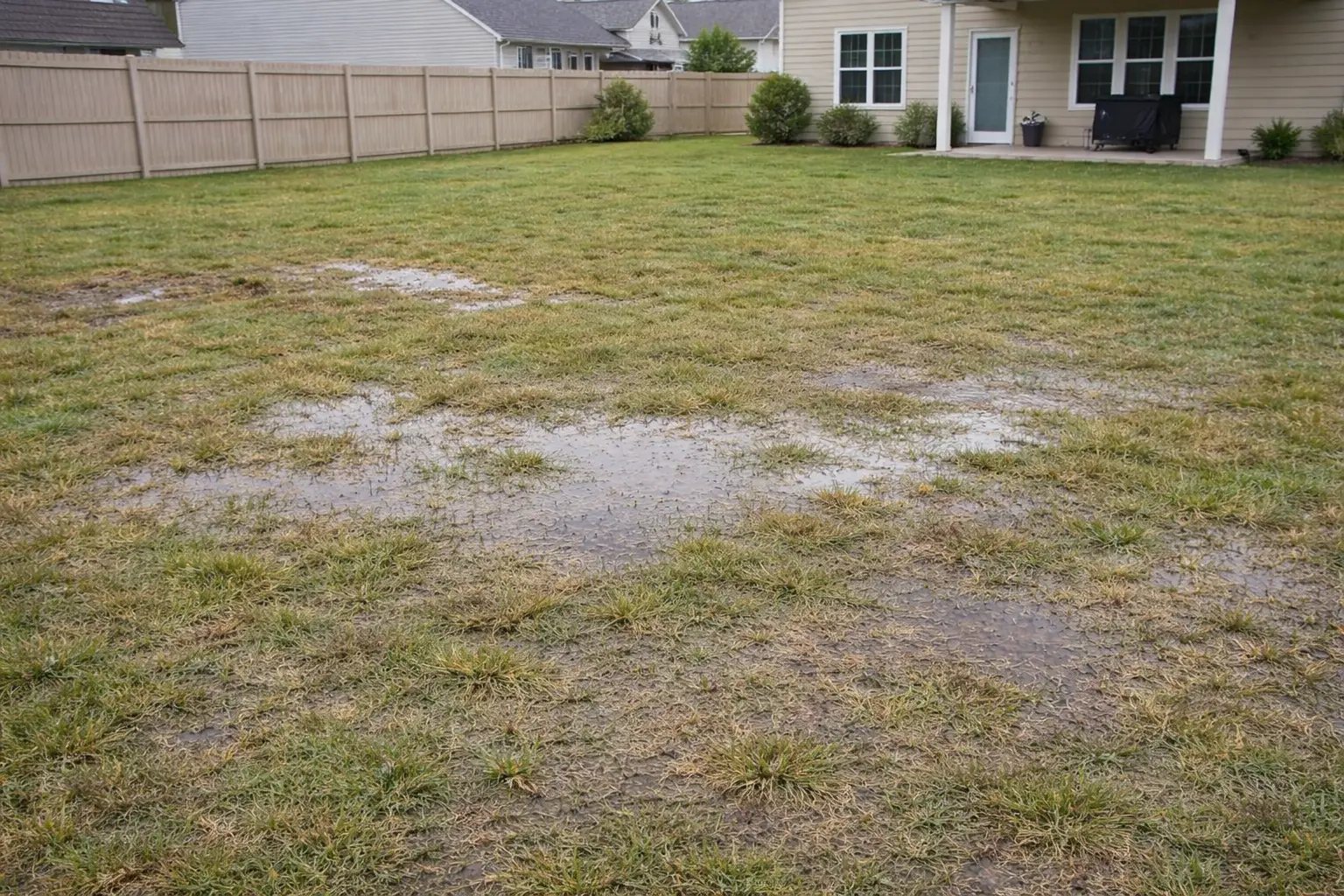
- Moss or algae appears in low spots. These organisms thrive where drainage is poor and moisture is persistent.
- Fungal growth appears. Mushrooms, white or gray mycelium, or circular discolored patches in the turf point to fungal disease taking advantage of prolonged wet conditions. If you’re seeing ring-shaped patches or irregular brown areas alongside soggy soil, read Brown Patch Disease in St. Augustine and Zoysia: How to Identify It and Kill It Fast and Cool Season Lawn Disease Identification — overwatering is one of the primary triggers for both.
- Weed pressure increases. Wet soil favors specific weeds, including nutsedge and annual bluegrass, which are both signs that soil moisture is consistently too high.
- Soil feels wet, slimy, or dense well below the surface even on days without recent rain.
- Water pools or drains slowly after irrigation or rainfall.
- The thatch layer feels soft, compacted, or smells sour.
A Note on Timing
If yellowing appeared shortly after a rainy period, an irrigation schedule increase, or a sprinkler system adjustment, that pattern points toward overwatering rather than nutrient deficiency or disease. If you’re not sure whether a recent fertilizer application is involved, see My Lawn Is Yellow After Fertilizing to rule that out before drawing conclusions.
How to Diagnose Watering Problems: The Screwdriver Test and Other Methods
Knowing the common underwatered vs. overwatered lawn signs gets you close — but these physical tests confirm your diagnosis before you take action. Don’t skip this step.
The Screwdriver Test (Primary Method)
- Take a standard flathead screwdriver with a blade at least 6 inches long.
- Push it straight into the lawn using only hand pressure — no hammering.
- Slides in easily to the handle: soil has adequate to excess moisture.
- Stops after 2–3 inches and requires real force: soil is too dry.
- Slides in easily but extracted soil smells sour or feels sticky and slick: likely waterlogged conditions, possibly with early root rot.
The Footprint Test (Secondary)
Walk across the lawn normally and turn around.
- Footprints that stay compressed for 30+ seconds = underwatered
- Footprints in soft, squishy turf that feel unstable underfoot = overwatered
The Soil Core Method (If Still Unsure)
Use a hand trowel or plug aerator to pull a 3-inch soil core from several spots across the lawn.
- Dark, consistently wet soil throughout the core = overwatering
- Dry, pale, loose soil with little cohesion = underwatering
- Variation across the yard = uneven irrigation coverage or drainage issues
If you want to remove all guesswork, a soil moisture meter — an inexpensive probe-style tool available at most hardware stores and on Amazon — gives you a direct reading of moisture at root depth. It’s not required, but it’s genuinely useful if you’re troubleshooting recurring problems or managing an irrigation system.
What These Tests Won’t Tell You
These tests confirm moisture status, not root health. If roots have already been damaged by prolonged rot or drought stress, the lawn may continue to decline even after you correct the watering. If grass fails to recover within a week of appropriate corrections, suspect deeper root damage or disease rather than a simple moisture problem.
How to Fix an Underwatered or Overwatered Lawn Without Making It Worse
Keep these two situations completely separate. The fix for one is the wrong move for the other.
If the Lawn Is Underwatered
Step 1: Water deeply rather than lightly. The goal is to wet the soil 4–6 inches down so roots are encouraged to grow deeper, where moisture is more stable.
Step 2: Target 1–1.5 inches of water per week total, counting both rainfall and irrigation. A simple rain gauge takes the guesswork out of tracking this — basic tube-style gauges cost just a few dollars and are genuinely useful for calibrating your schedule.
Step 3: Water in the early morning. This reduces evaporation loss and limits how long moisture sits on blades overnight. For more detail on timing, Best Time of Day to Water Cool Season Grass covers this thoroughly.
Step 4: Hold off on fertilizing until the lawn shows recovery. Applying nitrogen to drought-stressed roots increases the risk of burn.
Recovery timeline: Most lawns show visible improvement within 2–4 days if stress hasn’t progressed to crown damage.
What not to do:
- Don’t overcompensate by soaking the lawn daily — swinging between extremes stresses roots further.
- Don’t mow short during recovery. Taller blades shade the soil and reduce additional moisture loss.
If the Lawn Is Overwatered
Step 1: Stop all irrigation immediately. Let the soil dry before you do anything else.
Step 2: Do not aerate while the soil is still saturated. Wet soil compresses under aeration equipment rather than opening drainage channels — you’ll make it worse.
Step 3: Once the soil is dry enough to walk on without leaving deep impressions, core aerate to improve drainage and oxygen flow to the root zone.
Step 4: Audit your sprinkler system. Check for overlapping coverage zones, heads tilted toward one area, or run times that were set during summer and never adjusted for cooler seasons. A programmable sprinkler timer or a smart irrigation controller — one that adjusts run times based on local weather data — can prevent this from recurring automatically.
Step 5: If fungal disease has taken hold alongside the overwatering, treat it separately with an appropriate contact fungicide. Fixing the moisture alone won’t resolve active fungal infection. See Brown Patch Disease in St. Augustine and Zoysia: How to Identify It and Kill It Fast for identification and treatment guidance.
What not to do:
- Don’t apply fertilizer to waterlogged soil. Nutrients leach immediately and contribute nothing to recovery.
- Don’t assume the problem is fixed once the surface looks dry. Use the screwdriver test to confirm moisture levels at depth before resuming irrigation.
How to Avoid Getting the Diagnosis Wrong Again
Prevention is mostly about building two habits: checking the soil before watering, and calibrating your schedule to actual conditions rather than the calendar.
- Use a rain gauge. Track real precipitation so you’re not irrigating after nature already did the job. How Rain Affects Your Watering Schedule explains exactly when to skip a cycle and how rainfall totals should factor into your routine.
- Know your soil type. Sandy soil drains fast and needs more frequent watering. Clay holds moisture longer and is far more prone to overwatering. If you’re not sure what you have, a soil test kit can tell you exactly what you’re working with — including pH and nutrient levels that affect how your lawn responds to moisture stress.
- Adjust irrigation run time by season. Your lawn’s water needs in October are not the same as in July. Seasonal adjustments prevent both underwatering in heat and overwatering in cooler months. How to Adjust Your Lawn Watering Schedule for Summer Heat walks through how to make those changes without guessing.
- Audit your irrigation system annually. Check for stuck heads, tilted nozzles, and zone overlaps. One malfunctioning head can saturate a section of lawn while leaving another bone dry.
- Run the screwdriver test before every watering cycle. It takes 10 seconds and eliminates the guesswork entirely. Making it a routine — rather than a reaction to visible problems — is the single most effective habit change for lawn watering problems diagnosis.
FAQ
How long does it take for an underwatered lawn to recover? Most lawns recover within 2–7 days of correct watering if stress has not progressed to dormancy or crown death. Grass in dormancy can take 2–4 weeks to fully green up once regular watering resumes.
Can grass come back after overwatering damage? It depends on root survival. If roots have rotted, affected areas will likely need reseeding or resodding. Crowns sometimes survive even when top growth is lost — check for any green tissue at soil level before writing off a section.
How do I know if my lawn is dormant or dead from drought? Pull test: grab a handful of grass and pull firmly. Dormant grass resists. Dead grass releases easily at the crown. Also check the crown itself for any green tissue — presence of green at the base is a good sign.
Does overwatering cause fungal disease? Yes. Prolonged leaf wetness and waterlogged soil create ideal conditions for fungal pathogens. If you see circular patches, slime, or unusual growth alongside soggy conditions, suspect disease in addition to overwatering — the two problems often need to be addressed separately.
What does overwatered grass look like vs. drought stress? Overwatered grass typically feels soft and spongy underfoot, shows yellowing in older growth first, and may display fungal signs — all with wet soil at depth. Drought-stressed grass folds or curls at the blade, leaves persistent footprints, shifts to a blue-gray color, and sits above dry, hard soil. Understanding these underwatered vs. overwatered lawn signs side by side is the fastest way to reach the right diagnosis.
Summary
The core mistake when diagnosing watering problems is treating the symptom without confirming the cause. Both conditions wilt grass and discolor turf — but one needs more water and the other needs none. Use the screwdriver test first, every time. Let what’s happening at 3 inches below the surface guide your response, not what you see above it. Correct the moisture problem before addressing anything else, and hold fertilizer until the lawn has stabilized. Recognizing underwatered vs. overwatered lawn signs accurately before acting is what separates a quick recovery from a problem that compounds for weeks.