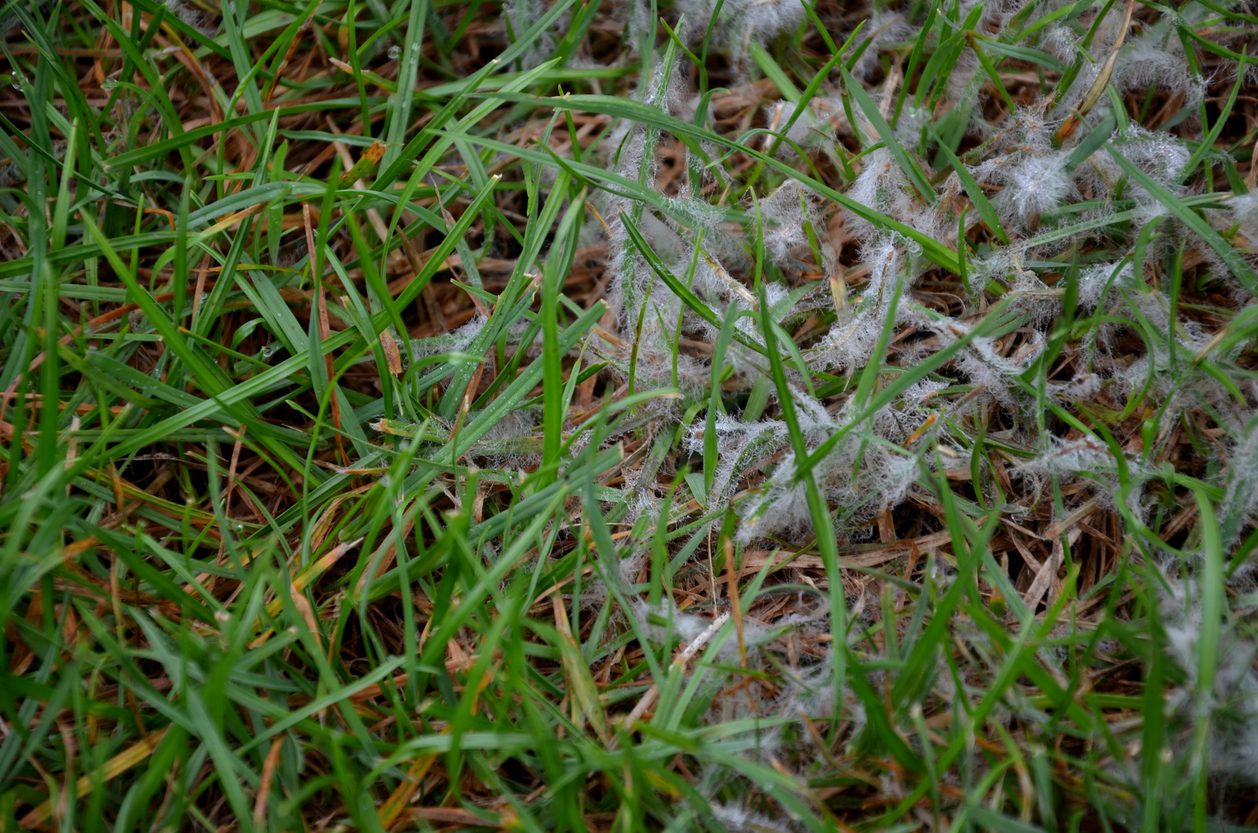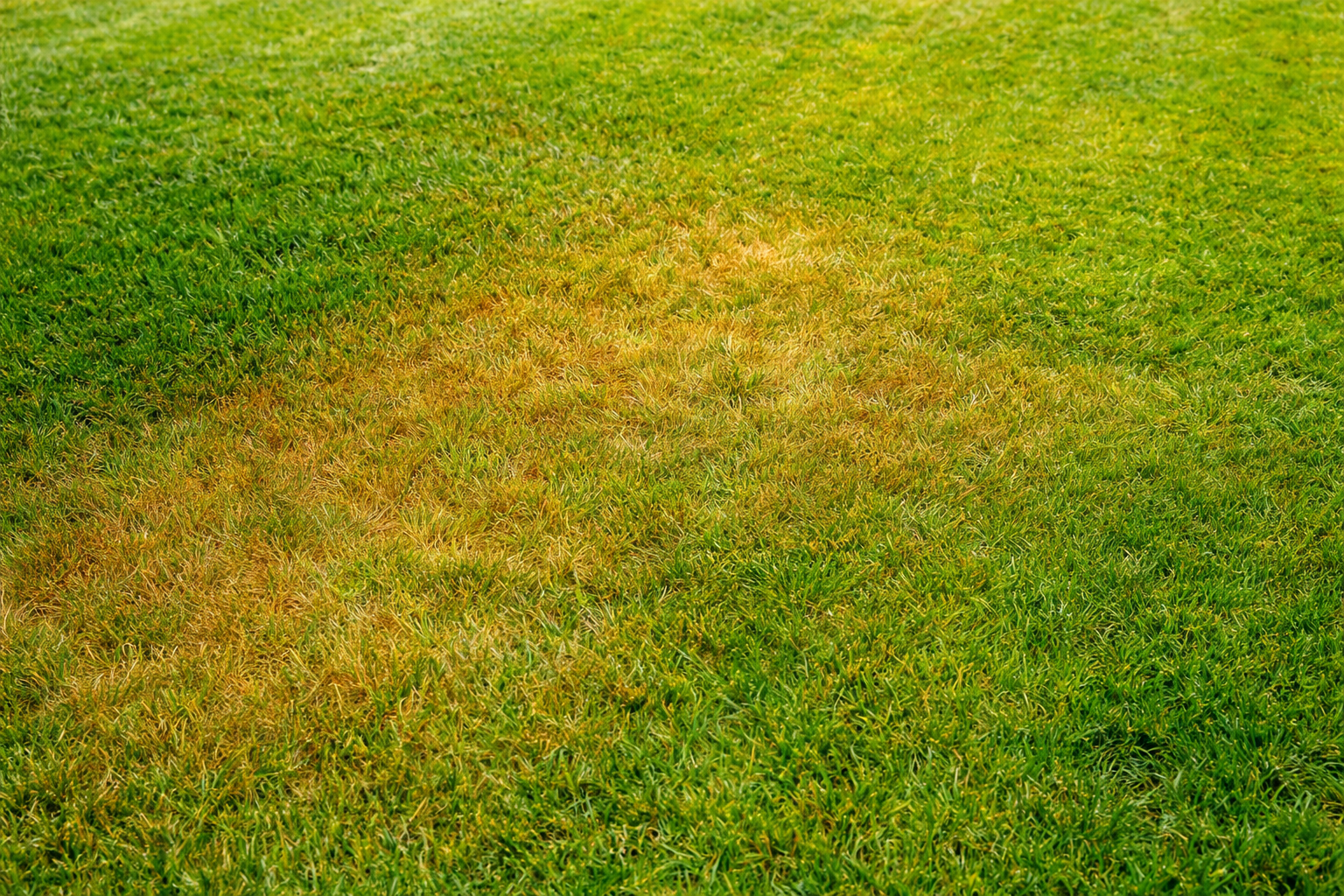
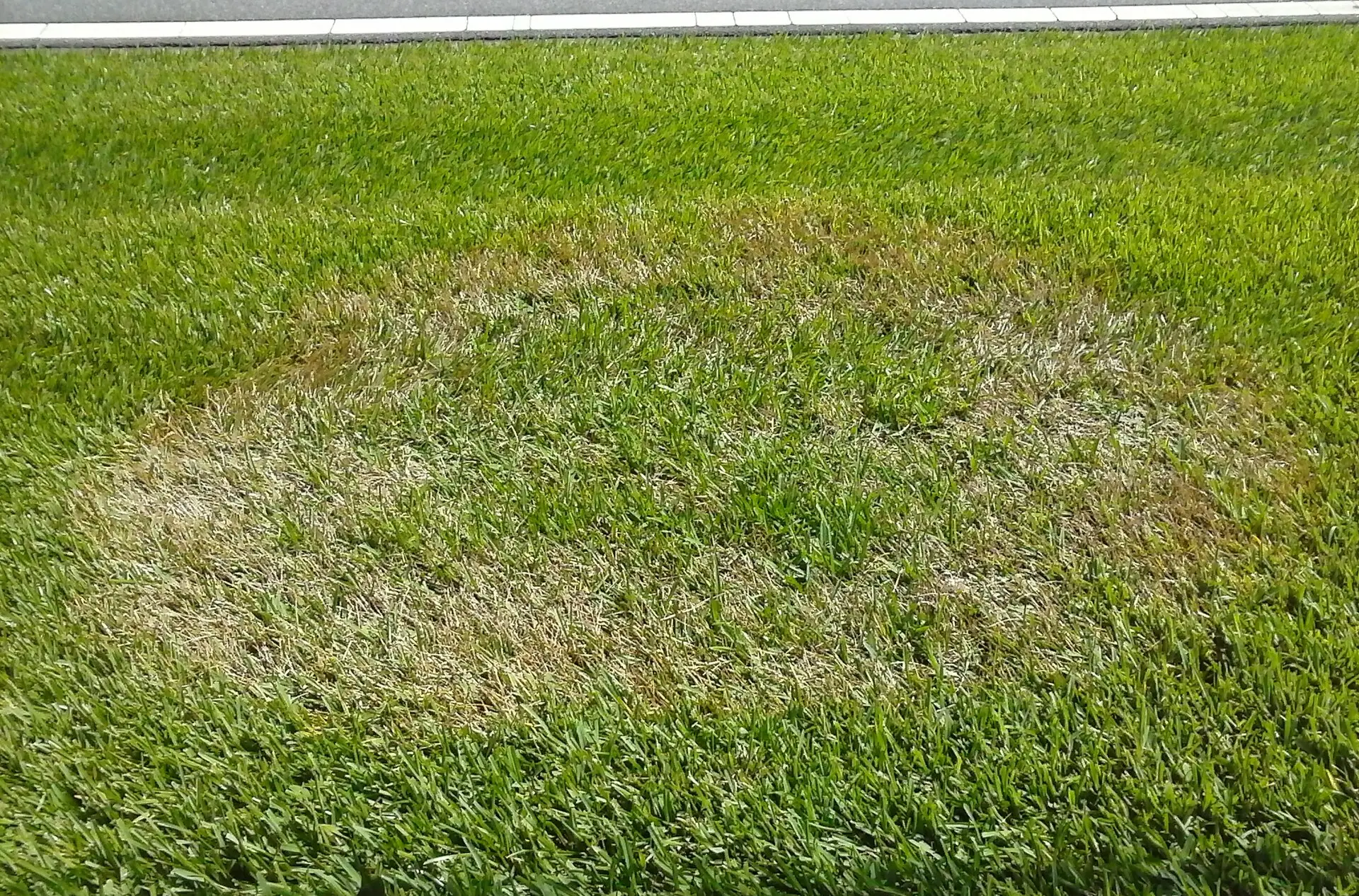
Brown patch disease in St. Augustine grass is one of the most common — and most misdiagnosed — lawn problems in the South. If you’re seeing circular brown patches forming during hot, humid weather, Rhizoctonia solani — the fungus behind brown patch disease in St. Augustine grass and zoysia — is a likely culprit. Acting fast matters because this disease can spread across a lawn in days under the right conditions. This guide walks you through how to identify it, rule out look-alikes, and stop it before it takes over.
Disclosure: This article contains affiliate links. If you purchase through these links, I may earn a small commission at no extra cost to you. As an Amazon Associate, I earn from qualifying purchases.
What Brown Patch Disease in St. Augustine Grass and Zoysia Actually Looks Like
Start here. Match what you’re seeing to the description before doing anything else.
St. Augustine Symptoms
- Circular or irregular brown patches, typically 1–3 feet across, but they can expand to 10 feet or more if left untreated
- Leaf blades rot at the base — grip a blade near the edge of the patch and pull gently. If it slides away from the stolon (the horizontal runner) with little resistance, that’s blade sheath rot — a clear sign of brown patch
- Smoke ring border — the outer edge of an active patch often shows a darker, water-soaked ring in early morning. It disappears as the lawn dries and is the most reliable visual marker for active infection
- Donut pattern — the center of older patches may begin to recover while the outer ring continues expanding, creating a ring-shaped dead zone
- Stolons survive — the runners themselves typically stay alive even when blades die off. This is an important detail: if the stolons are dead, you may be dealing with a more destructive problem
- Circular patch pattern similar to St. Augustine, but the smoke ring border often develops more slowly
- Affected blades turn tan or light brown and collapse rather than standing upright
- Zoysia’s dense growth can hide early patches — get down to soil level and look for blade rot at the base, not just surface browning
When to Expect It
Active infections occur when nighttime temperatures hold above 70°F and humidity is high. In most of the South, that means late spring through early fall — with peak activity typically in June through August.
Why Brown Patch Disease Spreads So Fast in St. Augustine Grass and Zoysia
Understanding the mechanism helps explain why speed matters and which conditions you can control.
Rhizoctonia solani is a soil-borne fungus. It spreads through water movement, foot traffic, and mowing equipment. A single rain event or heavy overnight dew can carry spores from one area of your lawn to another. Wet leaf tissue that stays wet through the night is the primary trigger — this is why evening watering is so damaging during an outbreak.
Excessive nitrogen fertilization is a major contributor. Lush, soft growth produced by high nitrogen inputs is significantly more susceptible to infection than moderate, firm growth. Overwatering creates the same problem — saturated soil and prolonged wet foliage provide ideal conditions for the fungus to establish and spread. If you’ve been watering newly sodded warm-season grass with frequent, heavy cycles and carried that habit into the summer, it may be contributing to your outbreak.
How to Confirm It’s Brown Patch and Not Something Else
This is the most important step. Applying the wrong fix wastes time and can make things worse.
Brown Patch vs. Drought Stress
- Drought stress affects large, irregular sections of your lawn — or areas where irrigation coverage is uneven. It does not create defined circular patches.
- Field test: Pull a blade from the edge of the patch. A clean pull with a rotting sheath = brown patch. Dry, crisp resistance with no rot = drought stress.
Brown Patch vs. Chinch Bug Damage
- Chinch bug damage is most common in full-sun areas. Brown patch disease in St. Augustine grass can appear in partial shade.
- Chinch bug patches are irregular and tend to spread outward from a central point rather than forming a defined circle.
- Field test: Part the thatch at the edge of the damaged area and look closely. Chinch bugs are visible to the naked eye — small insects with black bodies and white wing markings. If you see them, the problem is pest damage, not fungus.
Brown Patch vs. Fertilizer Burn
- Fertilizer burn follows the pattern of your spreader — straight lines, overlap zones, or where you turned around. It does not create circular patches.
- Burn damage appears within 1–3 days of a fertilizer application. Brown patch develops more gradually.
- Burned blades are dry and stiff from the tip downward. Brown patch blades rot from the base upward.
The Most Reliable Confirmation
Go out in early morning while dew is still present and look for the smoke ring border at the edge of the patch. This darker, water-soaked ring is the clearest visual indicator of active brown patch fungus. It disappears once the lawn dries, so timing matters.
How to Treat Brown Patch Disease in St. Augustine Grass and Zoysia Before It Spreads Further
Cultural changes alone will not eliminate an active infection, but they slow the spread immediately and make fungicide more effective. Start here before reaching for a product.
Step 1 — Adjust Watering Immediately
Move all irrigation to early morning — between 4 and 8 a.m. This allows the grass to dry fully before nightfall. Wet foliage overnight is the single biggest driver of continued spread. Never water in the evening during an active outbreak.
If you’re watering more than necessary, reduce frequency. Grass should dry out between cycles.
Step 2 — Stop All Nitrogen Fertilization
Hold every nitrogen application until the outbreak is controlled. Soft, nitrogen-fed growth accelerates the disease. Do not apply a lawn booster or quick-release nitrogen fertilizer thinking it will help the grass recover — it won’t. It will feed the problem instead. When you’re ready to fertilize again after the outbreak is controlled, a warm season fertilizer with a balanced slow-release formula is a safer choice that won’t push the soft, lush growth that makes turf vulnerable to reinfection.
Step 3 — Mow Carefully
Mow at your normal height. Do not scalp the lawn trying to remove diseased tissue — it doesn’t help and stresses the grass further. Clean your mower blades with a diluted bleach solution between passes over infected areas to avoid carrying spores to healthy sections. Bag clippings from infected areas rather than mulching them back into the lawn.
Step 4 — Apply a Systemic Fungicide
What to look for on the label: Active ingredients effective against Rhizoctonia solani include azoxystrobin, propiconazole, myclobutanil, and thiophanate-methyl. Most consumer products that list “brown patch” on the label use one of these.
Look for a systemic fungicide containing azoxystrobin or propiconazole — a product like this one on Amazon is the type to search for. Liquid formulations absorb faster and are preferred for active outbreaks. Granular fungicides work better as preventive treatments.
Application tips:
- Apply at the first sign of disease. Waiting until the patch is large significantly reduces effectiveness.
- Follow label rates exactly. More product does not mean faster control — it means potential turf damage.
- Plan for a repeat application in 14–28 days depending on conditions and product instructions.
- Water granular fungicides in lightly after application. Do not heavily irrigate liquid applications off the foliage.
What Not to Do
- Do not resume evening watering after applying fungicide. You will undo the treatment.
- Do not rely on contact-only fungicides as your primary treatment. Products that don’t list systemic action stay on the surface and don’t reach the infection at the thatch and soil level where Rhizoctonia solani lives.
- Do not assume one application is enough during a hot, humid summer. Reapplication within the label window is often necessary.
How to Prevent Brown Patch Disease in St. Augustine Grass From Returning Next Season
Once you’ve treated an active outbreak, the goal is to break the cycle before conditions favor it again next year.
Watering practice — Consistent early-morning irrigation is the single most effective prevention habit. Wet foliage overnight is the primary driver of outbreak conditions. Build this habit now and maintain it year-round.
Nitrogen timing and rate — Avoid high nitrogen applications in late spring and summer when temperature and humidity are already elevated. Soft, fast-growing turf is more vulnerable. Stay within the recommended annual nitrogen rate for your grass type, and be especially careful in June and July.
Thatch management — Thatch (the layer of dead organic matter between the grass blades and soil) over ½ inch holds moisture and harbors fungal activity between seasons. If your thatch is thick, plan to dethatch or verticut after the active outbreak is controlled — not during it. Addressing thatch long-term reduces the moist environment the fungus needs to persist.
Preventive fungicide in spring — If you had brown patch this year, apply a preventive fungicide the following spring before conditions turn hot and humid. A single application in late May or early June can interrupt the cycle before an outbreak has a chance to start.
Air circulation — Brown patch disease in St. Augustine grass is worse in low-lying areas, shaded spots, and places with poor airflow. If the same area gets infected every year, fungicide alone won’t permanently solve the problem. Structural factors like shade and drainage need to be addressed as well.
Summary
Brown patch disease in St. Augustine grass — and in zoysia — is a fast-moving problem that rewards early diagnosis. The key steps in order: confirm it’s actually brown patch using the smoke ring border and blade pull test, rule out drought stress, chinch bugs, and fertilizer burn, then act immediately by shifting to morning watering, stopping nitrogen, and applying a systemic fungicide containing azoxystrobin or propiconazole. Prevention comes down to one consistent habit more than anything else: keep foliage dry at night. Build that into your routine and you cut the disease’s opportunity significantly before it starts.
Frequently Asked Questions
Can brown patch kill my St. Augustine lawn permanently? Brown patch disease in St. Augustine grass is rarely fatal to the entire lawn. The fungus attacks leaf blades but typically leaves stolons (runners) alive. Once conditions improve and treatment is applied, the grass usually recovers from the stolons outward. Repeated severe infections with no treatment over multiple seasons can thin a lawn significantly, but permanent death across a large area is uncommon.
How long does it take for brown patch to go away after treatment? With cultural changes and a systemic fungicide applied early, you should see the active infection stop spreading within 7–14 days. Visible recovery — new blade growth filling in the patches — takes longer, typically 3–6 weeks depending on how fast your grass is actively growing. Patches treated late in the season may not fill in until the following spring.
Does brown patch come back in the same spot every year? Yes, it often does. Rhizoctonia solani persists in the soil and thatch layer between seasons. Areas with poor drainage, shade, or restricted airflow are especially prone to repeat infections. If you have a persistently affected area, address the underlying structural conditions — fungicide alone will not break the cycle permanently.
Is brown patch the same as large patch disease? They are closely related but not identical. Both are caused by Rhizoctonia solani, but large patch is the term used specifically for infections in warm-season grasses like St. Augustine and zoysia, while brown patch is more commonly applied to cool-season turf. The symptoms, treatment, and fungicide options are essentially the same. You will see both terms on product labels and in extension publications — they refer to the same practical problem in your lawn.
Can I overseed or resod a brown patch area while the fungus is still active? No. Installing new sod or seed into an actively infected area will expose it to the same fungus immediately. Wait until the outbreak is controlled, conditions have shifted away from the peak infection window, and at least one fungicide application has been completed. Then address bare areas if the grass hasn’t filled back in naturally from surrounding stolons.
Subscribe to our Newsletter for Weekly updates!