How much nitrogen does St. Augustine grass need? In short, for a full season, the answer is 2 to 4 lbs of actual nitrogen per 1,000 sq ft per year. But applying that correctly — the right amount at the right time — is where most homeowners go wrong. St. Augustine needs consistent nitrogen to stay thick, green, and competitive against weeds, but it’s more sensitive to over-fertilizing than most people realize. Get the rate wrong, apply it at the wrong time, or use the wrong nitrogen source, and you’re looking at thatch problems, fungal disease, or burned turf.
This guide covers the correct nitrogen rate per 1,000 sq ft, how to calculate how much fertilizer product to actually apply, when to feed through the season, and how to adjust based on shade, soil type, and region.
How Much Nitrogen Does St. Augustine Grass Need Per Season?
The target seasonal nitrogen rate for St. Augustine is 2 to 4 lbs of actual nitrogen per 1,000 sq ft per year. That range exists because climate, shade, and soil type all shift what your lawn can actually use.
To put that in context:
- Bermuda grass can handle higher nitrogen rates — often 4 to 6 lbs per season — because it grows aggressively and recovers quickly.
- Centipede grass sits at the opposite end, rarely needing more than 1 to 2 lbs per year and often showing stress from anything above that. Over-fertilizing centipede causes its own set of problems, which are covered in detail in this guide on Centipede grass yellowing after fertilizing.
- St. Augustine lands in the middle — it needs regular feeding to stay dense, but it accumulates thatch quickly when pushed too hard.
The key phrase here is actual nitrogen — not the weight of the fertilizer bag. That distinction matters, and it’s what the next section explains.
Every fertilizer bag shows three numbers on the front — the N-P-K ratio. N stands for nitrogen, P for phosphorus (as phosphate), and K for potassium (as potash). The nitrogen number tells you what percentage of the bag’s weight is actual nitrogen.
Example: A 40 lb bag labeled 28-0-3 is 28% nitrogen. That means:
40 lbs × 0.28 = 11.2 lbs of actual nitrogen in the bag.
To figure out how much product to apply per 1,000 sq ft, use this formula:
(Desired lbs of N ÷ % N on bag) × 100 = lbs of product per 1,000 sq ft
Worked example: You want to apply 1 lb of actual nitrogen per 1,000 sq ft using a 28-0-3 fertilizer.
(1 ÷ 28) × 100 = 3.57 lbs of product per 1,000 sq ft
If your lawn is 5,000 sq ft, you need 3.57 × 5 = 17.85 lbs of fertilizer to deliver 1 lb of nitrogen per 1,000 sq ft. That same 40 lb bag would cover nearly your entire lawn at that rate.
Run this math before every application. Applying product by feel is one of the most common ways homeowners under- or over-fertilize — and one of the easiest ways to misjudge how much nitrogen does St. Augustine grass need in practice.
Choosing the Right Nitrogen Source
For St. Augustine specifically, slow-release granular fertilizers are the better choice over quick-release products. Slow-release formulations — look for polymer-coated urea or IBDU (isobutylidene diurea) on the label — release nitrogen gradually over 6 to 12 weeks. This reduces burn risk, feeds the lawn more evenly, and is especially important during summer heat when quick-release nitrogen can scorch turf fast. A warm season fertilizer like Andersons PGF Complete 16-4-8 with the right N-P-K ratio for southern lawns will work well for St. Augustine.
Per-Application Cap
Never apply more than 1 lb of actual nitrogen per 1,000 sq ft in a single feeding. Exceeding this threshold in one application is where burn, rapid thatch buildup, and disease pressure begin. Space applications at least 6 to 8 weeks apart to let the lawn process each feeding before adding more.
When to Apply Nitrogen to St. Augustine Grass
St. Augustine’s active feeding window runs from spring green-up through late summer — typically May through August in most southern states, and slightly earlier along the Gulf Coast and South Florida.
The right trigger for your first application isn’t a calendar date — it’s soil temperature reaching 65°F consistently. Applying nitrogen before the lawn is actively growing wastes product and can push weak, shallow growth.
Here’s how the season breaks down:
- Spring: Apply once the turf has fully greened up and is actively growing. Don’t feed transitioning or dormant grass.
- Summer: Peak growth period. St. Augustine uses nitrogen most efficiently now. One or two summer applications are appropriate for most lawns.
- Late summer / early fall: Stop nitrogen applications 6 to 8 weeks before your first expected frost. Late feeding keeps grass growing into cold weather, which reduces winter hardiness and increases cold damage risk.
- Winter: No nitrogen. The lawn is dormant or semi-dormant and cannot use it.
Example schedule for a Zone 8 homeowner (e.g., Louisiana or Georgia):
| Application | Timing | Rate |
|---|---|---|
| First | Mid-April to early May (after green-up) | 1 lb N per 1,000 sq ft |
| Second | Late June | 1 lb N per 1,000 sq ft |
| Third | Early August | 1 lb N per 1,000 sq ft |
That totals 3 lbs of actual nitrogen per season — right in the middle of the recommended range for Zone 8. For a broader look at how fertilizer timing works across all lawn types and seasons, see the season-by-season timing guide. If you’re also maintaining Zoysia on your property, the Best Fertilizer Schedule for Zoysia Grass by Season covers how timing differs for that warm-season grass.
How Shade, Soil Type, and Region Change Your Nitrogen Rate
The 2–4 lb seasonal range isn’t one-size-fits-all. Three variables shift where your lawn falls within that range.
Shade
St. Augustine handles shade better than Bermuda, but shaded turf still grows more slowly than turf in full sun. Slow growth means less nitrogen demand. Applying full-sun rates to shaded areas causes weak, leggy growth and increases disease pressure.
Rule of thumb: Reduce your nitrogen rate by 25 to 30% in areas receiving fewer than 6 hours of direct sunlight per day. If you’re applying 1 lb N per 1,000 sq ft in sunny areas, drop to 0.7 to 0.75 lbs in shaded zones.
Soil Type
- Sandy soils drain quickly and leach nitrogen faster. Rather than applying higher doses, apply smaller amounts more frequently to compensate.
- Clay and loam soils hold nutrients longer. Stick to the lower end of the seasonal range and space applications further apart to avoid buildup.
A basic soil test — available through most county cooperative extension offices for $10 to $20 — removes guesswork entirely. It tells you exactly what your soil is holding and what it actually needs, which is far more useful than estimating.
Region
- Deep South (Zones 9–10, e.g., South Florida, Gulf Coast): Longer growing seasons support 3 to 4 applications and a seasonal total approaching 4 lbs N per 1,000 sq ft.
- Upper South and transitional zones (Zones 7b–8b, e.g., Georgia, Carolinas): Shorter active season — target 2 to 3 lbs N per year and stop feeding earlier in the fall.
Signs You Applied Too Much or Too Little Nitrogen
Too Much Nitrogen
Watch for these signs after an application or over a season of heavy feeding:
- Rapid, excessive growth that requires more frequent mowing
- Dark green, almost spongy leaf blades
- Accelerating thatch buildup above the soil line
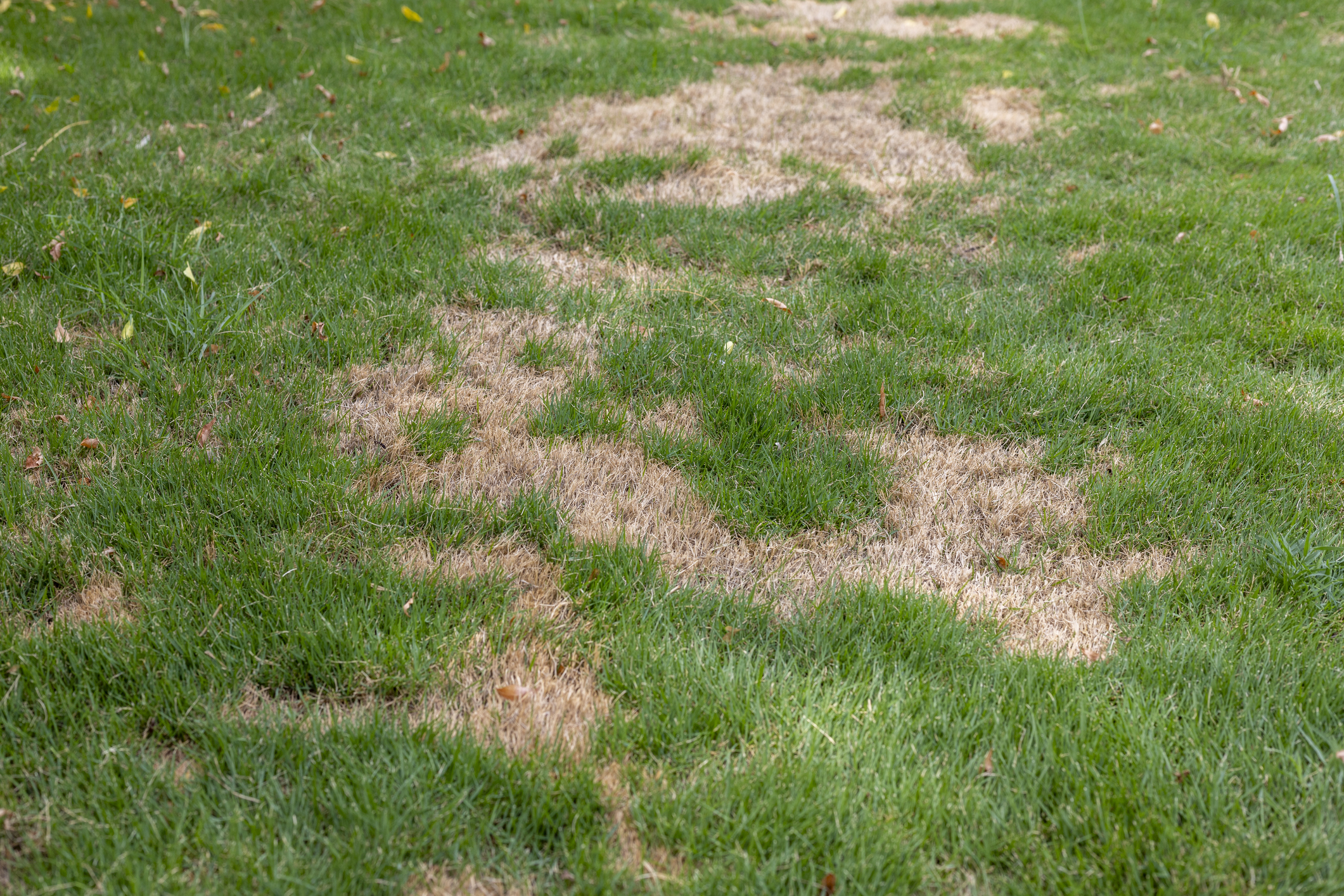
- Increased fungal disease pressure, particularly brown patch
- Tip burn or yellowing streaks if a single application was too concentrated
Too Little Nitrogen
- Slow growth and thin coverage that lets weeds move in
- Pale green or slightly yellow-green color not explained by drought or shade
- General loss of density over time
One important distinction: nitrogen deficiency shows as uniform, overall yellowing or pale green color. Iron deficiency appears as yellowing between the leaf veins while the veins themselves stay green. If your St. Augustine looks pale but you’ve been fertilizing adequately, iron may be the missing piece — not more nitrogen.
Common St. Augustine Nitrogen Mistakes That Damage Your Lawn
These are the specific errors that cause real problems — not general cautions.
- Fertilizing before green-up is complete. Feeding dormant or transitioning grass wastes product and risks pushing weak growth into a late cold snap.
- Using Bermuda grass nitrogen rates. Bermuda tolerates and benefits from aggressive nitrogen. St. Augustine cannot handle the same rates without building excessive thatch.
- Skipping the label math. Applying product by volume or feel — without calculating actual nitrogen delivered — leads to wildly inconsistent results.
- Applying nitrogen in September or October in cooler zones. Late feeding delays dormancy and leaves the lawn more vulnerable to cold damage.
- Treating shaded and sunny areas the same. Full-sun rates applied to heavily shaded sections over-feed those areas every single time.
- Using quick-release nitrogen in summer heat. The faster nitrogen hits the turf, the higher the burn risk. Slow-release granular fertilizers are worth the extra cost for summer applications specifically.
For help applying granular fertilizer evenly and safely — including how to use a broadcast spreader like the Scotts Turf Builder EdgeGuard DLX correctly — see the complete guide on how to apply granular fertilizer without burning your grass.
Conclusion
So how much nitrogen does St. Augustine grass need? The core numbers are straightforward: 2 to 4 lbs of actual nitrogen per 1,000 sq ft per season, with no more than 1 lb per individual application, spaced at least 6 to 8 weeks apart. Feed from spring green-up (once soil temps hit 65°F) through late summer, and stop 6 to 8 weeks before your first expected frost.
The two biggest adjustment factors are shade (reduce your rate by 25 to 30%) and region (warmer zones support higher totals and more applications). Slow-release granular fertilizers reduce burn risk and feed more evenly — they’re worth the extra cost for St. Augustine, especially through the summer months.
If something goes wrong after you fertilize — yellowing, streaking, or unexpected color changes — a soil test is your first step, not more product. Start with the math, respect the application cap, and your St. Augustine will stay dense and green through the season without the problems that come from pushing it too hard.
Frequently Asked Questions
What is the best fertilizer NPK ratio for St. Augustine grass? A ratio like 3-1-2 or similar is commonly recommended for St. Augustine — it reflects the grass’s higher nitrogen demand relative to phosphorus and potassium. Look for a slow-release formulation with those proportions rather than chasing a specific number. Products labeled for southern or warm-season lawns often fit this profile.
Can I fertilize St. Augustine in the fall? Only in the deep South (Zones 9–10) where the growing season extends into October. In cooler zones (7b–8b), stop nitrogen applications 6 to 8 weeks before your first expected frost. Fertilizing too late in fall delays dormancy and increases the risk of cold damage.
How often should I fertilize St. Augustine grass? Most lawns need 2 to 3 applications per season, spaced 6 to 8 weeks apart. In the deep South with a longer growing season, up to 4 applications may be appropriate. Never apply more frequently than every 6 weeks.
Is slow-release or quick-release nitrogen better for St. Augustine? Slow-release is better for St. Augustine in nearly every situation. It reduces burn risk, feeds more evenly over time, and is significantly safer during the summer heat when quick-release nitrogen can scorch turf quickly.
What happens if I over-fertilize St. Augustine grass? Over-fertilizing causes rapid, weak growth, thatch buildup, increased susceptibility to fungal disease like brown patch, and potentially tip burn or streaking. St. Augustine is less forgiving of excess nitrogen than Bermuda grass — the 1 lb per application cap exists for a reason.
Does St. Augustine grass need iron as well as nitrogen? Sometimes. If your lawn looks pale or yellow-green but you’ve been applying adequate nitrogen, iron deficiency may be the cause. Iron deficiency shows as yellowing between the leaf veins with the veins remaining green — distinct from the more uniform pale color of nitrogen deficiency. A soil test will confirm whether iron supplementation is needed.
How do I calculate how much fertilizer to buy for my lawn size? Use the formula: (desired lbs of N ÷ % N on bag) × 100 = lbs of product per 1,000 sq ft. Multiply that by the number of thousands of square feet in your lawn to get the total product needed. The worked example in the rate breakdown section above walks through this step by step.