If you’re standing in your yard looking at brown, patchy grass, you need to know which disease you’re dealing with before you spend money on treatment. Diagnosing a brown patch vs dollar spot lawn problem correctly is the difference between a fix that works and one that makes things worse. These are the two most commonly confused fungal diseases in cool season lawns. They look similar from across the yard. But they behave differently, respond to different conditions, and need different cultural corrections. This article walks you through a confirmed diagnosis before you do anything else.
Disclosure: This article contains affiliate links. If you purchase through these links, I may earn a small commission at no extra cost to you. As an Amazon Associate, I earn from qualifying purchases.
Brown Patch vs. Dollar Spot at a Glance: Key Differences Side by Side
Start here if you want a fast reference. But keep reading — both diseases require confirmation at the blade level, not just by looking at the patch from across the yard.
| Feature | Brown Patch | Dollar Spot |
|---|---|---|
| Patch size | 6 inches to several feet | Silver dollar to softball-sized |
| Grass blade lesion | Water-soaked margins, tan center | Hourglass-shaped, straw-colored, brown border |
| Mycelium visible | Smoke ring at patch edge (morning) | White cottony threads across blades (morning) |
| Peak season | Hot, humid nights (70°F+) | Cooler, humid conditions (60–80°F) |
| Primary trigger | Excess nitrogen + wet foliage | Low nitrogen + heavy dew |
| Grasses most affected | Tall fescue, perennial ryegrass | Fine fescue, Kentucky bluegrass, perennial ryegrass |
If you’re not sure yet, keep reading. Patch size alone is not enough to confirm either disease. The blade-level lesion is the most reliable diagnostic sign for both.
How to Identify Brown Patch in Cool Season Lawns
What to look for from a distance
- Circular to irregular patches ranging from about 6 inches to several feet wide
- Outer edges may appear darker or water-soaked, especially in early morning before the dew burns off
What to look for up close
Get down and look at individual blades inside and at the edge of the patch. This is where the diagnosis gets confirmed.
- Blades show a tan or light brown center lesion with a water-soaked, dark margin — the discoloration crosses the blade, but the defining feature is that dark, irregular border
- At the outer perimeter of the patch, look for a “smoke ring” — a dark, water-soaked band on the grass surface visible only in the morning before dew dries. Not every case shows this clearly, but when present, it is a reliable brown patch indicator
- Pull a few affected blades. They should come out with resistance. If they slip out cleanly from the base, you may be dealing with root rot from a different pathogen — brown patch attacks leaf tissue, not the crown or roots
What brown patch is not
- Brown patch does not leave a clean, symmetrical hourglass mark on individual blades — that is dollar spot
- Large dead patches caused by drought stress will not show blade-level lesions or a smoke ring
Conditions that support this diagnosis
- Nighttime temperatures sustained above 70°F for several consecutive nights
- Humid weather with slow-drying foliage — especially a problem when evenings are still and wet
- A recent heavy application of fast-release nitrogen fertilizer, which produces the lush, soft growth that brown patch fungus (Rhizoctonia solani) thrives in
How to Identify Dollar Spot on Cool Season Lawns
What to look for from a distance
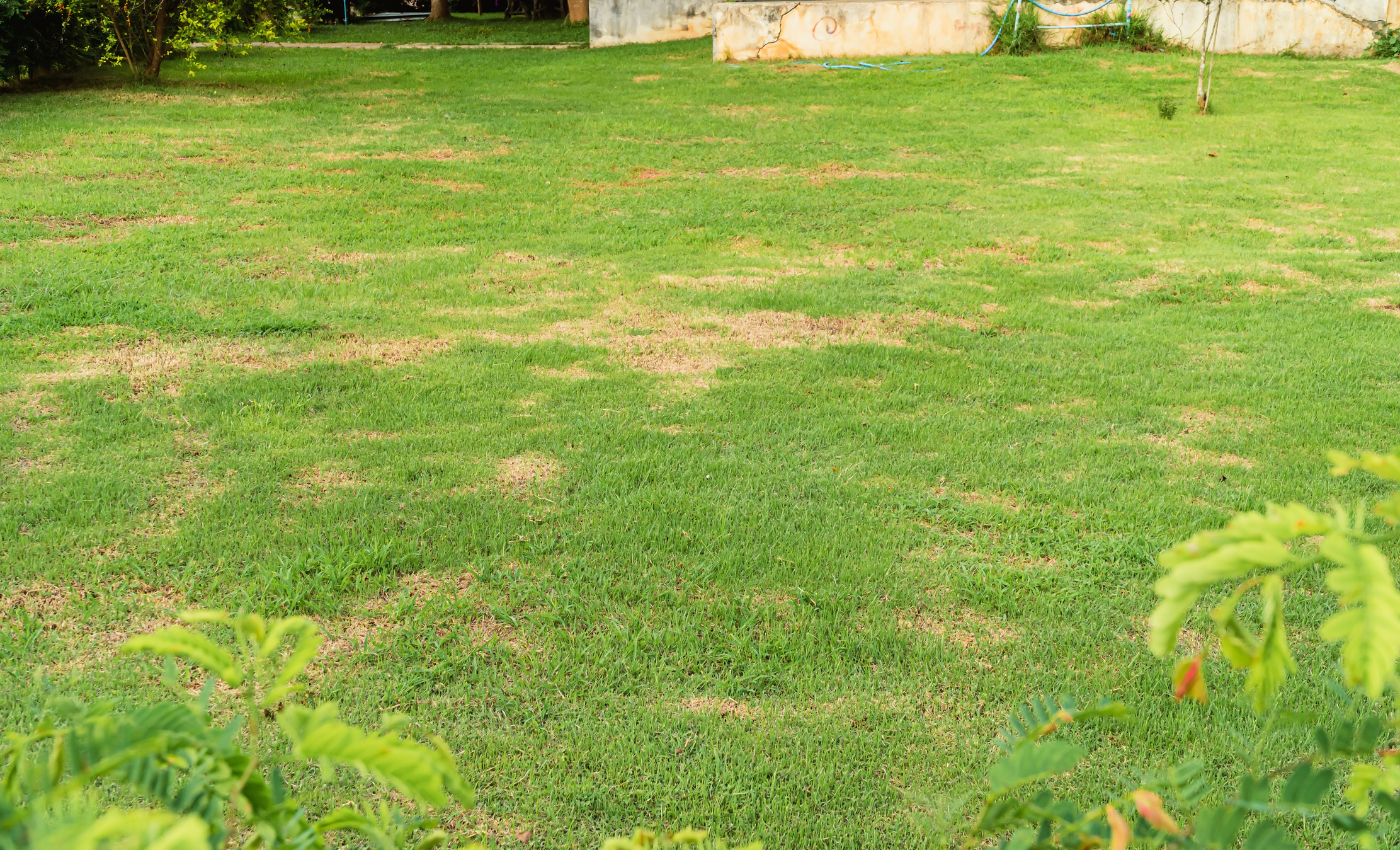
- Small, roughly circular patches — typically silver dollar to softball-sized — that look bleached or straw-colored
- Multiple scattered patches rather than one large, expanding ring
- Individual patches rarely exceed 6 inches in diameter. When numerous, they can merge and look like a single large dead area. That causes many homeowners to mistake them for brown patch
What to look for up close
- The definitive sign is the blade lesion: a bleached, hourglass- or band-shaped area crossing the full width of the blade, with a distinct reddish-brown or tan border on both edges
- The portion of the blade above and below the lesion may still be green — the lesion kills across the blade at a specific point rather than killing tip-down
What dollar spot is not
- Dollar spot does not create one large, expanding circular ring. If your patch is wider than 6 inches and growing outward, suspect brown patch
- The white mycelium in dollar spot is surface-level and delicate. It is not the same as the thick, dense white growth you would see with Pythium blight, which is a different and more aggressive disease
Conditions that support this diagnosis
- Daytime temperatures in the 60–80°F range — dollar spot (Clarireedia jacksonii) is often an early summer or fall disease, not a peak-heat disease
- Heavy dew with poor air circulation across the turf surface
- A lawn that has been under-fertilized or is running nitrogen-deficient — dollar spot actively exploits low-fertility conditions
Conditions That Trigger Each Disease — And Why This Matters Before You Treat
The same weather that drives brown patch can suppress dollar spot — and vice versa. Understanding which conditions are active in your yard right now does two things. It helps confirm your diagnosis. It also tells you which cultural corrections will actually work.
Brown patch triggers
- Heat is the biggest driver. Sustained nighttime temperatures above 70°F is the single strongest predictor of brown patch in cool season grass.
- Evening watering or poor drainage that leaves foliage wet overnight is a direct risk factor. Water sitting on grass blades after dark feeds the disease.
- Excess fast-release nitrogen applied in summer pushes soft, lush growth and feeds the fungus.
Dollar spot triggers
- Heavy dew or morning moisture combined with poor air movement at ground level.
- Low soil nitrogen — this is a counterintuitive trigger. Dollar spot actively exploits nitrogen-deficient turf. A lawn that has been skipping fertilizer is more vulnerable.
Why getting this right matters
Adding nitrogen to “green up” a patchy lawn during brown patch conditions feeds the fungus. Cutting nitrogen to avoid “pushing growth” during a dollar spot outbreak removes one of the best cultural defenses against that disease. The wrong cultural fix does not just fail. It actively worsens the problem you are trying to solve.
Brown Patch vs Dollar Spot Lawn: How to Confirm Your Diagnosis Before You Spray
Do not skip this step. Fungicide applications cost money. Some active ingredients perform better on one disease than the other. A five-minute diagnosis saves a $30–$50 misapplication.
Step 1: Check patch size Patches under 6 inches, multiple and scattered → lean toward dollar spot. Patches larger than 6 inches, circular or expanding outward → lean toward brown patch.
Step 2: Check individual blades Hourglass-shaped bleached band with a brown border crossing the blade → dollar spot confirmed. Tan lesion with a water-soaked, dark margin at the blade edge → brown patch confirmed. If you do not see a clear lesion on individual blades, do not guess yet.
Step 3: Check for mycelium at dawn White, cobweb-like threads lying across the grass surface → dollar spot. A dark, water-soaked ring visible at the outer edge of the patch before dew dries → brown patch smoke ring.
Step 4: Check your weather history Sustained nights above 70°F + high humidity + recent nitrogen application → brown patch. Mild days and nights in the 60s–70s + heavy dew + lawn has been under-fertilized → dollar spot.
Step 5: Rule out non-disease causes If blade-level lesions are absent entirely, consider whether you are dealing with drought stress (no lesions, dry soil confirmed by pushing a screwdriver 6 inches into the ground) or fertilizer burn (striped or patterned damage matching your spreader path). Neither will show mycelium or blade lesions. If symptoms still do not clearly point to one disease after these steps, revisit a broader lawn disease identification resource before applying any fungicide.
Treatment: What Works for Brown Patch vs. Dollar Spot
Brown patch treatment
Stop all nitrogen applications immediately. Fast-release nitrogen feeds the fungus and makes the outbreak worse. This is the single most important cultural step.
Shift watering to early morning only. Grass should be completely dry before nightfall. If you are currently running irrigation in the evening or at night, that schedule is directly contributing to the disease.
Fungicide: Systemic fungicides are the right tool for an active brown patch infection. Look for products containing azoxystrobin, propiconazole, or thiophanate-methyl — all are labeled for brown patch and move through plant tissue rather than just sitting on the surface. A product like Bonide Infuse Systemic Disease Control (propiconazole-based) is a widely available consumer option that covers brown patch effectively. [EDITOR: Please verify this ASIN (B0000DYDHB) is current and that this product is still available before publication.] Most systemic applications require a repeat treatment in 14–21 days to maintain control during active disease pressure.
Do not mow wet grass. Mower blades pick up and spread fungal spores across healthy turf. Mow only when the lawn is dry. Clean your mower deck between passes on diseased areas if possible.
Dollar spot treatment
Apply a light, slow-release nitrogen fertilizer. Unlike brown patch, where nitrogen makes things worse, a modest nitrogen application during dollar spot helps turf recover and resist further infection. Keep the rate low — this corrects a deficiency, it is not heavy feeding. A cool season fertilizer like Andersons Professional PGF Complete 16-4-8 fits well here — it feeds the lawn gradually without pushing the soft, lush growth that invites other diseases. [EDITOR: Verify this ASIN is current and accurately represents a widely available slow-release nitrogen fertilizer before publication.]
Reduce dew and surface moisture. Improve air circulation where possible by trimming back dense plantings at lawn edges. Adjust sprinkler timing so water is applied early enough that foliage is dry by mid-morning.
Fungicide: The same systemic fungicide categories effective on brown patch also work for dollar spot — propiconazole and thiophanate-methyl are both labeled for it. One important note: dollar spot has shown confirmed fungicide resistance in some areas, particularly where the same product class has been used repeatedly. If you have treated for dollar spot before with a DMI fungicide like propiconazole and it is returning in the same spots, rotate to a different mode-of-action class such as azoxystrobin for retreatment.
What not to do for either disease
- Do not apply a generic “lawn fungicide” without checking the label. Not all consumer fungicide products cover both diseases. Confirm the specific disease is listed on the label before purchasing.
- Do not overseed into active disease pressure. New seedlings are highly susceptible to both pathogens and will likely fail.
- Do not dethatch or aerate an actively diseased lawn. Both practices disturb the soil surface and spread fungal material to previously healthy areas.
Prevention: Stop Both Diseases Before They Start
Most brown patch and dollar spot outbreaks in cool season lawns are predictable. The same conditions, the same spots, the same time of year. If a disease has returned to the same area two or more years in a row, treat the underlying conditions — not just the outbreak.
- Water only in early morning. This single habit eliminates one of the biggest controllable risk factors for both diseases.
- Maintain balanced nitrogen levels year-round. Deficiency invites dollar spot. Excess invites brown patch. Use a soil test to guide fertilizer decisions rather than guessing.
- Avoid fast-release nitrogen in summer heat. Switch to slow-release nitrogen during June through August if your lawn is prone to brown patch.
- Improve drainage and air circulation in problem areas. Low spots that stay wet and shaded corners with poor airflow are where outbreaks reliably start.
- Consider a preventive fungicide application if either disease has appeared in the same location for two or more consecutive years. A preventive systemic application made before symptoms appear is significantly more effective than a curative application made after infection is established.
Frequently Asked Questions
Can brown patch and dollar spot appear on the same lawn at the same time?
Yes. It is uncommon but possible, especially during transitional weather in early summer or fall when temperatures fluctuate. Brown patch tends to peak when nights stay above 70°F. Dollar spot is more active when nights cool to the 60s. During a stretch of variable weather, both can be active simultaneously. Confirm each affected area individually at the blade level. Do not assume the same disease is responsible for every patch.
Does dollar spot kill grass permanently or will it recover on its own?
Dollar spot kills individual blades but does not typically destroy the crown or root system. In most cases, affected turf will recover once conditions change and the disease pressure eases. Recovery is faster when you correct the nitrogen deficiency that allowed the disease to take hold. Severe or prolonged outbreaks on fine fescue can cause thin or bare spots that need overseeding once the disease is controlled.
What does the smoke ring on brown patch actually look like — is it always visible?
The smoke ring is a dark, grayish-purple or water-soaked ring at the outer edge of the patch. It appears only in the early morning when dew is still present on the grass. By mid-morning it is usually gone. It is not always visible — thin or mowed-short turf may not show it clearly, and the ring becomes less distinct as the disease progresses. If you miss it, check the individual blade lesions instead. Those are more reliable.
Can I use the same fungicide for both diseases?
Yes. Systemic fungicides containing propiconazole, azoxystrobin, or thiophanate-methyl are labeled for both brown patch and dollar spot. If you are not yet sure which disease you have, a broad-spectrum systemic fungicide that covers both is a reasonable choice while you confirm the diagnosis. One caveat: dollar spot has developed resistance to DMI fungicides like propiconazole in some regions. If you have used propiconazole repeatedly for dollar spot and it keeps returning, rotate to azoxystrobin or a different mode-of-action class.
How long does it take for grass to recover after brown patch or dollar spot treatment?
Recovery time depends on how far the disease progressed before treatment and how quickly the underlying conditions are corrected. With brown patch, new growth from healthy crowns can fill in damaged areas in two to four weeks under good growing conditions. Dollar spot recovery is similar but depends heavily on correcting nitrogen levels. Severely damaged areas may need overseeding once the disease is fully controlled and temperatures are appropriate for germination.
Is dollar spot more common in certain cool season grasses?
Yes. Fine fescue and Kentucky bluegrass are particularly susceptible to dollar spot. Perennial ryegrass is also commonly affected. Tall fescue tends to show more brown patch than dollar spot, though it can develop dollar spot under the right conditions. If your lawn is primarily fine fescue or Kentucky bluegrass and you are seeing small scattered patches in early summer or fall, dollar spot should be your first suspicion.
Why does dollar spot keep coming back to the same spots every year?
Dollar spot recurs in the same spots for two main reasons. First, the fungus (Clarireedia jacksonii) can persist in soil and thatch between seasons. Second, the conditions that favor it — low nitrogen, poor air circulation, heavy dew — tend to be consistent from year to year in the same areas. Shaded corners, low spots with poor drainage, and sections of lawn that consistently miss fertilizer applications are the usual repeat sites. Correcting the cultural conditions is more important than fungicide alone for breaking the cycle.
Summary
Correctly diagnosing a brown patch vs dollar spot lawn problem saves money and prevents you from making the disease worse. Here is what to remember:
- Hourglass lesion on the blade = dollar spot. Dark-bordered tan lesion = brown patch.
- Dollar spot needs a light nitrogen correction and dew reduction. Brown patch needs nitrogen stopped and watering shifted to morning.
- Both respond to systemic fungicides, but apply the right cultural fix alongside — fungicide alone will not prevent recurrence.
- If symptoms do not clearly match either disease at the blade level, confirm before you spray.