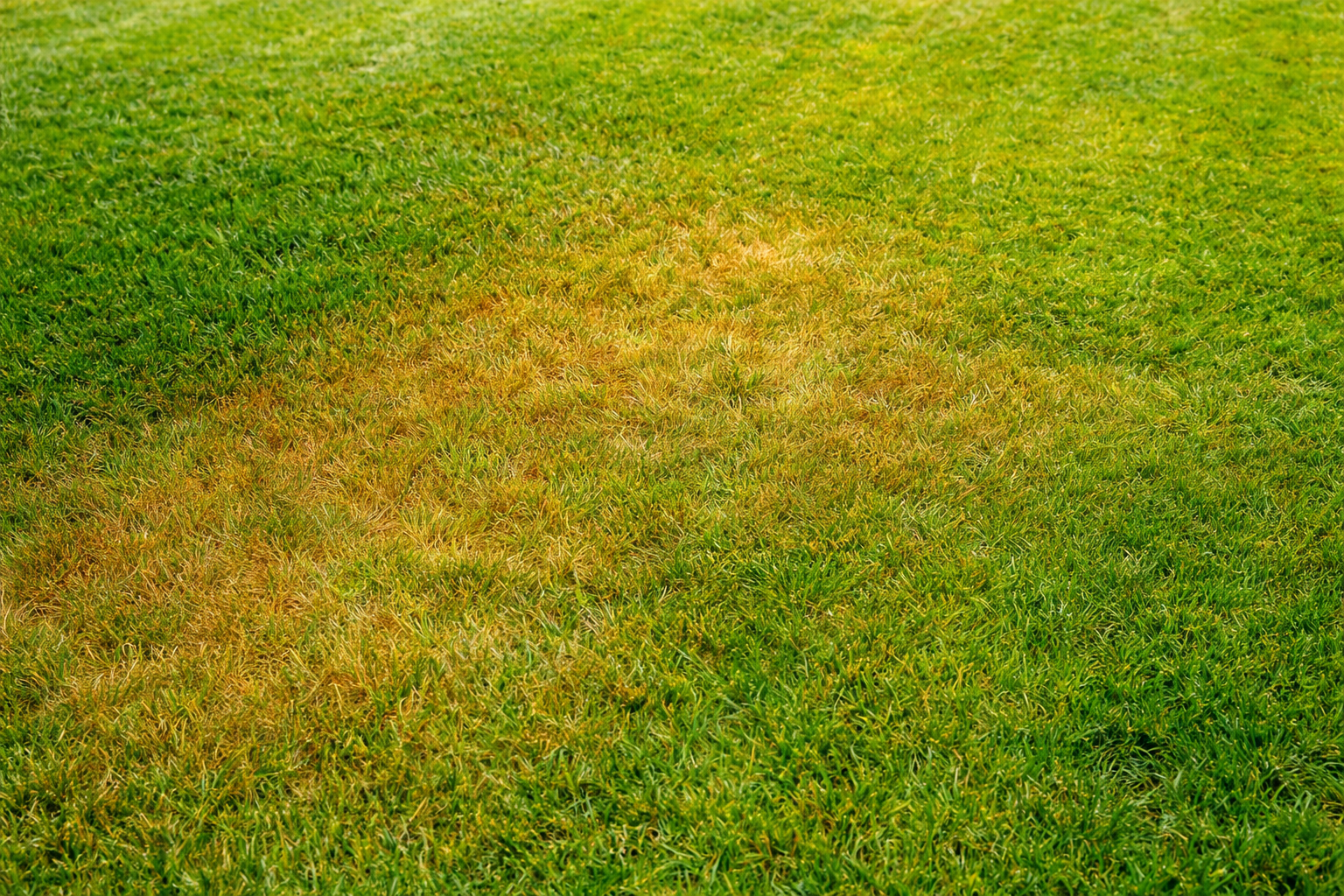
If your centipede grass turning yellow in spring has you searching for answers, start here. This is one of the most common complaints from Southern homeowners — and one of the most misdiagnosed. The yellowing almost always signals a nutrient uptake problem, not a watering issue or a disease. Understanding that distinction is what separates a quick fix from a problem that gets worse every season.
Before doing anything, identify which pattern you’re seeing:
- Uniform yellowing across the whole lawn → systemic cause (iron deficiency, soil pH, fertilizer)
- Patchy, streaky, or irregular yellowing → localized cause (overwatering, compaction, thatch)
The fix depends entirely on the cause. The most common mistake homeowners make is reaching for a bag of fertilizer the moment they see yellow grass. On centipede, that often makes things significantly worse.
Centipede Grass Iron Deficiency: The Most Common Cause of Spring Yellowing
Centipede grass iron deficiency is the leading cause of centipede grass turning yellow in spring, and it has a specific look. You’ll see a pale yellow-green color appearing first on new growth. Older grass blades stay comparatively greener. If the newest growth looks washed out while the older parts of the turf look normal, iron deficiency is the most likely culprit.
Centipede has higher iron requirements than most warm-season grasses. Two things trigger iron deficiency in spring specifically:
- Cool soil temperatures — After dormancy, soil is still cold. Even when iron is present in the soil, roots can’t absorb it efficiently until temperatures warm up consistently.
- High soil pH — When soil pH climbs above 6.5, iron becomes chemically unavailable to roots. This happens even if iron is physically present in the soil.
How to Diagnose Iron Deficiency
Check the timing and pattern. If yellowing shows up right after green-up and tracks with new growth rather than older turf, iron deficiency is the likely cause. If it’s uniform and widespread with no recent lime or fertilizer history, this is where to start.
How to Fix It
Two product types to look for:
- Chelated iron — absorbs faster and won’t stain concrete or pavement when applied correctly; this is the preferred option for most homeowners
- Iron sulfate — less expensive but can stain hard surfaces if overspray occurs; rinse surfaces immediately after application
Both are widely available at hardware stores and online. Look for “chelated iron” on the label and follow the dilution rate carefully. More is not better with iron applications.
What Not to Do
Do not apply nitrogen fertilizer to fix iron-related yellowing. Nitrogen pushes top growth that the iron-deficient plant can’t sustain. That adds stress rather than solving the problem.
Centipede Grass Spring Yellowing Causes: Wrong Fertilizer Choices
Centipede is a low-input grass. It grows slowly and doesn’t need the nutrient load that bermuda or St. Augustine requires. When it gets too much — especially too much nitrogen or phosphorus — it reacts badly.
Too much nitrogen triggers a flush of top growth the root system can’t support. The grass looks lush briefly, then yellows and weakens. Repeated over-fertilization leads to centipede decline. That’s a condition where the grass thins out and loses vigor over time.
High-phosphorus fertilizers interfere with iron and zinc uptake in centipede. Many general-purpose lawn fertilizers are high in phosphorus. They’re designed for bermuda or fescue — not centipede.
How to Diagnose Fertilizer-Related Yellowing
If yellowing started within a few weeks of a fertilizer application, look at what you applied. A product labeled for “all grasses” or formulated for bermuda may be the problem. Check the N-P-K ratio on the bag. The P (phosphorus) number should be low or zero for centipede.
What to Use Instead
Switch to a fertilizer formulated specifically for centipede grass. Or choose a product with a ratio like 15-0-15 or similar — low nitrogen, zero to low phosphorus, with potassium and ideally added iron. Centipede-specific fertilizers exist as a category at most garden centers and account for the grass’s unusual nutritional needs.
What Not to Do
Do not apply another round of fertilizer to “correct” fertilizer-related yellowing. That compounds the problem. Wait until the grass stabilizes before the next application.
Soil pH Problems and Why Centipede Grass Turns Yellow in Spring
Centipede grass has a narrower pH preference than almost any other common lawn grass. Its ideal range is 5.0 to 6.0. Most other grasses do well from 6.0 to 7.0 — which is exactly where centipede starts to struggle.
When soil pH climbs above 6.5, multiple nutrients become locked out of the root zone. Iron and manganese are especially affected. The nutrients are in the soil, but the grass can’t use them. The result looks like nutrient deficiency — because it functionally is one, even on a well-fed lawn.
The common mistake: homeowners receive a generic soil test recommendation to add lime and apply it without knowing centipede’s specific pH target. The pH goes too high. The yellowing that follows the next spring often gets blamed on something else entirely.
How to Diagnose pH-Related Yellowing
If you applied lime in the past 6 to 18 months and are now seeing widespread, uniform yellowing, high soil pH is a strong suspect. Get a soil test to confirm before taking any corrective action. A basic soil test from a county cooperative extension office or a mail-in lab typically costs under $20 — and it’s the only reliable way to know where your pH actually stands.
How to Fix It
If a soil test confirms pH above 6.5, apply elemental sulfur to bring it down. Sulfur-based amendments lower pH gradually. Expect the process to take months, not weeks. Use foliar iron applications in the short term to address the visual yellowing while pH correction works in the background.
What Not to Do
Do not add more lime to centipede grass without a soil test. Do not guess at pH — it’s invisible, and the consequences of getting it wrong compound over multiple seasons.
Overwatering, Compaction, and Other Spring Causes of Centipede Grass Yellowing
Not all centipede grass spring yellowing is a nutrient problem. Localized causes — patchy or irregular patterns — often point to physical issues in the lawn.
Overwatering in early spring keeps soil cold longer and creates low-oxygen conditions. Roots in waterlogged soil can’t absorb nutrients efficiently. This is true even when soil chemistry is correct. The grass turns yellow not because nutrients are missing, but because root function is impaired.
Thatch buildup creates a physical barrier between the soil surface and the root zone. When thatch exceeds about ½ inch, fertilizers and amendments applied on top don’t reach where they’re needed. Centipede is prone to thatch accumulation.
Soil compaction from winter foot traffic or equipment restricts root growth. It limits the grass’s ability to take up water and nutrients.
How to Diagnose Localized Yellowing
Look at where the yellow areas are. Do they match low spots or areas that stay wet? High-traffic areas? Patches of dense turf where thatch might have built up? If the pattern matches any of these, physical causes are likely contributing.
How to Fix It
- Overwatering: Reduce irrigation frequency immediately. In early spring, centipede needs far less water than most homeowners assume. Let the soil dry between watering cycles.
- Compaction: Core aeration opens the soil and restores root function. Spring is not the ideal time for aggressive aeration on centipede, but light aeration is better than none.
- Thatch: If buildup exceeds ½ inch, dethatching is warranted. Vertical mowing or power raking are the two main mechanical approaches for thatch removal on warm-season grasses, and the right choice depends on the severity of the buildup.
What Not to Do
Do not increase watering when centipede looks stressed in spring. This is a natural instinct — grass looks bad, so add water — but on centipede in cool spring soil, more water usually makes things worse.
How to Diagnose and Fix Centipede Grass Turning Yellow in Spring: Step by Step
If you’re asking why is my centipede grass yellow every spring, the answer usually falls into one of four categories. Work through these steps in order before applying any product or amendment.
Step 1: Observe the pattern
- Uniform yellowing across the whole lawn → systemic cause (iron, pH, fertilizer)
- Patchy or irregular yellowing → localized cause (overwatering, compaction, thatch)
Step 2: Review your recent inputs
- Applied lime in the past 1–2 seasons? pH may be too high.
- Applied fertilizer recently? Check the nitrogen rate and the N-P-K ratio.
- No inputs at all? Iron deficiency or cold soil slow green-up is most likely. If you haven’t fed the lawn in a while, a slow-release fertilizer can provide a gentle, sustained nutrient supply without the risk of pushing excessive top growth.
Step 3: Get a soil test if pH is in question Request centipede-specific recommendations if available. Or note that the target pH for centipede is 5.0–6.0 — different from the 6.0–6.5 range most general recommendations assume.
Step 4: Apply foliar iron for fast visual improvement Chelated iron works within days on iron deficiency. If color improves noticeably within a week, the diagnosis is confirmed. Keep in mind this addresses the symptom — not the underlying cause if pH is the root issue.
Step 5: Correct the root cause
- High pH → apply elemental sulfur per soil test guidance; retest in 6 months
- Wrong fertilizer → switch to a centipede-appropriate product at the next application window
- Overwatering → cut irrigation frequency; centipede in spring runs on less water than summer schedules
Step 6: Monitor and follow up Don’t expect overnight results on pH or structural corrections. Foliar iron buys time visually while longer-term fixes take hold. Use the monthly lawn care calendar to stay on track with spring centipede timing and avoid letting one problem carry into the next season.
Prevention: How to Avoid Centipede Grass Turning Yellow in Spring Next Year
Most centipede spring yellowing problems are preventable. The inputs and decisions made in fall and winter determine a lot of what happens at green-up.
- Test your soil every 2–3 years. Never apply lime to centipede without a current test in hand.
- Use centipede-appropriate fertilizer. Avoid high-nitrogen or high-phosphorus products. Stick to formulations designed for centipede’s low-input nature.
- Apply chelated iron in late spring after green-up if iron deficiency recurs annually. Preventive foliar iron is easier than chasing yellowing after it appears.
- Avoid overwatering in early spring. Centipede comes out of dormancy slowly. Match your irrigation schedule to actual soil conditions, not calendar habits.
- Keep thatch under control. Address buildup before it reaches ½ inch. Once thatch becomes a barrier, it amplifies every other problem on the lawn.
- Watch your fall inputs carefully. Lime applied in fall — especially at rates intended for bermuda or fescue — shows up as spring yellowing in centipede. Heavy fall fertilization can carry over too. Using a fall lawn fertilizer formulated for your grass type helps avoid the pH and nutrient imbalances that show up as spring yellowing. What you put down before dormancy follows the grass into spring.
Frequently Asked Questions
Why does my centipede grass turn yellow every spring even after I fertilize?
Fertilizing is often the wrong move on centipede. If you’re seeing centipede grass turning yellow in spring right after fertilization, the product or rate is likely the problem, not the solution. Centipede doesn’t need much nitrogen. High-nitrogen or high-phosphorus fertilizers cause yellowing by pushing top growth the plant can’t support and blocking iron uptake. Switch to a centipede-specific fertilizer with a ratio like 15-0-15 and added iron.
Can I use the same fertilizer on centipede and bermuda grass?
No. Bermuda grass is a high-nitrogen grass that responds well to aggressive feeding. Centipede grass yellowing causes are often rooted in too much nitrogen — not too little. Applying bermuda-formulated fertilizer to centipede will typically make yellowing worse over time and can contribute to centipede decline.
How fast will chelated iron fix yellow centipede grass?
Chelated iron works quickly. Most homeowners see visible color improvement within 3 to 7 days of a foliar application. If color does not improve within 10 days, the underlying cause is likely soil pH rather than simple iron deficiency. Foliar iron cannot overcome nutrient lockout caused by high pH on its own.
What soil pH should centipede grass be?
Centipede grass performs best at a soil pH between 5.0 and 6.0. This is lower than most other lawn grasses. Above 6.5, iron and manganese become chemically unavailable, which leads directly to yellowing. Never lime centipede grass without a current soil test confirming that pH correction is needed and what rate is appropriate.
Is yellowing in centipede grass a sign of disease?
Occasionally, but it’s not the first thing to suspect. Most centipede grass spring yellowing causes are nutritional or physical — iron deficiency, high pH, wrong fertilizer, overwatering, or compaction. Disease-related yellowing tends to appear in irregular patches with distinct margins and may include wilting or discoloration patterns not associated with new growth. If foliar iron and basic cultural corrections don’t improve the lawn within a few weeks, consult your local cooperative extension office.
Should I water more if my centipede grass is turning yellow in spring?
No. More water is one of the most common mistakes on centipede in spring. Overwatering keeps soil cold, reduces oxygen in the root zone, and impairs nutrient uptake. The grass looks stressed and homeowners add water — which extends the problem. Reduce irrigation frequency and let the soil dry between cycles until temperatures warm consistently.
Can I add lime to centipede grass if my soil test recommends it?
Only if the recommendation is calibrated for centipede’s target pH range of 5.0–6.0. Generic soil test recommendations are often written for grasses that prefer 6.0–6.5 or higher. If you apply lime at those rates to centipede, you’ll raise pH too high and trigger the exact nutrient lockout that causes spring yellowing. Always note to the lab — or account for it yourself — that the lawn is centipede grass with a target pH no higher than 6.0.
Summary
Centipede grass turning yellow in spring almost always comes down to one of four causes: iron deficiency, wrong or excessive fertilizer, soil pH that’s too high, or physical problems like overwatering and compaction. The pattern of the yellowing — uniform vs. patchy — is your first diagnostic signal. From there, your recent input history narrows it down quickly.
Resist the instinct to fertilize or water more when centipede looks bad in spring. On this grass, those are the moves most likely to extend the problem. A $15 soil test and a bottle of chelated iron will solve most cases faster than any bag of all-purpose fertilizer.
Subscribe to our Newsletter for Weekly updates!