Most homeowners see something wrong with their lawn and immediately reach for a product. That’s how you end up spending $40 on fungicide for a problem caused by soil compaction, or reseeding bare spots that will die again because the underlying cause hasn’t changed. If you’re asking “what is wrong with my lawn,” the most useful thing you can do first is diagnose before you treat. This guide gives you a repeatable framework for reading your lawn accurately — so whatever you do next actually works.
How to Figure Out What Is Wrong With Your Lawn Before You Treat Anything
The same visible symptom — brown patches, thinning grass, yellowing blades — can have five completely different causes. Brown grass might mean drought stress, fungal disease, grub damage, fertilizer burn, or dog urine spots. Treating for the wrong cause wastes money at best and accelerates the damage at worst.
Before you buy or apply anything, run through three questions:
- Where is the damage? Pattern is the most useful clue. Is the damage isolated to one spot, spread evenly across the whole lawn, concentrated near edges, or clustered under trees? Location tells you a lot about origin.
- When did it appear? Sudden onset (damage appeared over a few days) points toward an acute cause — pest activity, fertilizer burn, or disease outbreak. Gradual decline over weeks or months is more likely a cultural issue like compaction, shade increase, or chronic underwatering.
- What recently changed? Think back two to four weeks. New fertilizer application? Change in mowing height? Extended dry spell or heavy rainfall? New foot traffic pattern? Most lawn problems have a triggering event — finding it shortcuts the diagnosis.
Tools worth having before you start: A simple soil test kit removes the guesswork on pH and nutrient levels, which are behind more lawn problems than most homeowners realize. A screwdriver or soil probe helps you check compaction and moisture depth. Neither costs much, and both save you from misreading symptoms that look like one problem but stem from another.
What Is Wrong With My Lawn? The Most Common Causes by Symptom
This section organizes problems by what you see — because that’s how diagnosis actually works. Start with the visible symptom, then narrow it down.
Brown or Tan Patches
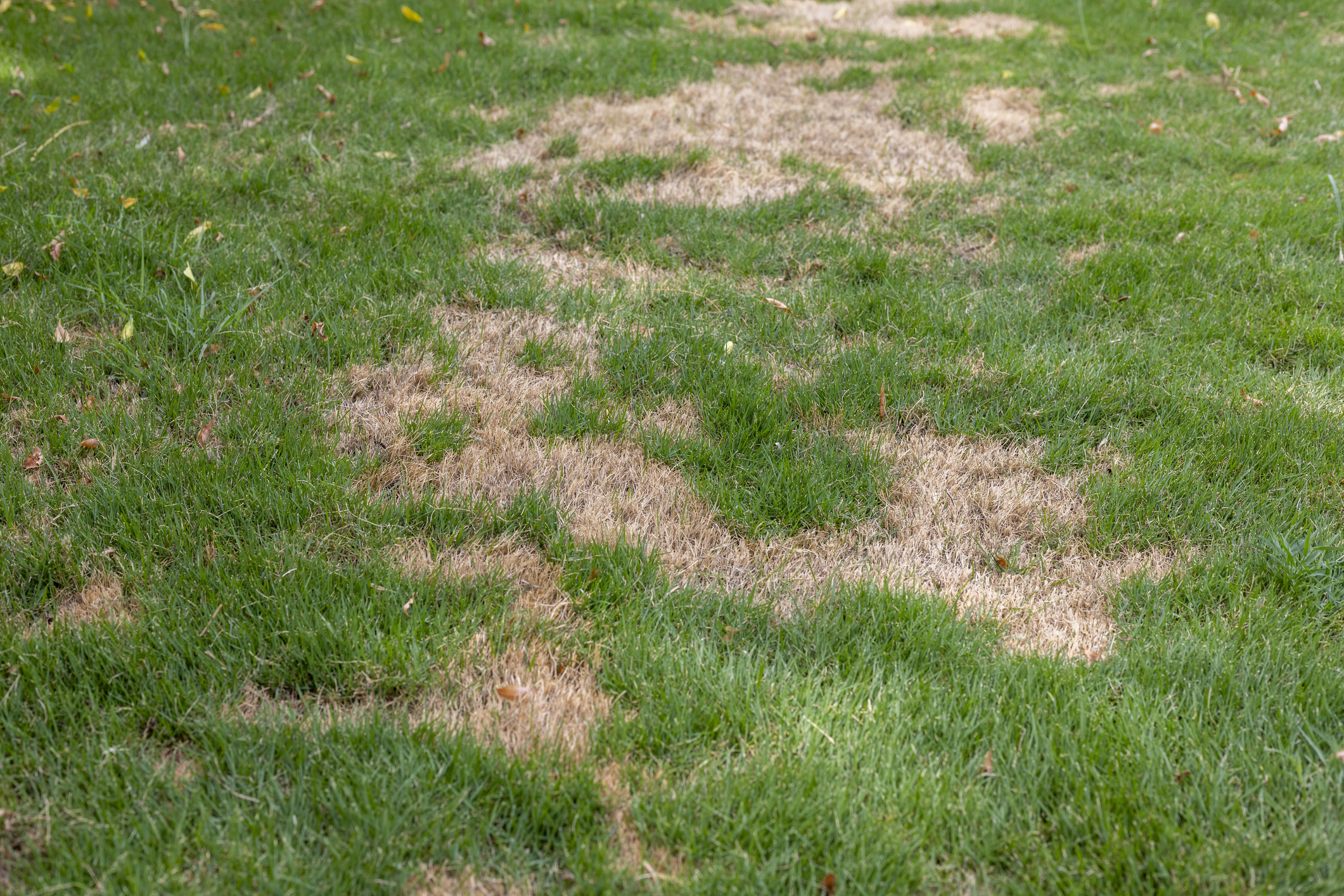
Heat or drought stress shows up as uniform browning, especially in open sunny areas. The grass goes tan and dormant but typically recovers when water returns.
Fungal disease produces irregular patches, often with a defined border, a darker ring at the margin, or a bleached center. The pattern is usually circular or semi-circular. It doesn’t recover with watering.
Grub damage creates patches that feel spongy and pull up easily from the soil — almost like lifting a loose carpet. The grass detaches because grubs have eaten the root system below.
Fertilizer burn produces crispy, straw-colored patches that appear within a few days of a fertilizer application. The affected area usually has a clear boundary corresponding to where product was applied.
Dog urine spots are small, circular brown patches with a ring of darker green grass at the outer edge. That green ring is caused by diluted nitrogen acting as fertilizer before becoming concentrated enough to burn.
Yellow Grass
Nitrogen deficiency causes general pale yellowing, starting on older blades first. The lawn looks washed out rather than spotted. It typically improves quickly after a balanced fertilizer application.
Overwatering or poor drainage produces yellowing with soft, soggy soil underneath. Roots suffocate in saturated soil, which limits nutrient uptake even when nutrients are present.
Iron chlorosis shows as yellowing between the leaf veins while the midribs stay green. It’s common on alkaline soils (high pH) because iron becomes unavailable to grass roots above a certain pH threshold.
Scalping or dull mower blades cause the tips of grass blades to turn yellow or white after mowing. The cut is ragged rather than clean, which stresses individual blades and makes the lawn look pale overall.
Bare Spots or Thinning Areas
Compaction creates bare zones in high-traffic areas — paths where kids cut across the yard, spots near gates, or anywhere foot traffic is concentrated. Compressed soil restricts root growth and water infiltration.
Shade increase is a gradual cause that homeowners often miss. As trees mature and canopies expand, grass that once thrived starts thinning. The change happens over multiple seasons.
Thatch buildup (a layer of dead organic material between the soil surface and living grass) blocks water, air, and seed contact with soil. Germination fails even when you overseed.
Herbicide overspray can kill grass in irregular patches that don’t follow any natural pattern. Check whether any weed control was applied recently in or near the affected area.
Spongy or Uneven Texture
Thatch accumulation makes the lawn feel springy underfoot, especially after rain. If the spongy layer is more than half an inch thick, it’s thick enough to cause problems.
Mole or vole tunneling creates raised ridges or soft depressions across the surface. You can often feel the tunnels collapse slightly underfoot.
Grub activity softens the lawn from below. The turf feels loose and may roll or lift because the root system holding it in place has been compromised.
Lawn Disease vs. Pest Damage vs. Cultural Problems: How to Tell the Difference
This is the most important conceptual distinction in lawn diagnosis. Most homeowners conflate these three categories, which is why misdiagnosis is so common. Understanding which category your lawn problem falls into is a critical step in figuring out what is wrong with your lawn and what to do about it.
Cultural problems are caused by how you’re managing the lawn — mowing height, watering frequency, fertilizer timing, or traffic patterns. They’re the most common cause of lawn decline and the most fixable. No product required in most cases. Just change the practice.
Pest damage is caused by insects (grubs, chinch bugs, sod webworms) or animals (moles, voles). It shows physical disruption — tunneling, turf lifting, irregular feeding damage. Pest problems have a biological source you need to identify before treating.
Disease is caused by fungal pathogens. Fungal issues typically emerge in hot, humid conditions or after overwatering. They have characteristic patterns: circular patches, defined rings, or distinct color changes at the margin. They don’t respond to water or fertilizer — and adding fertilizer can actually accelerate some fungal diseases.
Quick Identification Tests
The tug test: Pull a handful of grass at the affected edge. If it lifts easily with roots still attached, suspect grub or billbug damage below the surface. Healthy grass anchors firmly to the soil.
The moisture test: Push a screwdriver six inches into the soil. If it won’t penetrate, compaction is a factor. If the soil is saturated and the grass is yellowing, drainage is the issue. If it goes in easily and the soil is reasonably moist, look elsewhere for the cause.
The blade inspection: Pull a few individual blades in good light. A powdery or dusty coating on the blade surface suggests fungal activity. Clean blades that are pale or yellowing point toward a nutrient issue. Blades with brown tips but otherwise clean cuts may indicate a mowing problem.
Reading the Pattern: What Brown Patches, Yellow Grass, and Bare Spots Are Telling You
The pattern of damage is just as diagnostic as the color or texture. Same symptom, different distribution — different cause. When you’re trying to understand what is wrong with your lawn, the spatial pattern is often the single most useful piece of information you have.
- Uniform damage across the whole lawn usually points to a cultural issue: a watering problem, improper fertilizer application, or mowing stress. Something you’re doing (or not doing) is affecting the entire surface evenly.
- Damage only in low spots indicates a drainage problem. In warm, humid months, standing water in low areas also creates ideal conditions for fungal disease.
- Damage along edges or near hardscape (driveways, sidewalks, retaining walls) suggests reflected heat, herbicide runoff from adjacent areas, or compaction from foot traffic near hard surfaces.
- Circular or ring-shaped patches are the classic fungal disease signature. Dollar spot, brown patch, and fairy ring all produce circular or ring-shaped damage patterns. These don’t resolve with watering.
- Random irregular patches with no clear pattern often point to pest activity — chinch bugs, grubs feeding unevenly below the surface, or animal digging.
One thing worth knowing: lawn diseases are more common than most homeowners expect, and early-stage fungal damage looks almost identical to drought stress. If brown areas don’t recover within a week of adequate watering, fungal disease moves up the list. For confirmed fungal problems, a broad-spectrum fungicide can stop the spread — look for labels that list the specific pathogen (such as Rhizoctonia for brown patch) rather than reaching for a generic product.
Step-by-Step Lawn Diagnosis Checklist You Can Use This Weekend
Set aside 30 to 45 minutes on a dry morning when you can see the lawn clearly. Work through these steps in order. This is a practical method for answering the question “what is wrong with my lawn” without guesswork.
1. Walk the full lawn in good light. Cover the entire area and note where symptoms are, how large each affected zone is, and whether the pattern is circular, edge-related, or random. Take photos. You’ll refer back to them.
2. Check soil moisture at multiple points. Use a screwdriver or your finger to probe affected areas and healthy areas separately. You’re looking for whether the problem zone is drier, wetter, or the same as the rest of the lawn. Unexpected differences are significant.
3. Pull a few plugs in affected areas. Push a spade or trowel about three inches into the soil at the edge of a damaged zone and lift a small plug. Look at root depth and color — white roots are healthy, brown or absent roots mean something is wrong below the surface. Check the pulled plug for grubs (white C-shaped larvae).
4. Examine individual grass blades. Look for spots, lesions, powdery coatings, or discoloration patterns on the blade itself. Disease often shows at the blade level before it’s obvious from a standing view.
5. Review your recent care history. Run through the last three weeks: last mow date and height, last watering schedule, any fertilizer or weed control applications. If you’re unsure what your timing should look like, the fertilizer release type selection for warm season grass guide can help you assess whether recent applications were appropriately timed and formulated. Most acute problems connect to something that happened in this window.
6. Run a soil test if the cause is still unclear. A basic soil test gives you pH, nitrogen, phosphorus, and potassium levels — the four variables that explain a large proportion of unexplained lawn decline. Results typically come back in one to two weeks for mail-in kits, or same-day for home test strips. If your diagnosis points toward a deeper problem — widespread thinning, multiple failing areas, or poor soil structure — that’s when repair moves beyond spot treatment. See lawn renovation from a failing baseline for guidance on what to do when the diagnosis reveals a more serious situation.
When to Treat It Yourself and When to Call a Pro
Most lawn problems are DIY-fixable once correctly diagnosed. But not all of them are.
Treat it yourself when:
- The cause is clearly cultural — a mowing, watering, or fertilizer issue
- The affected area covers less than 25% of the total lawn
- You have a clear, single identifiable cause
Consider professional help when:
- Disease or pest infestation covers more than 30–40% of the lawn
- Multiple problems are present at the same time (for example, active disease plus grub damage plus compaction)
- You’ve applied the appropriate treatment twice and seen no improvement
- You suspect severe grub infestation, plant-parasitic nematodes, or a systemic problem that requires a licensed pesticide application
One underused resource: your state’s cooperative extension office. Most offer free or low-cost lawn diagnosis services, either by mail sample or in-person. These are university-based programs staffed by agronomists who can confirm disease or pest identification — no brand affiliation, no sales pressure. Search “[your state] cooperative extension lawn diagnosis” to find the program in your area.
If your diagnosis reveals damage serious enough to require full renovation, start with lawn renovation from a failing baseline before investing in seed or sod. Getting the sequence right matters more than acting fast.
Conclusion
Effective lawn diagnosis comes down to three things: observe the pattern, identify the cause category (cultural, pest, or disease), and match your response to the actual problem. Most lawn issues are fixable — but treating the wrong cause at best wastes time and money, and at worst makes the underlying problem harder to correct.
If this diagnosis process reveals that your lawn has widespread damage rather than isolated problems, the next step is assessing whether it needs renovation rather than repair. Timing matters significantly at that stage — if your lawn is warm-season grass, the warm season lawn care schedule by growth phase will tell you the right window to treat and reseed. For cool-season lawns, use the cool season lawn care schedule by month to time your recovery work correctly — most repair efforts fail simply because they happen at the wrong point in the growing cycle. If you’re unsure what type of grass you have, the Complete Guide to Cool Season Grasses (Fescue, Bluegrass, Rye) can help you identify your turf before moving forward.
Start with observation. The lawn is telling you something specific — you just need to know how to read it.