If your lawn is yellow after fertilizing, the most likely cause is fertilizer burn. The fix depends on exactly what went wrong during application. This guide walks you through a step-by-step diagnosis before any fixes, so you’re not treating the wrong problem. Getting the diagnosis right first is what separates a lawn that recovers in two weeks from one that needs reseeding.
Disclosure: This article contains affiliate links. If you purchase through these links, I may earn a small commission at no extra cost to you. As an Amazon Associate, I earn from qualifying purchases.
Why Fertilizer Turns Grass Yellow Instead of Green
When fertilizer is applied in excess or isn’t watered into the soil, the salt concentration around the grass roots spikes. Through osmosis, that high-salt environment pulls moisture out of the root cells. The grass dehydrates from the outside in. That’s fertilizer burn.
It is not a disease. It is not a pest problem. And watering alone won’t always reverse it. The outcome depends on how severe the damage is and how quickly you respond.
There are two distinct causes. They require slightly different responses:
- Too much fertilizer applied at once — excess nitrogen overwhelms the grass, even if the product was watered in correctly
- Fertilizer not watered in — granules or liquid residue sitting on dry blades or dry soil, concentrating salts at the surface
These two causes can look nearly identical. But the patterns on your lawn tell different stories. The next section shows how to read them.
Work through this sequence before doing anything else. Applying more water or product before you know what’s wrong can make things worse.
Step 1 — Check the Timing
Did yellowing appear within 1–3 days of fertilizing? Fertilizer burn moves fast. If yellowing took two weeks or longer to develop after application, something else is likely driving it. Scroll to the next section.
Step 2 — Look at the Pattern
The shape of the yellowing is one of the most useful clues:
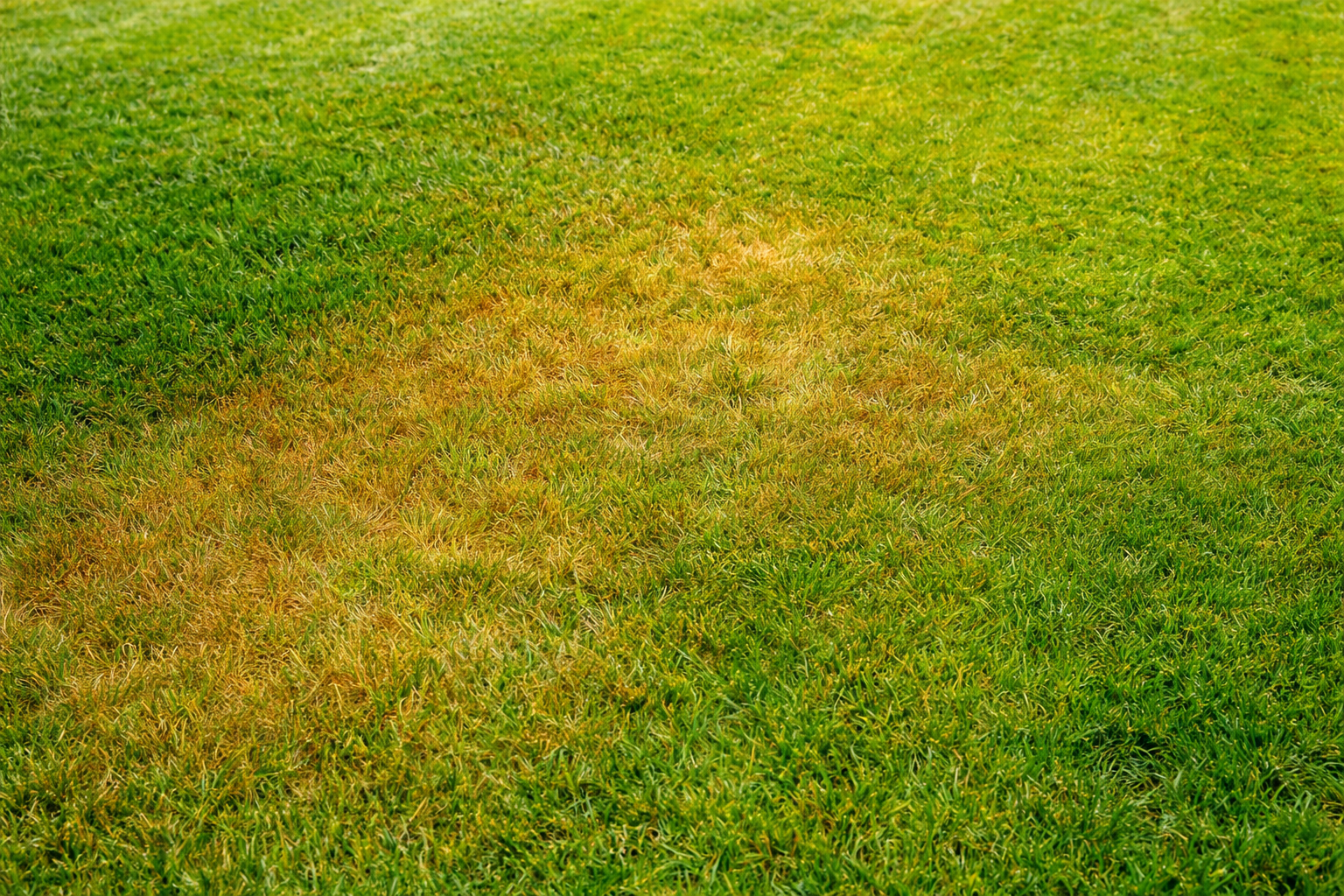
- Streaky or striped yellow patches that follow the path of your spreader usually point to application overlap. A stuck spreader wheel or a double-pass concentrates the product.
- Uniform yellowing across the whole lawn suggests you over-applied to the entire area, not just one zone.
- Random irregular patches are less typical of burn. They’re more consistent with disease or pest activity.
Step 3 — Check Shaded Areas
Shaded areas grow more slowly. They typically receive less fertilizer contact stress. If your shaded lawn sections look fine while sun-exposed areas are yellow, that pattern strongly supports fertilizer burn.
Step 4 — Examine Individual Blades
Pull up a few yellow blades and look at where the color starts:
- Yellow or tan from the tip downward, with a still-green base = classic fertilizer burn (tip burn)
- Yellow from the base up, or uniformly dull and pale = potentially something else — nutrient deficiency or disease is more likely
Step 5 — Recall Whether You Watered After Applying
- Applied granular fertilizer and didn’t water within 24 hours, and no rain fell? Dehydration burn is the likely culprit.
- Watered right away but still seeing a lawn yellow after fertilizing? Check your application rate against the bag’s directions — you may have over-applied.
Other Reasons Your Lawn Is Yellow After Fertilizing (That Aren’t Burn)
Yellow grass after fertilizing doesn’t always mean burn. Several other conditions can produce the same symptom. Misdiagnosing this leads to wasted effort and sometimes more damage.
Iron or Micronutrient Lockout
High-nitrogen fertilizers can temporarily block iron uptake. This is especially common in soils with a pH above 7.0. The lawn looks pale yellow-green or washed out — not scorched or streaky. If you used a high-nitrogen product and your soil is alkaline, this is worth investigating. A soil test from your local extension office or a home test kit can confirm it.
Lawn Was Already Stressed Before Fertilizing
Fertilizing drought-stressed, dormant, or disease-weakened grass often triggers yellowing. Grass that is already struggling cannot process nutrients efficiently. If you applied during extreme heat (above 85–90°F), during a dry stretch, or over grass already showing signs of stress, the fertilizer compounded a problem that already existed. This is one of the most common reasons a lawn is yellow after fertilizing — even when the application rate was correct.
Watering Disruption After Fertilizing
Heavy rain immediately after application can flush nutrients before the grass absorbs them. That removes the expected green response. Alternatively, the lawn going dry too soon after application disrupts uptake. Either scenario can leave you with a lawn that looks worse after fertilizing than before.
Dormancy Misread as Yellowing
If you fertilized a warm-season lawn in late fall, or cool-season grass heading into summer dormancy, the lawn was going to yellow regardless. The fertilizer didn’t cause it — the timing was coincidental. Check whether your grass type is naturally entering dormancy for the season. For guidance on getting the timing right, see When to Fertilize Your Lawn: A Season-by-Season Timing Guide. Applying a cool season fertilizer like Andersons PGF Complete 16-4-8 at the right time — during active growth — avoids this timing mismatch entirely. For a deeper look at how different cool-season grass types respond to fertilizing, and to plan your applications throughout the year, see the Cool Season Lawn Care Schedule Month by Month Guide and the Complete Guide to Cool Season Grasses (Fescue, Bluegrass, Rye).
Excess nitrogen produces lush, soft growth. That growth is more vulnerable to fungal disease. Dollar spot and brown patch can develop shortly after fertilizing if humidity and temperatures are favorable. Burn and disease can appear at the same time. Look for circular lesions, thread-like mycelium visible in early morning, or distinctive patch shapes. These point to disease rather than chemical damage.
How to Fix a Lawn Yellow After Fertilizing
Once you’ve identified the cause, use the correct fix track. Mixing these up wastes time.
Track A: Fertilizer Burn (Over-Application or Failure to Water In)
- Water deeply — right now. Apply 1 inch of water as soon as possible. The goal is to dilute and flush excess salts below the root zone. Light watering won’t reach deep enough to matter.
- Continue watering daily for 5–7 days. Keep the soil consistently moist but not waterlogged. You’re flushing, not drowning.
- Stop all other applications. No more fertilizer, no weed killer, no fungicide, no insecticide. Every additional product adds stress to already-compromised grass.
- Raise your mower blade. Cutting burned grass short adds mechanical stress. Keep the height higher than normal until the lawn shows clear recovery.
- Check the crowns after two weeks. The crown is the base of the grass plant at soil level. Gently part the yellow blades and look at the base. Green or pinkish crowns mean the plant is alive and recovery is likely. Tan, dry crowns mean that grass is likely dead and will need reseeding.
Track B: Iron Deficiency or Micronutrient Issue
- Do not apply more nitrogen. Adding more fertilizer will deepen the lockout.
- Apply a foliar iron supplement. Chelated iron products correct iron deficiency quickly. Apply as a foliar spray directly to the blades. Iron sulfate granules are another option. Both are available at garden centers and online.
- Test and address soil pH over time. If your soil is alkaline, sulfur amendments will gradually lower pH. This improves nutrient availability long-term. It is not an overnight fix.
How Long Does a Lawn Yellow After Fertilizing Take to Recover?
Recovery time depends on how much damage was done.
| Severity | Signs | Recovery Timeline |
|---|---|---|
| Mild | Wilted, some yellowing, crowns intact | 2–4 weeks with consistent watering |
| Moderate | Large yellow patches, some dead blades, crowns viable | 4–8 weeks, patchy during recovery |
| Severe | Crispy blades, tan crowns throughout | Grass is likely dead — needs reseeding after 4–6 weeks |
The tug test: Grab a handful of yellow grass and pull gently. If blades release with no resistance, the plant is dead and won’t recover. If you feel root resistance — even slight — the plant is still anchored and recovery is underway.
For areas that need reseeding after severe burn, use a starter fertilizer. Don’t reach for a standard N-P-K product. Starter formulas are lower in nitrogen and higher in phosphorus. They support root development in new seedlings without the burn risk of full-rate fertilizers.
What Not to Do When Your Lawn Is Yellow After Fertilizing
Common instincts make this problem worse. Avoid these mistakes:
- Don’t apply more fertilizer to “fix” the yellowing. If burn is the cause, more product accelerates the damage. If deficiency is the cause, you need to identify which nutrient first.
- Don’t assume rain will handle it. A single rainstorm won’t deliver the sustained flushing that burn recovery requires. Light rain on a burned lawn often does very little.
- Don’t mow short. Scalping stressed grass removes the green tissue the plant needs for photosynthesis. It slows recovery significantly.
- Don’t apply herbicide while the lawn is recovering. Weed killers add chemical stress that weakened grass cannot handle. Wait until the lawn has fully recovered.
How to Prevent Your Lawn Going Yellow After Fertilizing
Most fertilizer burn is preventable. These habits eliminate the most common mistakes.
- Measure your lawn before you buy. Over-application almost always starts with guessing the square footage. Use a measuring tape or a free online map tool to get an accurate number.
- Calibrate your spreader every season. Even a quality spreader can drift from its setting over time. Verify the setting matches the bag’s recommendation for your spreader type.
- Water in granular fertilizer immediately. Apply ¼ to ½ inch of water right after spreading. This moves product off the blades and into the soil before it can concentrate on the surface.
- Never fertilize stressed grass. Drought, heat above 85–90°F, dormancy, and disease all reduce the grass’s ability to process nutrients. Wait for actively growing, well-watered turf.
- Turn off the spreader when pausing or turning. Overlapping passes double the application rate in those strips. This is the most common cause of the yellow-stripe pattern on a lawn yellow after fertilizing.
- Switch to a slow-release lawn fertilizer. Slow-release products deliver nitrogen gradually over weeks. Look for “slow release,” “polymer-coated,” or “IBDU” on the bag label. This dramatically reduces burn risk compared to fast-release formulas. It is the single most effective prevention step for homeowners who have burned their lawn before.
Frequently Asked Questions
Can yellow grass from fertilizer burn turn green again?
Yes — if the grass crowns are still alive. Do the tug test: pull a handful of yellow blades. If you feel root resistance, the plant is alive and will recover with consistent watering. Expect new green growth within 2–4 weeks for mild burn.
How much water does it take to flush fertilizer burn?
Apply at least 1 inch of water as soon as possible. Then water daily for 5–7 days. The goal is to push excess salts below the root zone. A soil moisture meter helps confirm you’re reaching root depth and not just wetting the surface.
What does fertilizer burn look like vs. drought stress?
Fertilizer burn shows as yellow or tan from the blade tip downward. The base of the blade often stays green at first. Drought stress tends to produce a uniform dull gray-green or tan across the whole blade and whole lawn. Burn also appears within 1–3 days of application. Drought stress develops more gradually.
Can I mow a lawn that has fertilizer burn?
Yes, but keep the blade height higher than normal. Don’t scalp the lawn. Cutting burned grass short removes the green tissue the plant is using to recover. Raise the deck and mow lightly until the lawn shows clear signs of new growth.
How do I know if I over-fertilized my lawn?
The clearest signs are yellowing or browning that appears within 1–3 days of application, streaky or striped patterns that follow your spreader path, and tip burn on individual blades. If the yellowing is uniform across the whole lawn and matches the area you treated, over-application across the full surface is likely.
Will rain fix fertilizer burn on its own?
Light rain usually won’t. You need sustained, deep watering to flush salts below the root zone. A brief shower may soften the surface but won’t dilute the salt concentration enough to reverse the damage. Water manually if rain is light or infrequent.
Is it possible to kill grass permanently with too much fertilizer?
Yes. Severe over-application can kill the grass plant completely. If the crowns — the base of the plant at soil level — are tan and dry after two weeks of watering, that grass is dead. Those areas will need reseeding or resodding. Mild to moderate burn usually recovers fully with consistent watering.
Should I apply more fertilizer if my lawn is still yellow after a few weeks?
No. If the lawn is yellow after fertilizing and still recovering, adding more fertilizer will almost always make things worse. Wait until the lawn shows clear new green growth. Then evaluate whether a nutrient deficiency is the cause before applying anything. If burn was the issue, switch to a slow-release product and measure your lawn area carefully before the next application.
Summary
A lawn yellow after fertilizing is almost always the result of fertilizer burn — from excess application or failure to water the product in. But the fix only works if you’ve correctly identified the cause. Use the five-step diagnosis above to confirm what you’re dealing with before taking action. If burn is confirmed, flush deeply, water consistently, and let the crowns tell you whether recovery or reseeding is the right next step. If the issue is a nutrient lockout or pre-existing stress, more nitrogen is the last thing the lawn needs. Going forward, slow-release fertilizers and accurate square footage measurement eliminate the majority of fertilizer burn risk before it starts.