What is lawn scalping?
Lawn scalping is the practice of cutting grass significantly lower than its normal mowing height — typically to remove dead thatch or dormant top growth — and it benefits warm season grasses in early spring while causing serious damage to cool season grasses.
Lawn scalping is one of those terms you keep running into in spring lawn prep content — and the advice is all over the place. Knowing when to scalp grass, and whether you even should, comes down to one thing: your grass type. Get it right and your lawn greens up faster. Get it wrong and you’re looking at brown patches that take weeks to recover — if they recover at all.
This article explains what lawn scalping actually is, why it works on some grasses and damages others, and how to tell whether it applies to your yard.
What Lawn Scalping Actually Means (and What Counts as Too Low)
Scalping isn’t just mowing short. It means cutting grass approximately 1 to 1.5 inches lower than its recommended mowing height. For warm season grasses, that can mean cutting all the way down to near-soil level — typically between 0.5 and 1 inch — to strip away dormant brown material sitting above the crown.
There are two distinct versions of this:
- Intentional scalping — a deliberate spring practice on warm season grasses to remove the dead, dormant top growth before the growing season begins
- Accidental scalping — what happens when any lawn gets mowed too short, whether because the deck is set too low, the terrain is uneven, or someone applies “scalp your lawn in spring” advice to the wrong grass type
Here’s what most people miss: the same mowing height can be perfectly normal on one grass and severely damaging on another. Cutting bermudagrass to 0.75 inches is standard practice. Cutting tall fescue to 0.75 inches is aggressive scalping that removes far more than the plant can safely lose at once. Understanding How to Set Your Mower Deck Height for Different Grass Types before you cut is one of the most important steps in avoiding accidental scalping.
That grass-type dependency runs through everything that follows.
Lawn scalping has a legitimate purpose, but it’s a narrow one. It applies specifically to warm season grasses — bermudagrass, zoysiagrass, St. Augustine, centipedegrass — coming out of winter dormancy.
Here’s the problem these grasses face in early spring: during dormancy, the top growth dies back and turns brown. That brown layer doesn’t just look bad — it sits on top of the crown and soil, blocking sunlight and restricting airflow right when the grass is trying to wake up. New green growth has to push up through a dead mat.
Scalping removes that mat. Once it’s gone, sunlight reaches the crown and soil directly. The soil warms faster. New lateral growth can emerge without obstruction. The practical result is earlier, more uniform green-up compared to a lawn next door that wasn’t scalped.
The timing window matters more than most people realize:
- After the last hard frost has passed — scalping exposes the crown to the elements. If frost is still coming, that exposure causes cold damage to the very growing points you were trying to help.
- Before the grass has actively greened up — once new growth has started, you’re no longer cutting dormant material. You’re cutting living tissue, which causes unnecessary stress.
- Typical window: late February through early April, depending on your region and USDA hardiness zone
If you’re in the deep South, you might scalp in late February. In the transition zone — the mid-Atlantic or lower Midwest — early to mid-March is more realistic. The goal is to catch the gap between frost risk passing and active growth beginning.
Which Grass Types Tolerate Lawn Scalping — and Which Don’t
This is the section most generic scalping content skips. It’s also the most important part.
Warm season grasses that benefit from scalping:
- Bermudagrass
- Zoysiagrass
- Centipedegrass
- St. Augustine (with a caveat — it’s less tolerant of extreme low cuts than bermuda or zoysia)
These grasses survive aggressive cuts because of how they’re structured. Their growing points — the crowns and lateral runners called stolons and rhizomes — sit at or below the soil surface. When you cut the blade down to an inch or less, you’re removing dead material. The parts of the plant that drive regrowth are underground and untouched. The Complete Guide to Warm Season Grasses covers each of these species in detail, including their growth habits and why they respond differently to aggressive mowing than cool season varieties.
- Tall fescue
- Kentucky bluegrass
- Fine fescue
- Perennial ryegrass
These grasses are built differently. They store a large share of their carbohydrate reserves in their leaf tissue. Remove too much blade at once and the plant runs out of energy. The root system can’t make up for what the leaf tissue was providing. For a deeper look at how these species differ in structure and care requirements, the Complete Guide to Cool Season Grasses (Fescue, Bluegrass, Rye) covers each one in detail.
This is also why the one-third rule exists. The principle — never remove more than one-third of the blade in a single mowing — isn’t arbitrary. It reflects how much leaf tissue a plant can lose without depleting its energy reserves. Cool season grasses have less tolerance. Warm season grasses have more. But the principle applies to both.
The Real Damage Lawn Scalping Causes on Cool Season Lawns
When a cool season lawn gets scalped — intentionally or by accident — here’s what happens:
- Crown exposure — the growing point is suddenly exposed to direct sun, wind, and temperature swings it was protected from by the blade canopy
- Energy depletion — without leaf tissue, the plant can’t produce energy through photosynthesis. It has to draw on root reserves just to survive.
- Vulnerability window — the grass is now stressed and exposed. It can’t recover quickly if heat, drought, or pest pressure follows.
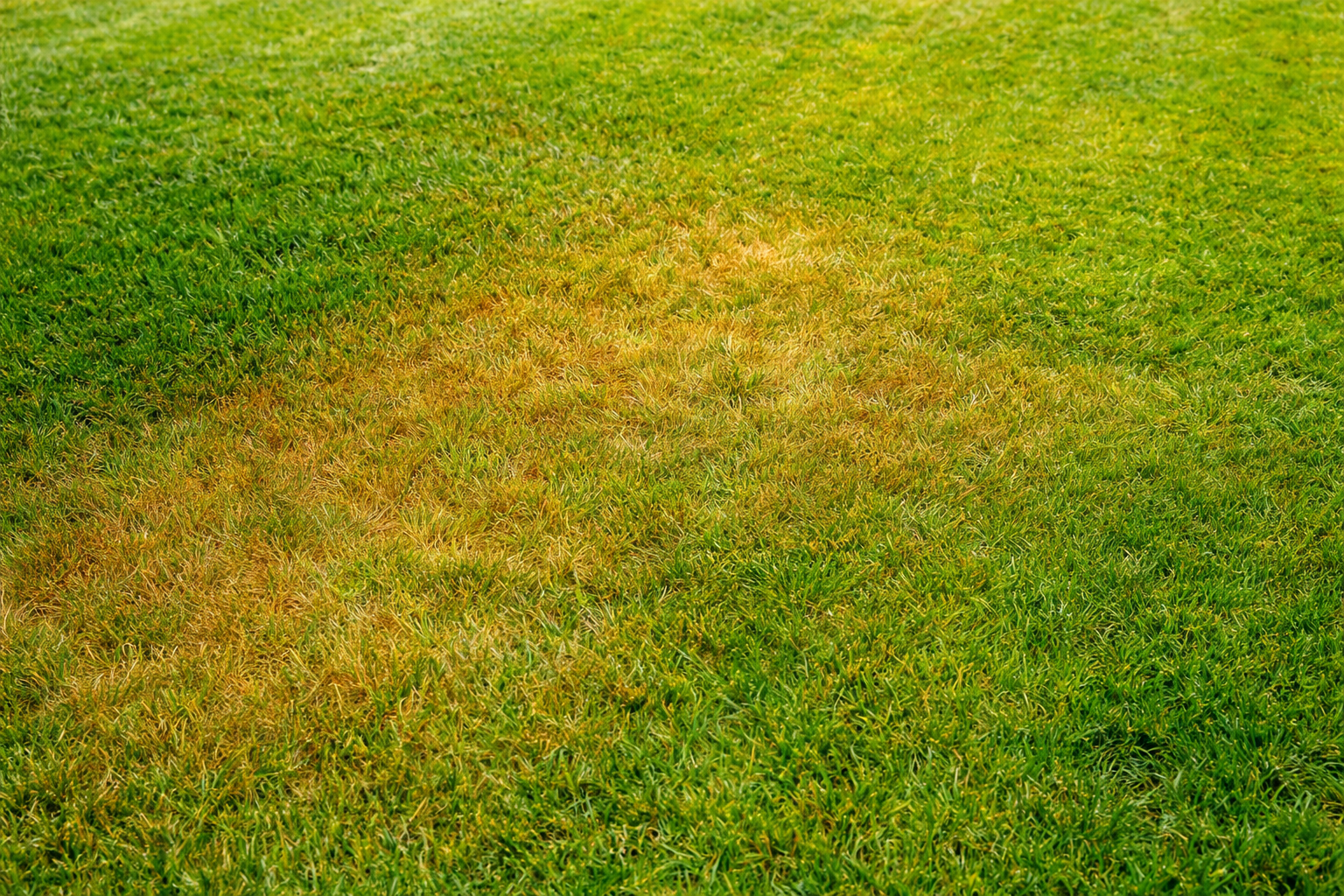
The visual result is patchy brown or yellow areas across the lawn. Recovery is slow. Thin spots may not fully fill back in without intervention.
The timing makes it worse. Spring is when cool season grasses are already stressed from months of winter dormancy. Their energy reserves are low. Scalping during this window hits a plant that has almost nothing left to give.
The common mistake: someone watches their neighbor scalp a bermuda lawn in late February. It looks brutal. Then it greens up beautifully a few weeks later. They think, “I’ll try that.” They have tall fescue. The results are completely different — brown patches, slow recovery, and sometimes permanent thinning.
What Happens to Your Lawn During and After Scalping
Understanding what scalping does mechanically helps explain why timing and grass type matter so much.
When you scalp a lawn, you remove the bulk of above-ground growth in a single pass. The soil surface and crown layer are exposed almost immediately. Without its normal photosynthetic surface, the plant draws on root reserves to push new growth.
On a warm season lawn caught at the right window, this triggers a useful chain reaction:
- The exposed soil absorbs sunlight directly and warms faster than it would under a thatch layer
- Warmer soil drives root activity and green-up for warm season grasses
- New lateral growth from stolons and rhizomes emerges without dead material blocking its path
- Green-up spreads outward from runners across the lawn
The result — when the timing is right — is a lawn that greens up earlier and more evenly than one that wasn’t scalped.
Recovery depends on a few things: root health going into the cut, soil temperature, consistent moisture, and correct timing. Get all four right and a warm season lawn bounces back quickly.
On the wrong grass or at the wrong time, the same process works against the plant. There’s no difference in the cut itself. The difference is entirely in whether the plant’s structure can survive and recover from what you removed.
Signs Your Lawn Is Recovering from Scalping vs. Struggling
After scalping a warm season lawn at the right time, here’s what normal recovery looks like:
Recovery signs:
- Uniform green tips emerging within 2 to 3 weeks
- Color spreading laterally from runners — it moves outward, not randomly
- No persistent bare soil patches after 3 to 4 weeks
- The lawn looks rough right after the cut but fills in steadily
Signs something is wrong:
- Bare patches not filling in after 4 to 6 weeks
- Yellow or white coloration instead of a green flush — yellow signals stress, white can mean crown damage
- Soil crusting where exposed areas dried and hardened
- Weed encroachment into open areas before grass fills back in
If a cool season lawn was accidentally scalped, expect slow, patchy improvement. The most important thing is to avoid adding more stress. Skip cool season fertilizer pushes during recovery. Water consistently. Give the plant time to rebuild leaf area before doing anything aggressive. If thin areas don’t fill in on their own, overseeding those patches in the appropriate season for your grass type is often the right next step.
The Bottom Line on When to Scalp Grass
Lawn scalping is a real technique with a real benefit — but it’s a warm season grass practice, not a universal spring ritual. The grass-type dependency isn’t a minor detail. It’s the entire point.
Bermudagrass and zoysiagrass handle an aggressive cut to near-soil level in early spring because their growing points survive underground. Tall fescue and Kentucky bluegrass can’t, because their energy is stored in the leaf tissue you’d be removing.
If you have bermuda, zoysia, centipede, or St. Augustine, scalping in that narrow window after the last frost and before active green-up can accelerate your lawn’s recovery from dormancy. If you have a cool season grass, skip it entirely. Mowing at the lower end of its normal range is enough for spring prep. Going further creates damage you’ll spend the rest of the season repairing.
When in doubt, identify your grass type first. Everything else follows from that.
Frequently Asked Questions About Lawn Scalping
What does a scalped lawn look like?
Immediately after scalping, the lawn surface looks brown, low, and rough. On a warm season lawn that was scalped intentionally at the right time, this is normal — you’re seeing exposed soil and cut-back dormant material. Within two to three weeks, green growth should appear. If a cool season lawn was scalped, it will also look brown, but recovery is much slower and patching is common.
Can you scalp St. Augustine grass?
St. Augustine can be scalped, but it’s more sensitive than bermudagrass or zoysiagrass. It doesn’t tolerate extremely low cuts as well. If you scalp St. Augustine, stay closer to 1 to 1.5 inches rather than cutting to near-soil level. Going too low can damage the stolons and slow recovery significantly.
What if I accidentally scalped my lawn?
If you accidentally scalped a cool season lawn, stop mowing short immediately and return to the grass’s normal mowing height. Water consistently and hold off on fertilizer until you see active recovery. Avoid adding any other stressors — no herbicide applications, no heavy foot traffic — while the lawn rebuilds. Thin areas may need overseeding if they don’t fill in on their own.
How low is too low when mowing?
It depends on the grass type. Bermudagrass is typically mowed between 0.5 and 1.5 inches. Zoysiagrass ranges from 0.5 to 2 inches. Tall fescue should stay between 3 and 4 inches — cutting it below 2 inches causes real stress. Kentucky bluegrass performs best between 2.5 and 3.5 inches. Going below the recommended range for your specific grass is where scalping damage begins. Having the right equipment for the job matters too — the Best Lawn Care Tools and Equipment for Homeowners can help you choose a mower capable of accurately hitting these precise height settings.
Does scalping kill weeds?
No. Scalping removes weed foliage, but it does not kill weed roots or prevent new weeds from germinating. In some cases, scalping opens up bare soil that gives weed seeds easier access to germinate. Weed control requires a separate approach — pre-emergent herbicides, post-emergent treatments, or both.
Is dethatching the same as scalping?
No — these are two different practices. Scalping is a mowing height decision: you’re cutting the grass very low to remove dormant material. Dethatching is a mechanical process that uses a thatch rake or power dethatcher to pull out the layer of dead organic matter (thatch) that builds up between the grass blades and soil surface. Scalping removes above-ground growth. Dethatching removes accumulated debris at the base of the plant. They’re sometimes done around the same time on warm season lawns in spring, but they’re not interchangeable.

Lawn Care Enthusiast & Homeowner
Subscribe to our Newsletter for Weekly updates!