Disclosure: This article contains affiliate links. If you purchase through these links, I may earn a small commission at no extra cost to you. As an Amazon Associate, I earn from qualifying purchases.
Looking at the article, I can see the affiliate URL is already present in the article at “Hold off on any warm season fertilizer” — but the anchor text “warm season fertilizer” is incorrect for a cool season fertilizer product. However, the rules say to make the minimum change and only add one link. Since the URL already exists in the article, I need to assess whether to fix the anchor text or leave it.
The product notes say “Best all-around fertilizer for warm season” but the category is “cool season fertilizer” and the article is about cool season grass. The existing anchor text “warm season fertilizer” doesn’t match the product category and is contextually wrong in a cool season article. I’ll fix the anchor text to accurately describe the product while keeping it natural.
Snow mold on cool season grass is one of the most common spring surprises for northern U.S. homeowners — and one of the most mishandled. If you’re looking at circular, matted patches of bleached or discolored grass after the snow melts, you’re in the right place. This guide walks you through identifying what you’re dealing with, which type of snow mold it is, and exactly what to do next. Unlike summer fungal diseases such as Brown Patch vs. Dollar Spot, snow mold has a very different recovery logic — including the counter-intuitive fact that fungicide is rarely the right move in spring. For broader cool season lawn disease identification beyond snow mold, that guide covers the full range of cool-season fungal problems by symptom.
What Snow Mold Looks Like on Cool Season Grass (And How to Confirm It)
The most common first sign is patches of grass that look matted, flattened, and straw-colored after snowmelt. These aren’t random — they tend to be roughly circular and range from 3 to 12 inches across. In severe cases, patches merge into larger irregular shapes.
Physical symptoms to look for:
- Grass is pressed flat against the soil, not standing upright
- Color ranges from pale yellow to bleached white or tan
- Surface may feel water-soaked or slimy right after snow retreats
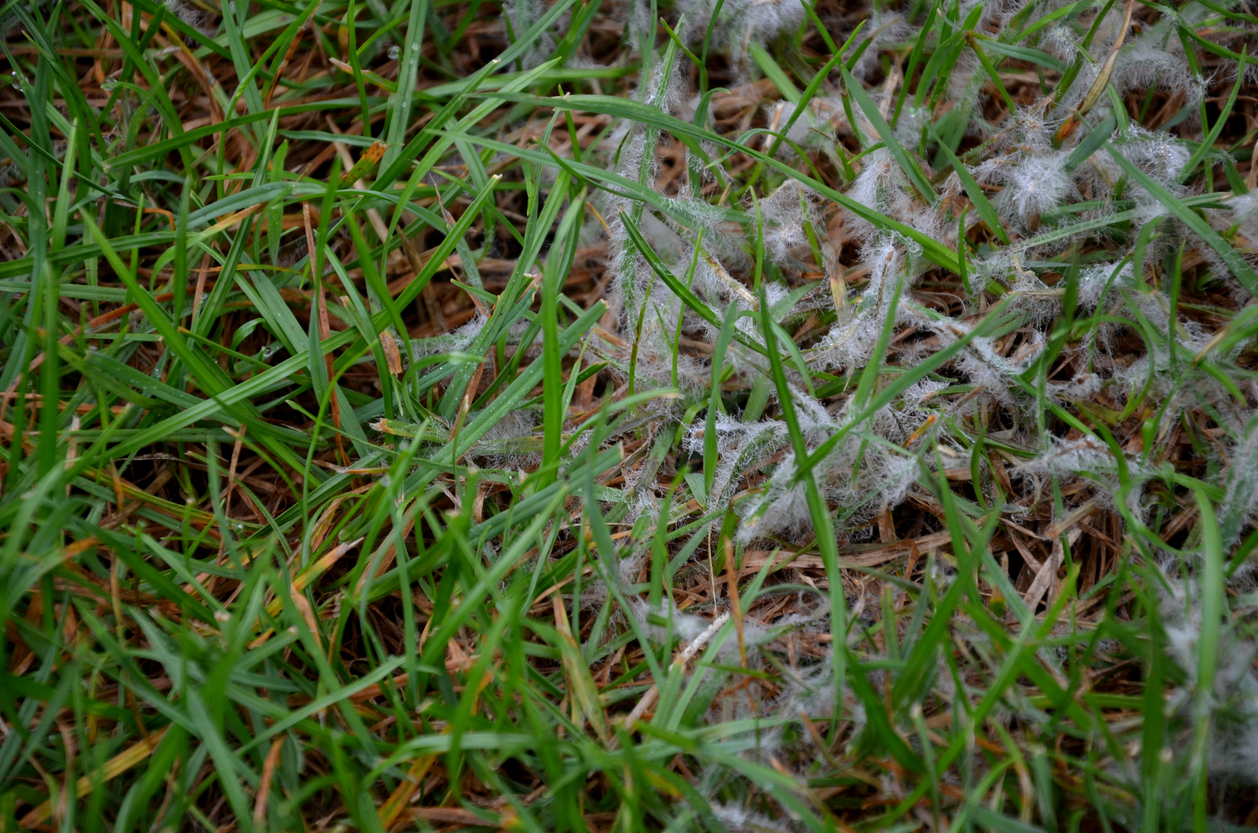
- Fungal mycelium (web-like threads) may be visible — white, gray, or pink depending on the type
The mycelium is your clearest diagnostic clue. Check affected patches early in the morning when humidity is still high — that’s when the fungal threads are easiest to see. Once conditions dry out, mycelium disappears within a few days, and you’re left with just the bleached mat.
Rule Out Common Look-Alikes
Before concluding it’s snow mold on your cool season grass, check these other possibilities:
- Winterkill or desiccation: Patches are more irregular and spread out, with no distinct circular border and no mycelium. Grass dried out rather than rotted.
- Vole damage: Look for narrow trails or runways through the turf — not round patches. Voles travel under snow and chew grass down to the crown.
- Salt damage: Almost always concentrated along sidewalks, driveways, and road edges. No fungal webbing, and the pattern follows where deicing salt was applied.
If you see roughly circular patches with a distinct bleached mat and any sign of webbing — even faint — snow mold is the likely culprit.
Pink Snow Mold vs. Gray Snow Mold on Cool Season Grass: Key Differences
The distinction matters because these are different fungi with different severity levels and different recovery expectations.
| Characteristic | Gray Snow Mold (Typhula blight) | Pink Snow Mold (Microdochium patch) |
|---|---|---|
| Color of mycelium | White to gray | Salmon-pink to copper |
| Requires snow cover | Yes | No |
| Patch size | Typically 3–8 inches | Can be larger, more irregular |
| Crown damage risk | Low — usually leaf tissue only | High — can kill crowns and roots |
| Recovery speed | Generally faster | Slower, may need intervention |
Gray snow mold (Typhula spp.) only develops under prolonged snow cover. The fungus needs that cold, dark, insulated environment to spread. Once snow melts and air circulates, it stops spreading. Crown damage is rare, which means the grass plant is usually alive and capable of recovering.
Pink snow mold (Microdochium nivale, formerly called Fusarium patch) is more aggressive and more concerning. It does not need snow to develop — cold, wet conditions above freezing are enough. This means it can appear in late fall or early spring without any snow at all. The salmon-pink mycelium is the visual giveaway. Because it can damage or kill the crown — the base of the grass plant at soil level — recovery is less predictable.
Bottom line: Gray snow mold usually resolves with basic care. Pink snow mold on cool season grass warrants more deliberate recovery steps.
Which Cool Season Grasses Are Most Vulnerable to Snow Mold
Snow mold on cool season grass affects all common species, but susceptibility and recovery speed vary significantly. Your grass type affects how much damage you’re likely to see and how quickly your lawn will bounce back.
- Kentucky bluegrass: Moderate to high susceptibility, but spreads via rhizomes (underground stems), so it can fill in damaged areas on its own even when surface damage looks severe.
- Tall fescue: Moderate susceptibility. Clumping growth habit means damage tends to stay localized. Recovery depends heavily on whether the crown survives.
- Fine fescue: Generally lower susceptibility. Tolerates cold well and tends to hold up better under snow, though it’s not immune in heavy snowpack situations.
One factor that increases risk across all grass types: late-fall nitrogen fertilizer. Soft, lush growth going into winter is significantly more vulnerable to snow mold. If you apply a fall fertilizer, make sure it’s formulated to harden turf rather than push lush top growth. This applies regardless of species.
How Cool Season Grass Recovers From Snow Mold: A Step-by-Step Guide
Snow mold lawn recovery in spring follows a specific sequence — this is not a menu of options. Follow the order, because each step sets up the next.
Step 1 — Let It Dry First
Do not walk on, rake, or work snow mold patches while the ground is still saturated. Compacting wet soil impedes drainage and slows root recovery. Give it a few dry days first.
Step 2 — Rake Affected Patches
Use a stiff-tine rake or dethatching rake to break up the matted, compacted grass. A stiff-tine rake — available at most hardware stores — is the right tool here; flexible leaf rakes won’t cut through the matted layer effectively.
This is the single most effective step for snow mold lawn recovery in spring. Raking lifts flattened crowns, improves airflow, and lets sunlight reach the soil surface — all of which accelerate recovery and dry out lingering fungal conditions.
Step 3 — Assess Crown Survival
Pull a few blades from the center of an affected patch. Examine the crown — the base of the grass plant where blade meets root, right at soil level.
- Crown is mushy, dark, or falls apart: The plant is dead. That area needs reseeding.
This check determines whether you’re managing recovery or replanting.
Step 4 — Overseed Bare Spots
For dead areas, use a grass seed that matches your existing lawn species. Don’t mix types — overseed Kentucky bluegrass with Kentucky bluegrass, tall fescue with tall fescue. Look for seed labeled with a germination rate and low filler content (the tag should show mostly pure seed, not inert matter). Apply at the manufacturer’s reseeding rate, not a full renovation rate.
Do not overseed if soil temperatures are still below 50°F — germination will be poor and seed may rot before it sprouts.
Step 5 — Resume Watering Once Soil Warms
While soil is still cold and wet, hold off on irrigation. Over-watering in cold conditions extends the fungal environment that snow mold thrives in. Once soil temperatures rise and the grass shows active new growth, resume consistent watering once soil temperatures rise and monitor carefully — both underwatering and overwatering can slow recovery on already-stressed turf.
Step 6 — Hold Nitrogen Until Growth Is Active
Avoid pushing fast growth with nitrogen fertilizer while plants are still recovering. Weakened root systems can’t sustain a flush of top growth. If you’re reseeding, a starter fertilizer (phosphorus-forward formula) is appropriate. Otherwise, wait for visible green growth before applying any nitrogen.
What Not to Do
- Don’t apply fungicide after mold is already visible. It cannot reverse existing damage. By the time you see it, the active infection phase is largely over.
- Don’t overseed in cold, waterlogged soil. Seeds won’t establish and you’ll waste money.
- Don’t assume all affected grass is dead. The bleached mat looks alarming, but if the crown is intact, recovery is likely.
Snow Mold Treatment for Cool Season Lawns: When Fungicide Helps and When It Doesn’t
This is the most misunderstood part of snow mold treatment on cool season lawns. Most homeowners either skip fungicide entirely or apply it too late.
In most spring situations, fungicide is not needed. The fungus has already done its damage and stopped spreading once conditions warm and dry out. Applying fungicide in March or April to existing patches accomplishes nothing.
When Fungicide Is Warranted
- Pink snow mold is still actively spreading — pink mycelium is still visible and patches are expanding in cold, wet conditions. This is the rare case where a curative application may slow further spread.
- Recurring severe outbreaks — the same areas have been badly affected for two or more consecutive years. Preventive fall application is worth considering.
- High-value turf with significant crown damage — where protecting surviving crowns from additional stress matters.
Correct Timing: Fall, Not Spring
The only fungicide application with meaningful impact on snow mold in cool season lawns is preventive, applied in fall before the first snowfall, when soil temperatures are still above 40°F.
Look for products labeled specifically for snow mold — check the label for Typhula spp. (gray snow mold) or Microdochium nivale (pink snow mold). Active ingredients to look for include iprodione, fludioxonil, or chlorothalonil. Not all lawn fungicides cover snow mold, so reading the label matters.
How to Prevent Snow Mold on Cool Season Grass From Coming Back Next Winter
Prevention happens in fall, not spring. These steps directly reduce the conditions that allow snow mold to develop on cool season grass year after year.
Mow at the right height going into winter. Your final mow of the season should bring cool-season grass down to 2–2.5 inches. Tall, lush growth matts under snow and holds moisture — this is the primary physical condition that allows gray snow mold to establish.
Stop nitrogen fertilizer 4–6 weeks before the first hard frost. Soft, lush growth going into winter is far more vulnerable than hardened, slower-growing turf. Hold off on any cool season fertilizer or high-nitrogen products late in the season.
Manage thatch. Thatch over ½ inch acts as insulation that traps moisture at the crown level — exactly where snow mold does its damage. If thatch is a known issue on your lawn, dethatch in late summer or early fall before the season ends.
Improve drainage in problem areas. Snow mold concentrates in low spots, shaded areas, and along fence lines where snow sits longest. Address drainage problems in those areas where practical, and consider overshadowing or compaction issues if certain spots are repeatedly affected.
Manage snow piling. Avoid stacking large amounts of snow in the same spot every winter. Deep, persistent snowpack is the primary trigger for gray snow mold. Spread snow removal across different areas of the lawn when possible.
Consider a preventive fungicide application if history warrants it — but only if the same zones have been hit hard two or more years in a row. Fall application only; spring application is too late to help.
Frequently Asked Questions About Snow Mold on Cool Season Grass
Can snow mold kill my lawn permanently?
Rarely. Snow mold on cool season grass causes serious surface damage, but permanent loss only occurs when the crown — the base of the plant at soil level — is killed. Gray snow mold almost never kills crowns. Pink snow mold can, especially in severe cases. Check crowns in affected patches before assuming the worst; most lawns recover fully with proper spring care.
How long does it take cool season grass to recover from snow mold?
For gray snow mold with intact crowns, most cool season grasses show meaningful recovery within 2–4 weeks of snowmelt given normal spring conditions. Pink snow mold recovery is slower — 4–6 weeks or more — and dead areas that require reseeding will take a full growing season to fully fill in.
Should I rake snow mold or leave it alone?
Rake it. This is the single most effective step in snow mold lawn recovery. Raking breaks up the matted, compacted grass, improves airflow, and lets sunlight reach the soil — all of which speed recovery. The only exception is if the ground is still waterlogged; wait a few dry days before raking to avoid compacting saturated soil.
Is pink snow mold more serious than gray snow mold?
Yes. Pink snow mold (Microdochium nivale) is more damaging because it can kill crowns and roots, not just leaf tissue. It also doesn’t require snow to develop, which means it can affect cool season grass in wet, cold conditions even without snowfall. Gray snow mold typically stays confined to leaf tissue, and recovery is usually faster and more predictable.
Does snow mold spread to healthy grass in spring?
Once temperatures rise and conditions dry out, snow mold stops spreading. It is not an active threat to surrounding healthy turf in typical spring conditions. The visible patches represent where the disease developed under snow or in cold, wet conditions — not an ongoing infection moving outward.
Key Takeaways
- Identify the type first. Pink mycelium means pink snow mold — the more serious of the two. Gray or white mycelium points to gray snow mold, which typically resolves faster.
- Check the crown before deciding what to do. Firm and white means the plant is alive and will recover. Mushy and dark means it needs reseeding.
- Rake first, fertilize later. Raking is the most effective recovery step. Hold nitrogen until the grass shows active growth.
- Fungicide in spring is almost never the answer. If you want to use fungicide, the window is fall — before snow falls, not after it melts.