Kentucky bluegrass (KBG) is one of the most popular cool-season grasses in northern U.S. lawns — and summer is where it struggles most. Understanding how much water Kentucky bluegrass needs is the single most important thing you can do to keep it alive and healthy through July and August. Get it wrong in either direction and you’re either looking at dead patches or a lawn weakened by disease.
This guide covers the baseline Kentucky bluegrass water requirements, how to schedule irrigation, what stress looks like before it becomes permanent damage, and how to decide whether to water through summer or let the lawn go dormant.
Disclosure: This article contains affiliate links. If you purchase through these links, I may earn a small commission at no extra cost to you. As an Amazon Associate, I earn from qualifying purchases.
How Much Water Does Kentucky Bluegrass Need Per Week in Summer?
In normal summer conditions, Kentucky bluegrass needs 1 to 1.5 inches of water per week. During extended heat above 90°F, that number can push to 2 inches per week.
“Water per week” means the total moisture delivered to your lawn from all sources — rainfall plus irrigation combined. If it rained 0.5 inches on Tuesday, you only need to make up the remaining amount through your sprinkler system. You’re managing a target, not just running a schedule.
Why KBG Has Higher Water Requirements Than Other Cool-Season Grasses
Kentucky bluegrass has a shallower root system than most cool-season alternatives. KBG roots typically reach 4 to 6 inches deep, while tall fescue — another common cool-season grass — roots to 6 to 12 inches. Deeper roots can access soil moisture lower in the profile, which provides a buffer during heat and dry spells. KBG doesn’t have that buffer.
KBG also has a finer leaf texture and stays in an active growth mode during early summer, which increases its water consumption. It’s a beautiful grass, but it’s not naturally drought-resilient.
How Soil Type Affects Kentucky Bluegrass Water Requirements
Understanding how much water Kentucky bluegrass needs in your specific yard also means accounting for your soil type — the same weekly target applies, but how you deliver it changes.
- Sandy soil drains fast and can’t hold water in the root zone for long. KBG on sandy soil pushes toward the higher end of requirements and needs more frequent applications.
- Clay soil holds moisture longer but becomes hydrophobic (water-repellent) when it dries out completely. Water can sheet off the surface rather than soaking in.
- Loam (a balanced mix of sand, silt, and clay) is the closest to ideal and behaves predictably with standard watering schedules.
To track how much water your lawn is actually receiving, a rain gauge is a simple and inexpensive tool worth having. A basic model like the AcuRite 5-inch Easy-Read Rain Gauge placed near your lawn gives you a real number to work with instead of guessing. Smart irrigation controllers can automate this tracking and skip cycles when rainfall has already met the weekly target.
How Often Should You Water Kentucky Bluegrass in Summer Heat?
Frequency matters as much as total volume. The right approach is deep and infrequent watering — not a little every day.
Watering deeply 2 to 3 times per week encourages roots to grow downward to follow moisture. Shallow daily watering does the opposite: roots concentrate near the surface where they’re most vulnerable to heat and evaporation.
Here’s a practical starting point for your Kentucky bluegrass watering schedule in summer:
- Moderate summer heat (75–89°F): 2 sessions per week, each delivering roughly 0.5–0.75 inches
- Prolonged heat above 90°F: 3 sessions per week to hit the higher 1.5–2 inch weekly total
Always water before 10 a.m. Early morning watering reduces evaporation loss because temperatures are lower and wind is typically calm. It also gives the grass blades time to dry during the day, which is important — wet foliage that stays wet through the evening creates ideal conditions for fungal diseases like brown patch and dollar spot.
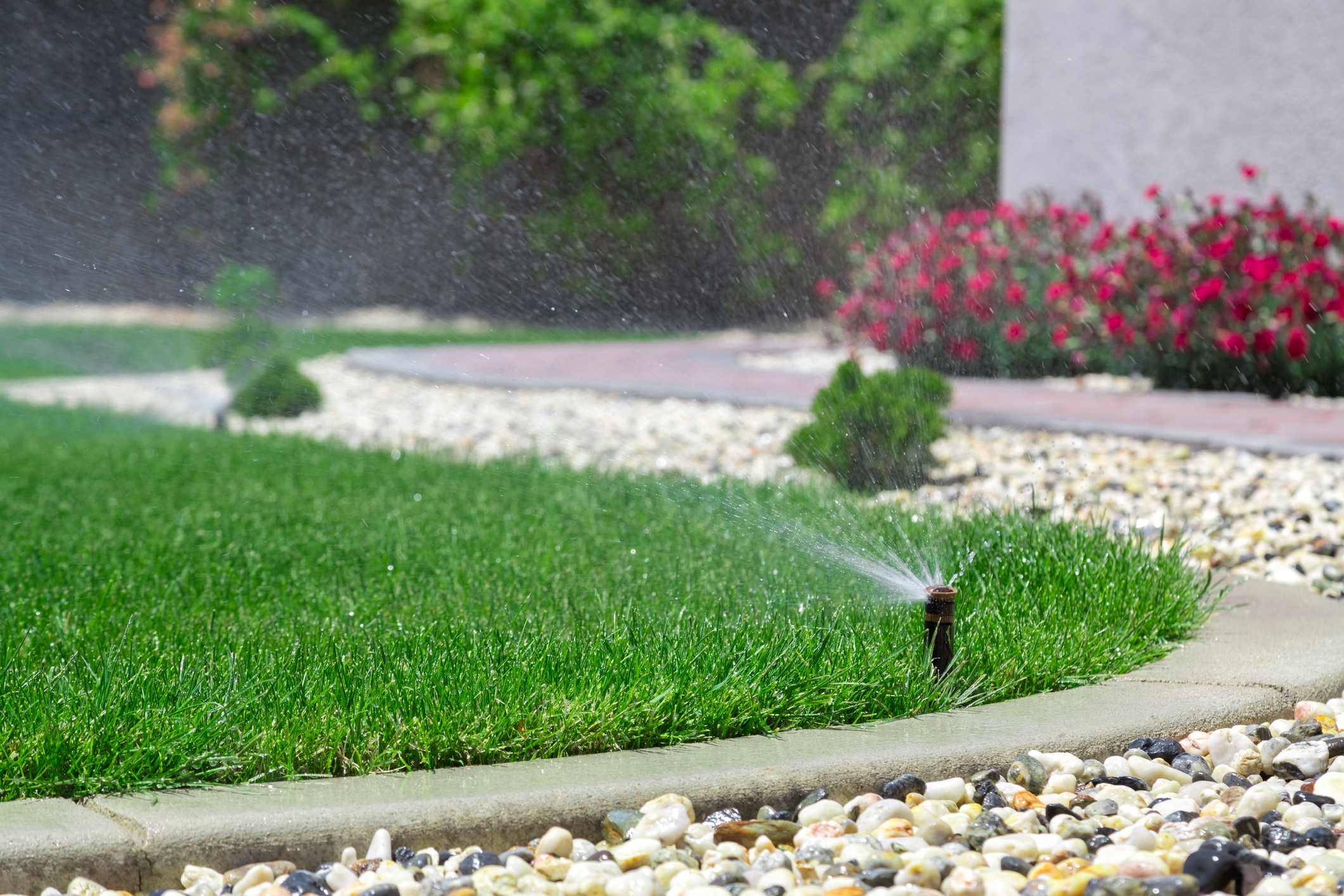
If you’re using a hose-end sprinkler rather than an in-ground system, an oscillating or rotary sprinkler with a consistent coverage pattern makes a real difference. Uneven distribution means some areas get too much water while others stay dry. A well-reviewed option like the Melnor XT Turbo Oscillating Sprinkler covers up to 4,200 square feet and allows coverage adjustments for different lawn shapes.
Running a Catch Test to Know How Long to Run Your Sprinkler
Before you set a watering schedule, you need to know how long it takes your sprinkler to deliver a specific depth of water. This is called a catch test, and it takes about 30 minutes to run once.
- Place several identical containers across your lawn — tuna cans or short-sided cups work perfectly.
- Run your sprinkler for exactly 15 minutes.
- Measure the water depth in each container and calculate the average.
- Divide your target depth (e.g., 0.5 inches) by the depth collected in 15 minutes, then multiply by 15 to get the total run time needed.
Example: If your sprinkler delivers 0.25 inches in 15 minutes, you need to run it for 30 minutes to deliver 0.5 inches per session. Do this once and it calibrates your entire summer schedule.
Signs Your Kentucky Bluegrass Is Drought Stressed and Needs Water Now
KBG shows drought stress progressively. Catching it early means the lawn recovers cleanly. Catching it late means patchy regrowth and potential reseeding.
Watch for these Kentucky bluegrass drought stress signs in order of severity:
- Footprint test fails: Walk across the lawn. If footprints remain visible after 30 minutes because the grass blades didn’t spring back, the lawn is under moisture stress.
- Blade folding: Leaves curl inward lengthwise as the plant conserves water. This is a clear visual signal that the plant is actively stressed.
- Blue-gray cast: Color shifts from healthy green to a dull, muted blue-gray tone. This is one of the most distinctive early drought indicators specific to KBG.
- Wilting at edges first: Heat and moisture stress typically appear at lawn edges near pavement, sidewalks, and elevated spots before affecting the center of the lawn.
Drought stress vs. dormancy: These are different conditions. Drought stress means the plant is struggling and needs water now. Dormancy is a deliberate survival state the plant enters to protect itself — the lawn turns straw-tan but the crowns and underground rhizomes (horizontal stems) remain alive. Both can be reversed with water, but a deeply stressed lawn that isn’t watered can cross the line from dormancy to crown death, which requires reseeding.
Adjusting How Much Water Kentucky Bluegrass Needs Based on Soil and Heat
The 1 to 1.5 inch baseline is a starting point. How much water KBG needs in your yard depends on local soil conditions, temperature patterns, and terrain.
Soil type adjustments:
- Sandy soil: Water 3 times per week in smaller amounts. Sandy soil can’t absorb and hold 0.75 inches at once — you’ll get runoff before it reaches the roots.
- Clay soil: Use the cycle and soak method — run two short irrigation cycles back-to-back with a 30-minute pause between them. This allows the first cycle to partially absorb before the second is applied, preventing surface runoff on compacted or dry clay.
- Loam: Standard 2x per week schedule works well; this soil type behaves closest to the baseline assumption.
Temperature adjustments: For every week that averages above 90°F, add approximately 0.25 to 0.5 inches to your weekly total. A week that averages 95°F is meaningfully different from one at 88°F, and KBG’s water consumption reflects that.
Shade and slope: Shaded areas of the lawn stay cooler and lose less moisture to evaporation — they typically need 20 to 30 percent less water than full-sun areas. Sloped sections lose water to runoff and benefit from the cycle and soak approach regardless of soil type.
If you want a precise read on actual soil moisture before watering rather than relying on visual cues, a soil moisture meter like the XLUX Soil Moisture Meter can help. These inexpensive tools tell you whether the root zone is still adequately moist so you’re not watering unnecessarily.
For adjusting your schedule around rainfall events specifically — including when to skip a cycle entirely — a dedicated guide on how rain affects your watering schedule and when to skip a cycle covers that framework in detail.
Should You Let Kentucky Bluegrass Go Dormant in Summer Instead of Watering?
Kentucky bluegrass has a natural dormancy mechanism. When heat and drought push beyond what it can handle, KBG slows down, turns straw-tan, and goes semi-dormant to protect itself. This is not the same as the lawn dying.
When dormancy makes sense:
- Water restrictions are in place
- Water costs are a concern during extended drought
- Multi-week heat events make maintaining green turf impractical
How to manage a dormant KBG lawn correctly:
- Apply 0.5 inches every 2 to 3 weeks minimum to keep crowns and rhizomes alive — even a dormant lawn needs some moisture
- Avoid foot traffic on dormant grass — dry, brittle blades break and won’t recover until the lawn actively greens up again
- Do not fertilize a dormant lawn — fertilizer pushes growth the plant cannot sustain without adequate water; wait until fall recovery to apply a balanced fertilizer like Andersons PGF Balanced 10-10-10
The real risk: If soil moisture drops too low for too long — typically several weeks with no rainfall and no supplemental water — crowns die. A dead crown won’t green up in fall no matter how much you water. At that point, reseeding is the only recovery path.
Coming out of dormancy: Once nighttime temperatures consistently drop below 85°F and cool fall conditions return, resume normal watering. Most KBG lawns green up within 2 to 3 weeks of resumed irrigation in favorable conditions. For a full recovery protocol, see how to bring Kentucky bluegrass out of summer dormancy.
Common Watering Mistakes That Weaken Kentucky Bluegrass
Even homeowners who understand Kentucky bluegrass water requirements make scheduling decisions that damage KBG over time. These are the most common:
- Watering in the evening: Leaf wetness that lasts through the night significantly increases fungal disease risk. Always water in the morning.
- Short daily cycles: This builds shallow roots and increases the lawn’s vulnerability to heat stress exactly when it needs depth.
- Ignoring rainfall totals: Running a fixed schedule regardless of what fell that week leads to overwatering in cooler weeks and underwatering in hot ones. Track your rain and adjust.
- Waiting until the lawn is severely stressed: Once KBG reaches deep drought stress, recovery is slower and often patchy. Catch it at the footprint test stage, not after blades are folded and color has shifted.
- Running irrigation during wind: Wind reduces distribution efficiency and creates dry spots. Morning irrigation typically coincides with the calmest part of the day.
Frequently Asked Questions
How long should I run my sprinkler to water Kentucky bluegrass 1 inch? Run time depends on your sprinkler’s output rate. Use the catch test described above to measure how much your sprinkler delivers in 15 minutes, then calculate accordingly. A typical oscillating sprinkler might take 45–60 minutes to deliver 1 inch across its coverage area, but this varies significantly by model and water pressure.
Can I water Kentucky bluegrass every day in summer? Daily watering is not recommended for KBG. Short daily cycles encourage shallow root growth, which makes the lawn more vulnerable to heat stress — not less. Water deeply 2 to 3 times per week to build the deep root system that helps KBG handle summer heat.
Will Kentucky bluegrass come back after going dormant? Yes, in most cases. If the lawn has received the minimum 0.5 inches every 2 to 3 weeks to keep crowns alive, it will green back up within 2 to 3 weeks once cooler fall temperatures return and normal irrigation resumes. If crowns dry out completely, recovery is not possible and reseeding is required.
Is 1 inch of water per week enough for Kentucky bluegrass in a heat wave? During a heat wave with sustained temperatures above 90°F, 1 inch per week is likely not enough. Push toward 1.5 to 2 inches per week during prolonged heat events. Watch for the blue-gray color shift and blade folding as indicators that the current amount isn’t meeting the lawn’s needs.
What time of day should I water Kentucky bluegrass in summer? Before 10 a.m. is the target window. Early morning watering minimizes evaporation loss and allows blades to dry during the day, which reduces fungal disease risk significantly.
Conclusion
How much water does Kentucky bluegrass need in summer? The baseline is 1 to 1.5 inches per week — more during heat spikes above 90°F. That total comes from rain and irrigation combined, so tracking what actually falls matters.
Water deeply 2 to 3 times per week rather than shallowly every day. Deep watering encourages roots to grow downward, which makes the lawn more resilient when heat intensifies. Always water before 10 a.m. to minimize evaporation and reduce fungal risk.
Watch for the early signs of drought stress — failed footprint test, blade folding, and the blue-gray color shift — before the lawn reaches the point where recovery becomes patchy. Adjust your Kentucky bluegrass watering schedule for your soil type, local temperatures, and any shaded or sloped areas. If you’re not sure what your soil is working with, a soil test kit can reveal nutrient levels and pH so you’re not guessing when adjusting your lawn care approach.
If you’re facing a long hot spell with water restrictions or high costs, letting KBG go dormant is a legitimate option — but the lawn still needs a minimum of 0.5 inches every 2 to 3 weeks to keep the crowns alive. Manage dormancy correctly and the lawn will green back up when fall arrives.
For readers establishing new KBG from seed, the watering needs during germination are entirely different and covered separately.