Fall weed control for cool season lawns is one of the most effective things you can do for your turf — and one of the most commonly skipped. Most homeowners treat weed control as a spring job, pulling out the herbicide when they see dandelions or patches of chickweed in March. By that point, the damage is already done. The weeds have been growing since October, competing with your grass through its most important recovery period, and setting seed for next year.
This guide covers the biology of fall weeds, when to apply pre-emergent and post-emergent herbicides in a cool season lawn, and how to sequence weed control around overseeding without undermining your results.
Disclosure: This article contains affiliate links. If you purchase through these links, I may earn a small commission at no extra cost to you. As an Amazon Associate, I earn from qualifying purchases.
Why Fall Is the Most Effective Window for Cool Season Lawn Weed Control
The misunderstanding starts with timing. Spring feels like weed season because that’s when you see the weeds. But the class of weeds causing the most damage in cool season lawns — winter annuals — germinate in fall. Treating them in spring means reacting after the fact.
Cool season grasses like Kentucky bluegrass, tall fescue, and perennial ryegrass follow a growth cycle that peaks in fall. After summer stress, the lawn is actively recovering: root systems are rebuilding, turf density is thickening, and the grass is storing energy for winter. Weeds that germinate during this window directly compete with that recovery. The result is a weaker lawn entering spring, with a larger weed seedbank ready to repeat the cycle.
There are two separate problems to solve, and they require different products:
- Pre-emergent herbicides prevent weed seeds from germinating — they create a chemical barrier in the soil before seeds sprout
- Post-emergent herbicides kill weeds that are already actively growing
Which one you need depends on which weeds you’re targeting and whether they’ve already germinated. Understanding the biology of your specific weeds is the foundation of any effective fall weed control program for cool season grass.
Winter annuals complete their full life cycle in the cool months. They germinate when soil temperatures drop below roughly 70°F in fall, grow slowly through winter, then push hard in late winter and set seed before dying off in late spring.
The frustrating part: they’re nearly invisible during fall and winter. By the time you see a thick mat of chickweed or a lawn full of henbit in February, those plants have been growing for four to five months — and they’re about to drop thousands of seeds. Understanding what happens during those quiet months is part of what makes winter annual weed control so important to get right. For more on what your lawn is doing between December and February, see cool season lawn care in winter.
Common Winter Annual Weeds in Cool Season Lawns
Annual bluegrass (Poa annua) is the most widespread cool season lawn invader in the U.S. It resembles desirable turf grasses, forms light-green clumpy patches, and produces seed heads even when mowed short. It’s extremely competitive and spreads aggressively.
Common chickweed and mouseear chickweed form dense, low mats with small white flowers. They thrive in moist, cool conditions and are a consistent problem in shaded or overwatered lawns.
Henbit and purple deadnettle are related broadleaf winter annuals with distinctive purple flowers visible in late winter. They’re common in disturbed or thin turf areas.
Hairy bittercress germinates in fall, stays low through winter, then shoots up seed pods in early spring. Each plant can launch seeds several feet — it spreads fast.
Common scenario: You notice chickweed taking over the same patches every spring. That’s a fall germination problem. Spring herbicide treatment clears this year’s visible plants but leaves the seedbank intact. Fall pre-emergent herbicide is the fix — not a reactive spring treatment.
By the time any of these weeds are flowering in late winter, they’re setting seed. Treating them in March solves this year’s visible problem but does nothing for next year.
A Quick Note on Perennial Broadleafs
Winter annuals aren’t the only weeds worth targeting in fall. Perennial broadleafs like dandelion, plantain, and clover also respond well to fall post-emergent treatment. In fall, these plants move carbohydrates down into their roots. Herbicide applied to the leaves moves with them. That’s why fall treatment is more thorough than spring — the product reaches the root system instead of just the top growth.
Fall Pre-Emergent Herbicide Timing for Cool Season Grass
What Pre-Emergents Do and Don’t Do
A pre-emergent herbicide doesn’t kill existing weeds. It creates a chemical barrier in the top layer of soil that prevents germinating seeds from establishing roots. Established grass is unaffected. Existing weeds are unaffected. The barrier only works on seeds trying to germinate after application — which is why timing is everything.
Soil Temperature Is the Trigger — Not the Calendar
The most common mistake in fall pre-emergent applications is using the calendar as a guide. Within any region, soil temperatures can vary by two to three weeks from year to year. Calendar-based applications frequently miss the window.
The target: apply before soil temperatures consistently drop below 70°F. That’s the threshold at which winter annual seeds — particularly Poa annua — begin germinating. You want the barrier in place before that happens.
Check soil temperature with a soil thermometer inserted two inches deep, taken in the morning when readings are most stable. Check it for a few days in a row to confirm a trend rather than acting on a single reading.
General timing by region:
- Northern zones (USDA zones 4–5): Late August through mid-September
These windows are starting points. Soil temperature always takes priority over the date.
Active Ingredients to Look For
Prodiamine is the gold standard for fall weed control in cool season grass, particularly for Poa annua suppression. It has a long residual — typically providing protection into late fall and early winter — and is available in both granular and liquid forms.
Dithiopyr is also effective. It provides some post-emergent activity on very young crabgrass seedlings (less relevant in fall) and is a solid option if you’re applying slightly later in the window. It’s also the better choice if you’re considering a staggered overseeding approach (covered in the next section).
Both active ingredients are widely available in granular formulations for broadcast spreader application. For whole-lawn coverage, a granular pre-emergent herbicide applied with a broadcast spreader gives consistent, even results.
Application Rate Notes
Follow the label rate exactly. Underapplication is the most common reason fall pre-emergents fail. Some products specify a higher fall rate than their spring crabgrass rate — check the label, don’t assume.
Granular pre-emergents must be watered in within 24–48 hours of application. Without moisture, the granules sit on the surface and don’t form the soil barrier. A quarter inch of rain or irrigation is enough.
Post-Emergent Herbicide for Fall Lawn Weed Treatment: When and How to Use It
Post-emergent herbicides make sense in fall when weeds are already visible, when the pre-emergent window has passed, or when you’re targeting perennial broadleafs that a pre-emergent won’t affect.
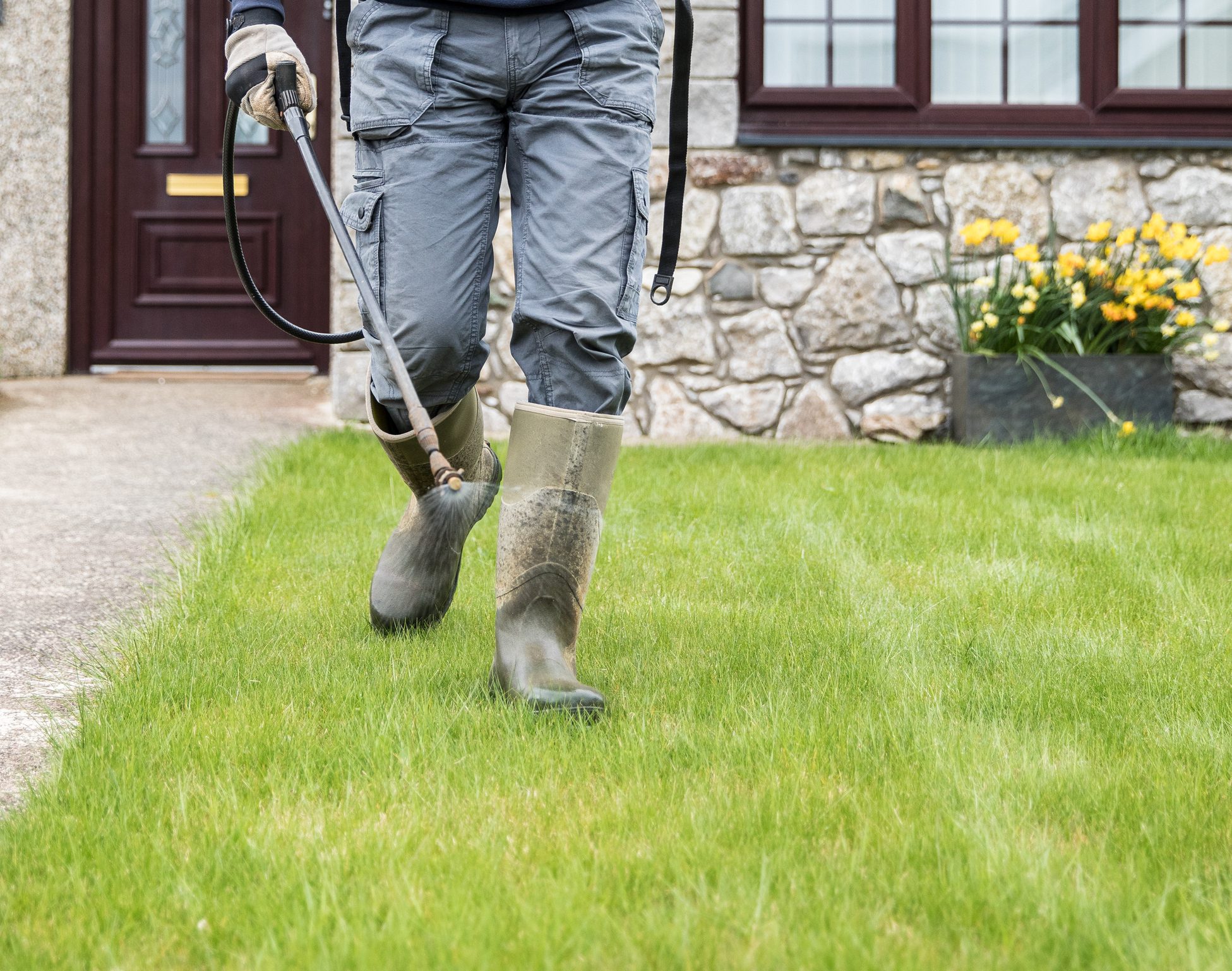
The standard product for broadleaf weeds is a three-way herbicide mix containing 2,4-D, MCPP (mecoprop), and dicamba. These are widely available, safe for cool season turf when used as directed, and effective against chickweed, henbit, dandelion, plantain, and most other broadleaf weeds. For spot treatment, a post-emergent herbicide in a ready-to-use format — or applied through a refillable hose sprayer — works well without mixing or full-lawn application.
Fall is the best time to hit perennial broadleafs. Dandelion and plantain in October are pulling energy into their roots. Herbicide moves with that flow. The result is much stronger control compared to spring applications.
Temperature and Application Conditions
Apply broadleaf post-emergent herbicide for your fall lawn when daytime temperatures are consistently between 50°F and 85°F. Below 50°F, weed metabolism slows and herbicide uptake drops — you’ll get poor results.
Avoid applying within 24 hours of expected rain (wash-off risk) or during drought stress (stressed weeds resist uptake). Fall’s cooler, more stable temperatures actually make timing easier than summer applications.
Cool season grass handles herbicide better in fall than in summer. It’s actively growing and not heat-stressed, which reduces the risk of turf discoloration that sometimes occurs with summer applications.
What Post-Emergents Won’t Fix
Annual bluegrass (Poa annua) is a grass, not a broadleaf weed. Three-way broadleaf herbicides have zero effect on it. If Poa annua is your primary problem, you need a pre-emergent applied before germination — or a selective grass herbicide with specific turf compatibility requirements.
How to Apply Fall Weed Control Without Conflicting With Overseeding
Pre-emergent herbicides prevent all seed germination — including grass seed. This conflict trips up many homeowners trying to overseed and control weeds in the same fall season.
There are three practical approaches:
Option 1 — Overseed first, skip fall pre-emergent. This is the right call for lawns with thin or bare areas that genuinely need new grass this season. Accept some winter annual pressure this fall. Use post-emergents to manage visible broadleaf weeds after the new grass is established (after two to three mows). Plan pre-emergent for next fall once the lawn is dense enough that weed competition is more manageable.
Option 2 — Apply pre-emergent, skip overseeding this fall. Best for established lawns that are reasonably dense without significant bare areas. Full pre-emergent protection this fall, overseeding planned for next fall.
Option 3 — Staggered approach with dithiopyr. Dithiopyr at reduced rates can sometimes be applied four to six weeks after overseeding, once new seedlings are established. This is a narrower window and requires careful label review — restrictions on new seedling age vary by product. It’s not guaranteed, but it’s an option if you want some pre-emergent coverage without fully sacrificing your overseeding effort.
For a full discussion of the overseeding timing decision, see Best Time to Overseed Cool Season Grass: Fall vs. Spring Compared.
Common scenario: You overseeded two weeks ago. Should you apply pre-emergent now? No. The new grass seed hasn’t established yet — pre-emergent will prevent it from rooting. Spot-treat visible broadleaf weeds with post-emergent after the new grass has been mowed two to three times. Plan pre-emergent for next fall.
Fall Weed Control Mistakes That Carry Into Spring Problems
These are the errors that show up as a weedy lawn in February and March — traced back to decisions made (or not made) the previous fall.
- Applying pre-emergent too late. Once soil temperatures drop below 55°F, Poa annua and other winter annuals have already germinated. Pre-emergent does nothing to seeds that have already sprouted. The window is narrower than most people expect.
- Skipping the watering-in step. Granular pre-emergents sitting dry on the surface form no barrier. Water in within 48 hours. Don’t assume rainfall will handle it on its own schedule.
- Relying on spring post-emergent treatment as the primary strategy. Treating chickweed in March eliminates this year’s plants but leaves the seedbank intact. The same weeds return next fall in equal or greater numbers. You’re treating symptoms, not the cause.
- Applying broadleaf herbicide too late in fall. Once daytime temperatures drop below 50°F consistently, broadleaf herbicide uptake is too slow to produce reliable results. Apply early enough in fall to catch weeds while temperatures are still in the active range.
- Using pre-emergent after overseeding. This kills new grass seedlings as reliably as weed seeds. The conflict is real — understand it before you buy a product.
- Treating Poa annua with a broadleaf herbicide. Annual bluegrass is a grass. Broadleaf formulas don’t affect it. If you’re applying a three-way mix hoping to clear up those light-green clumpy patches, you’ll be disappointed. Poa annua needs a different management strategy entirely.
- Underapplying pre-emergent. Applying at too low a rate creates gaps in the chemical barrier. Weeds find those gaps. Follow the label rate, and check whether a product specifies a different fall rate than the standard spring application.
Frequently Asked Questions
When is it too late to apply pre-emergent in fall?
Once soil temperatures drop below 55°F consistently, most winter annual seeds — including Poa annua — have already begun germinating. Pre-emergent applied after germination has started won’t stop the weeds already in the ground. Check soil temperature with a thermometer rather than guessing by the date.
Will fall pre-emergent hurt my overseeded grass?
Yes, if applied too close to seeding. Pre-emergent herbicides prevent all seed germination, including desirable grass seed. Wait until new grass seedlings are well established — typically after two to three mows — before applying any pre-emergent. Better yet, choose between overseeding and pre-emergent for this fall and do the other next year.
Can I use a broadleaf herbicide to kill annual bluegrass?
No. Annual bluegrass (Poa annua) is a grass, not a broadleaf weed. Three-way broadleaf herbicides containing 2,4-D, MCPP, and dicamba have no effect on it. Poa annua control requires a pre-emergent applied before germination or a selective grass herbicide. Using a broadleaf product on a Poa annua problem is a wasted application.
How long does fall pre-emergent last into spring?
Prodiamine applied in fall typically provides residual control through late fall and into early winter. In most climates, a fall application is unlikely to carry full activity all the way into March or April. If spring annual weeds like crabgrass are a concern, a separate spring pre-emergent application is still worthwhile.
What if I missed the fall pre-emergent window — what can I do in spring?
If winter annuals are already growing, a spring post-emergent broadleaf herbicide can eliminate chickweed, henbit, and other broadleaf weeds before they finish setting seed. For Poa annua, the options are more limited — a selective grass herbicide or waiting for it to die off naturally in summer and preventing it again next fall with pre-emergent. Apply a spring pre-emergent before soil temperatures reach 55°F to block crabgrass and warm-season annuals.
Is fall or spring better for treating dandelions?
Fall is better. In fall, dandelions are moving carbohydrates down into their roots. Broadleaf herbicide applied to the leaves moves with that flow — giving you much stronger root-level control. Spring treatments kill top growth but often allow roots to recover. If you can only treat once, treat in fall.
How do I know if chickweed germinated before I applied pre-emergent?
Get close to the ground and look carefully in shaded, moist areas where chickweed typically starts. If you see tiny seedlings — two small oval leaves on a thin stem — germination has already happened and pre-emergent won’t help. Switch to a post-emergent broadleaf herbicide applied while the seedlings are still small and temperatures are above 50°F.
Conclusion
Fall weed control for cool season lawns is more effective than spring weed control for one simple reason: the weeds you’re fighting germinate in fall. Acting in spring means reacting after the damage is done.
Three takeaways to carry into your fall lawn weed treatment program:
- Winter annual weeds germinate in fall — prevention through fall pre-emergent cool season grass applications beats reactive spring treatment every time
- Pre-emergent timing depends on soil temperature, not the calendar — apply before soil temperatures consistently reach 70°F and water in within 48 hours
- Overseeding and pre-emergent herbicides conflict — decide which is the priority for this season and plan the other for next fall
Fall weed control doesn’t exist in isolation. For the full set of fall tasks — aeration, fertilization, and overall lawn prep — the fall lawn prep checklist will help you sequence everything in the right order. Pairing your weed control program with a quality cool season fertilizer during fall’s active growth window gives the turf the density it needs to resist weed pressure going into winter. And if you’re planning ahead to what follows, the spring cool season lawn care checklist covers what carries over from fall weed control into the next growing season.
Subscribe to our Newsletter for Weekly updates!