Disclosure: This article contains affiliate links. If you purchase through these links, I may earn a small commission at no extra cost to you. As an Amazon Associate, I earn from qualifying purchases.
St. Augustine grass is one of the most popular warm-season turf choices across the South. But when it comes to post emergent herbicides for St. Augustine grass, the margin for error is narrow. Apply the wrong product and you can damage or kill a lawn that took years to establish. Apply the right one incorrectly and you’ll still see injury.
This guide covers which post emergent herbicides are safe for St. Augustine grass, which ones to avoid, how to apply them correctly, and what to do if something goes wrong. Think of it as a reference you can return to every time a new weed shows up in your lawn.
Why St. Augustine Grass Is Sensitive to Post Emergent Herbicides
Not all warm-season grasses respond to herbicides the same way. Bermuda grass and zoysia have a thicker cuticle — the waxy outer layer of the leaf blade — and stronger enzymatic systems. These help them break down certain herbicide compounds before lasting damage occurs. St. Augustine lacks both of these advantages.
Bermuda and zoysia can tolerate many herbicide active ingredients without damage. St. Augustine cannot. A broadleaf herbicide that sits harmlessly on a bermuda lawn can curl, thin, and kill St. Augustine stolons — the above-ground runners that drive lateral spread and recovery.
How Stress Multiplies Herbicide Risk
Timing matters as much as product selection. When St. Augustine is under heat stress, drought stress, or coming out of dormancy, its ability to process herbicide compounds drops. Applying even a “safe” herbicide to a stressed lawn can push a mild reaction into serious turf damage.
Every product recommendation and application guideline in this guide is built around that sensitivity. A product technically labeled for St. Augustine can still cause damage if applied during a drought or at the wrong temperature.
Safe Post Emergent Herbicides for St. Augustine Grass
Atrazine
Atrazine is one of the most widely recommended active ingredients for St. Augustine grass weed control. It controls a broad range of broadleaf weeds and some grassy weeds, and St. Augustine tolerates it well at labeled application rates.
Two important caveats: atrazine is restricted or unavailable in some states due to groundwater concerns. Confirm availability in your area before purchasing. And application rate matters — doubling the dose to speed results will cause turf damage, not faster weed control.
Triclopyr (Broadleaf Focus)
Triclopyr is the right choice when you’re dealing with tough broadleaf weeds that atrazine doesn’t fully suppress. Dollar weed, clover, and ground ivy respond well to it.
The critical rule: only use triclopyr formulations that do not include dicamba or 2,4-D. Many broadleaf herbicide products combine multiple active ingredients, and either of those additions makes the product unsafe for St. Augustine. Read the active ingredient list, not just the front of the label.
Formulation also matters. Triclopyr comes in two forms — amine and ester. In warm conditions, use the amine formulation. The ester version carries a higher risk of vapor drift in heat. A triclopyr amine product like Monterey Turflon Ester labeled for use on southern turf is an appropriate example for this weed type.
Metsulfuron-Methyl
Metsulfuron-methyl controls a wide range of broadleaf weeds and some grassy weeds. It’s available in consumer-grade products marketed for southern lawns. The catch is that application rates are extremely low — fractions of an ounce per acre. Overdosing causes turf thinning that can take a full season to recover from.
Measure carefully and resist the urge to apply more when you don’t see immediate results.
MSMA (Monosodium Methanearsonate)
MSMA is an older herbicide chemistry used primarily for grassy weed control — crabgrass and goosegrass in particular. It’s still available in some consumer products, but with important limits.
Injury risk is higher on stressed lawns or newly established St. Augustine. MSMA is also restricted in some states — confirm local availability before buying. Treat this as a targeted option rather than a routine broadleaf weed killer.
Herbicides You Should Never Use on St. Augustine
This category is just as important as knowing what’s safe. Several common, widely available products will seriously damage St. Augustine grass.
- 2,4-D: Found in many “weed and feed” products and general broadleaf herbicides. Causes leaf curl, stem damage, and turf thinning on St. Augustine. This is one of the most common sources of herbicide injury on St. Augustine lawns.
- Dicamba: Often paired with 2,4-D. Carries the same injury profile. Always check for dicamba in the active ingredient list before buying any broadleaf product.
- Glyphosate (Roundup): Non-selective. It kills every plant it contacts, including St. Augustine. This is never an appropriate post emergent weed control option for an established lawn.
- 3-way broadleaf herbicides: These products typically combine 2,4-D, MCPP (mecoprop), and dicamba. All three active ingredients are problematic for St. Augustine. The label may say “broadleaf weed control,” but it’s not safe for this grass type.
- Imazaquin (Image): Some older formulations are not labeled for St. Augustine. If you’re considering any imazaquin product, confirm the current label specifically lists St. Augustine as a tolerant turf.
How to Screen Any Product Before Buying
How to Apply Post Emergent Herbicides Without Damaging Your St. Augustine Lawn
Correct product selection is only half the equation. Application technique determines whether a safe herbicide stays safe.
Temperature window: Apply when air temperatures are between 60°F and 85°F. Above 90°F, herbicide injury risk increases — even with labeled products.
Avoid stressed grass: Don’t apply during drought conditions or immediately after heat stress. Well-watered, actively growing St. Augustine tolerates herbicide contact much better than a stressed lawn.
Watering timing: Lightly water the lawn the day before applying if the soil is dry. After application, wait 24 to 48 hours before watering. This allows time for foliar uptake through the leaf blade.
Mowing: Skip mowing for 2 to 3 days before and after application. More leaf surface area means better herbicide absorption and more effective weed control.
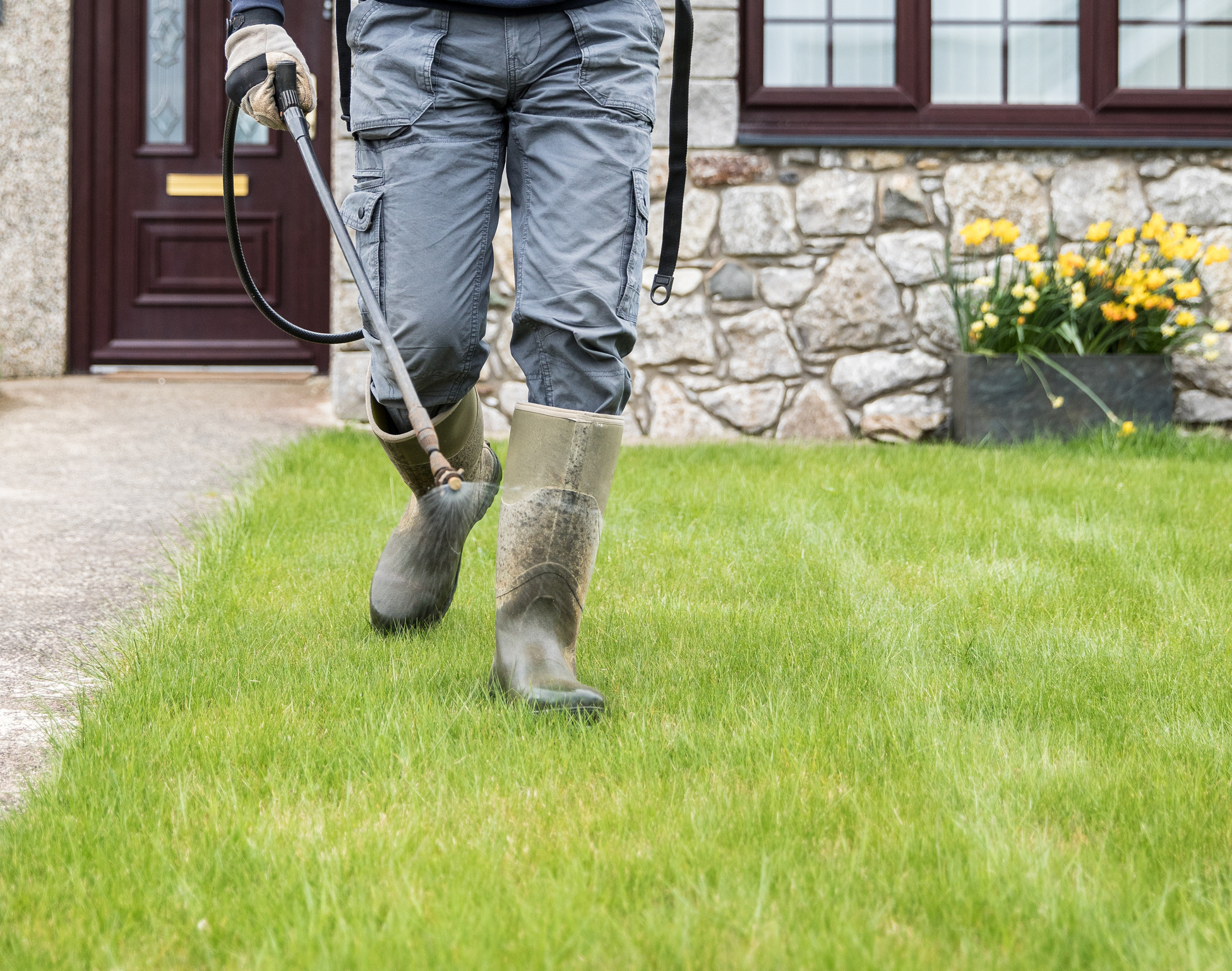
Application equipment: Uneven application is a real risk. Over-saturated patches concentrate the herbicide and cause localized injury. A pump sprayer with an adjustable nozzle, like the Chapin 1-Gallon Pump Sprayer, gives you better control over application rate than a hose-end sprayer.
New lawns: Wait until St. Augustine has been fully established for at least one complete growing season before applying most post emergent herbicides. Newly laid sod or plugs don’t have the root system to handle the additional stress. If you’re also considering overseeding your St. Augustine lawn, it’s important to coordinate timing carefully with any herbicide applications.
Weed-by-Weed Guide: Matching the Right Post Emergent Herbicide to the Problem
| Weed Type | Example Weeds | Recommended Product Category | Notes |
|---|---|---|---|
| Broadleaf weeds | Dollar weed, clover, dandelion, chickweed | Atrazine, triclopyr amine | Most common weed category; both products effective |
| Grassy weeds | Crabgrass, goosegrass | MSMA (where legal), atrazine (limited) | Confirm MSMA availability in your state |
| Sedges | Yellow nutsedge, purple nutsedge | Halosulfuron or sulfentrazone | Standard broadleaf herbicides have no effect on sedges |
| Perennial vines | Ground ivy, wild violet | Triclopyr amine | Repeat applications required for full control |
Nutsedge note: Nutsedge is frequently mistaken for a grass — it’s not. It’s a sedge, and standard broadleaf herbicides have no effect on it. Halosulfuron-methyl (sold under the brand name Sedgehammer) or sulfentrazone are the right options for nutsedge in St. Augustine. Both are labeled for St. Augustine turf.
Pre-emergent herbicides — which prevent weed seeds from germinating in the first place — are a separate category with their own timing and product requirements. They’re not interchangeable with the post emergent herbicides covered here.
What to Do If You Applied the Wrong Herbicide on St. Augustine
Mistakes happen. If you’ve applied a damaging product and caught it early, you have a reasonable window to minimize the injury.
Act immediately: Water the area heavily as soon as you realize the error. Diluting the herbicide and moving it away from roots and stolons reduces the depth of damage.
Hold off on fertilizer: Do not apply fertilizer to a chemically stressed lawn. Fertilizer on damaged turf compounds the stress rather than aiding recovery. If you later notice yellowing after resuming your fertilizer routine, see Lawn Yellow After Fertilizing: What Went Wrong for help diagnosing the cause.
Watch for look-alike damage: Herbicide injury on St. Augustine can be confused with other problems. Chinch bug damage produces irregular dead patches that look similar to chemical injury — checking for pest activity alongside chemical exposure helps you identify the actual cause and respond correctly.
Assess at two weeks: St. Augustine recovers through its stolons. If you’re seeing new lateral growth emerging from runners within two weeks of the damage, the lawn is recovering. Give it time and consistent watering before deciding further action is needed.
When recovery isn’t happening: If crowns are dead and no new growth is visible after two to three weeks, the affected area likely won’t fill in on its own. Sodding or plugging the damaged section is the most reliable fix at that point.
Frequently Asked Questions
Is atrazine safe for St. Augustine grass?
Yes. Atrazine is one of the most widely recommended post emergent herbicides for St. Augustine grass. It’s well-tolerated at labeled rates and controls a broad range of broadleaf weeds. Apply at the correct rate — overdosing causes turf damage. Also note that atrazine is restricted in some states due to groundwater concerns, so confirm local availability.
Can I use Weed B Gon on St. Augustine grass?
Most formulations of Weed B Gon contain 2,4-D or a combination of 2,4-D, MCPP, and dicamba — none of which are safe for St. Augustine. Check the active ingredient list before using any product with “Weed B Gon” in the name. Some formulations exist without these ingredients, but it’s your responsibility to verify the label.
What kills dollar weed in St. Augustine grass without damaging the lawn?
Atrazine and triclopyr amine are both effective against dollar weed in St. Augustine. Triclopyr amine tends to be more aggressive on dollar weed specifically. Use a formulation that does not contain 2,4-D or dicamba. Repeat applications may be needed.
Can I use 2,4-D on St. Augustine grass?
No. 2,4-D is one of the most damaging herbicides you can apply to St. Augustine grass. It causes leaf curl, stem injury, and turf thinning. It appears in many common “weed and feed” products and broadleaf herbicides — always read the active ingredient list before applying anything to a St. Augustine lawn.
How long after applying herbicide can I mow my St. Augustine lawn?
Wait at least 2 to 3 days after application before mowing. Mowing too soon removes leaf surface area before the herbicide is fully absorbed, which reduces effectiveness. For the same reason, avoid mowing 2 to 3 days before application as well.
Will my St. Augustine recover from herbicide damage?
It depends on the severity. If stolons and crowns are still alive, St. Augustine can recover through lateral spread. Water the area thoroughly after catching the damage, hold off on fertilizer, and look for new growth at the two-week mark. If no new growth appears and crowns are dead, sodding or plugging the area is the best path forward.
What kills nutsedge in St. Augustine without harming the grass?
Halosulfuron-methyl (brand name: Sedgehammer) and sulfentrazone are both labeled for use on St. Augustine and are effective against yellow and purple nutsedge. Do not use standard broadleaf herbicides for this — nutsedge is a sedge, not a grass or broadleaf weed, and those products won’t work.
Is it safe to apply herbicide to a newly planted St. Augustine lawn?
No. Wait until St. Augustine has been fully established for at least one complete growing season. Newly laid sod and plugs lack the root system and stolon density to handle the added stress of herbicide contact. Applying post emergent herbicides too early can cause significant damage to an already vulnerable lawn.
Conclusion
Choosing the right post emergent herbicides for St. Augustine grass starts with reading the active ingredient label — not the product name or the front of the bottle. Atrazine and triclopyr amine cover the majority of broadleaf weed problems. Sedges need dedicated chemistry. And 2,4-D, dicamba, and glyphosate should never come near a St. Augustine lawn.
Key takeaways:
- Read active ingredient lists, not just product names or front labels
- Atrazine is the most broadly safe option for St. Augustine weed control
- Triclopyr amine handles tough broadleaf weeds — confirm no 2,4-D or dicamba is in the formulation
- Nutsedge requires halosulfuron or sulfentrazone — broadleaf products won’t work
- Apply between 60°F and 85°F on a well-watered, actively growing lawn
- Both atrazine and MSMA may be restricted in some states — confirm local availability before purchasing
- If injury occurs, water immediately, skip fertilizer, and assess recovery at two weeks
For further reading, look into pre-emergent herbicide timing for St. Augustine. A premium granular pre-emergent herbicide applied at the right time can stop crabgrass and other weeds before they ever break the surface. Once your weed pressure is under control, supporting recovery and density with a quality warm season fertilizer will help St. Augustine fill back in and stay competitive against future weed encroachment. Preventing the next generation of weeds before they emerge is always easier than treating them after the fact.