Knowing how often to water Bermuda grass in summer is one of the most important things you can get right as a homeowner in a southern or transitional climate. Water too often and you train the roots to stay shallow. Water too little and the grass goes dormant before its time. Get the frequency and depth right, and Bermuda grass becomes one of the toughest, most heat-resilient lawns you can grow.
This guide walks through the full watering framework for Bermuda grass in summer — schedule, depth, timing, heat adjustments, and equipment — so you can build a reliable routine and keep it running all season.
Disclosure: This article contains affiliate links. If you purchase through these links we may earn a small commission at no extra cost to you.
How Often Should You Water Bermuda Grass in Summer?
The answer most homeowners need first: water 2–3 times per week, not every day. Daily watering feels attentive, but it works against how Bermuda grass is designed to grow.
Bermuda grass develops an extensive root system when conditions encourage it. Frequent shallow watering keeps moisture concentrated at the surface, which is exactly where roots will stay if the water never goes deeper. Shallow roots are vulnerable to summer heat — the top inch or two of soil can reach temperatures that stress or kill fine root tissue.
The “Deep and Infrequent” Principle
“Deep and infrequent” means letting the top portion of the soil dry out slightly between waterings. That drying cycle creates a mild moisture gradient — roots follow the moisture downward, building a deeper, more drought-resistant system. You’re not starving the grass; you’re directing where it invests its energy.
Soil Type Changes the Bermuda Grass Watering Frequency in Summer
- Sandy soil drains quickly, so moisture is gone faster. Three waterings per week is often the right call.
- Clay soil holds water longer, so two waterings per week may be enough — and overwatering on clay encourages fungal problems.
- Loam (mixed soil) typically falls in the middle at 2–3 times per week depending on temperature and recent rainfall.
A Practical Starting Schedule
A simple baseline bermuda grass watering schedule for summer that works for most lawns:
Water Monday, Thursday, and Saturday.
This spaces sessions 2–3 days apart and gives the soil time to partially dry between cycles. If rainfall fills in one of those days, skip that session. If temperatures stay below 90°F consistently, drop to twice a week and monitor.
How Deep to Water Bermuda Grass in Summer
Frequency matters, but depth is what actually determines whether the watering is doing its job. The target is 6 to 8 inches of soil moisture per session.
That depth is where Bermuda grass roots are actively growing — or where you want them to grow. Wetting only the top 2–3 inches is the most common mistake homeowners make, even when they think they’re watering thoroughly.
Translating Depth Into Inches of Water
Reaching 6 to 8 inches of soil depth typically requires ¾ to 1 inch of water per session. Across a full week with two to three sessions, you’re targeting roughly 1 to 1.25 inches of total water per week in summer.
How to Measure What You’re Applying
You don’t need to guess. Three easy methods:
- Tuna can or rain gauge — place several empty cans around the lawn while the sprinkler runs. When you have about ¾ to 1 inch of water in the cans, the session is done.
- Soil moisture meter — insert the probe near the root zone before and after watering to confirm moisture is reaching depth. This is especially useful on uneven ground or with sandy soil where water moves quickly. A basic soil moisture meter (widely available at hardware stores and on Amazon for under $20) removes the guesswork entirely and pays for itself quickly in water savings.
- Screwdriver test — after watering, push a standard screwdriver 6 inches into the soil. If it slides in without much resistance, moisture is adequate. If it meets hard resistance before 6 inches, the soil is still dry at depth.
The screwdriver test is quick, free, and surprisingly accurate. Make it a habit for the first few weeks of summer until you know your soil.
Best Time of Day to Water Bermuda Grass in Summer
Water Bermuda grass between 5 a.m. and 9 a.m. — early morning is the clear best window for summer watering.
Two reasons drive this:
- Efficiency — temperatures are lowest, wind is typically calmer, and water reaches the soil before heat-driven evaporation can pull it away. You lose less to the air.
- Disease prevention — grass blades wet at 5 a.m. are dry by mid-morning. Grass blades wet at 9 p.m. stay wet through the night, creating ideal conditions for fungal diseases like brown patch.
What About Watering in the Middle of the Day?
Midday watering is inefficient — a meaningful portion evaporates before it reaches the root zone — but it’s better than skipping a session during a heat wave. If you miss your morning window and the lawn is showing stress signs, water anyway and get back on schedule the next morning.
Evening watering is the one timing to consistently avoid. The overnight wet-leaf period is the primary trigger for fungal disease in warm, humid climates.
Signs Your Bermuda Grass Is Not Getting Enough Water in Summer
Even with a solid schedule in place, summer conditions can outpace your routine. Knowing how to read the lawn helps you catch problems before they become damage.
Visual Signs
- Blades folding lengthwise — Bermuda grass curls its leaf blades inward as a moisture-conservation response. This is one of the earliest and most reliable stress signals.
- Color shift — healthy Bermuda is a medium to dark green. Water-stressed Bermuda shifts toward a dull blue-grey or olive tone.
- Footprints remain visible — walk across the lawn and look back. Grass under normal moisture springs back quickly. If your footprints are still visible 30 minutes later, the lawn is under stress.
Soil Signs
- Hard, cracked surface — when the top layer of soil cracks or feels dense and dry to the touch, the profile below is likely bone dry.
- Failed screwdriver test — if you can’t push a screwdriver 6 inches in without forcing it, the water isn’t reaching depth.
A Key Distinction
If the lawn looks stressed just 24 hours after a watering session, the issue is almost always depth, not frequency. More days of shallow watering won’t fix it — you need to run longer sessions that push water further down.
Bermuda Grass Watering Schedule During a Summer Heat Wave
When temperatures stay above 95–100°F for several consecutive days, your standard schedule may not be enough — not because it’s wrong, but because the soil is drying out faster than usual.
Adjust Depth First, Not Just Days
The instinct is to add more watering days, but the smarter first move is to increase session run time by 10–15 minutes. This pushes water deeper and extends how long the soil holds moisture. Adding days of shallow watering doesn’t solve a heat-wave deficit.
If the soil is drying out in under 48 hours even with deeper sessions, then add a third (or temporary fourth) watering day until the heat breaks.
Watch Hardscape Edges
Pavement, concrete edges, and driveways radiate stored heat onto nearby lawn areas. The 2–3 feet of turf bordering hardscape often dries out faster than the rest of the lawn. Spot-water these edges separately if needed.
Returning to Normal After a Heat Wave
A Note on Dormancy
If water is withheld completely during extreme heat, Bermuda grass will go dormant — it turns tan and stops active growth. Dormancy is a survival mechanism, not permanent damage. The grass will recover once watering resumes and temperatures moderate. Some continued irrigation during dormancy (roughly ½ inch every two to three weeks) helps the root system survive even if top growth has stopped.
Sprinkler vs. Irrigation System: Summer Watering for Bermuda Grass
The method you use to deliver water matters less than whether water is consistently reaching 6–8 inches of depth on schedule. Both portable sprinklers and in-ground irrigation systems can do the job.
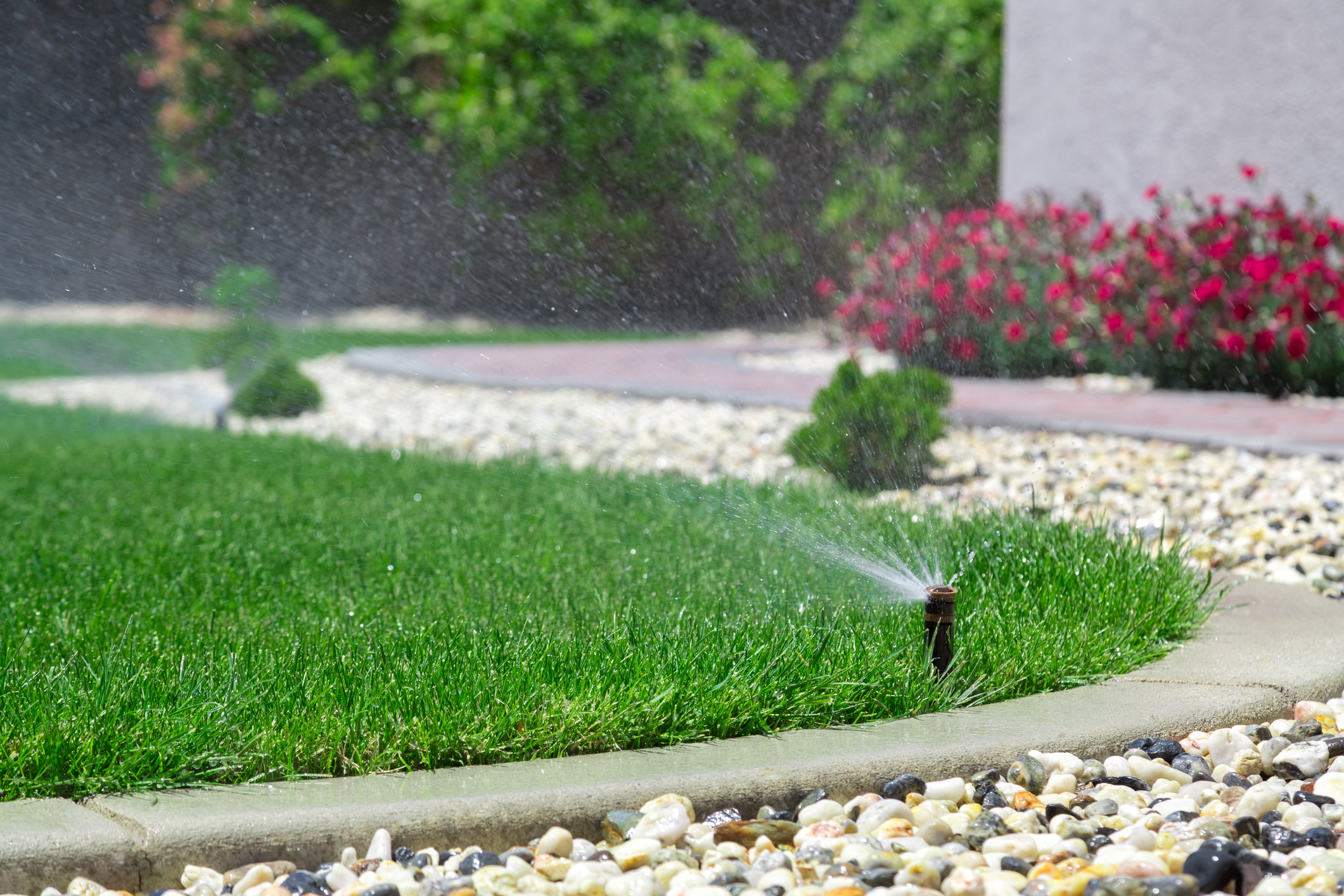
In-ground irrigation systems handle the early-morning schedule automatically. The primary maintenance task is calibration — check for clogged, misaligned, or low-pressure heads that create dry patches even when the system is running. Walk the coverage zone after a session and look for areas that didn’t get wet.
Portable sprinklers require you to time and position sessions manually. Use the tuna can method to measure output: once you know how long your sprinkler takes to deliver ¾ to 1 inch, you have a repeatable run time. Move the sprinkler between positions to check for dry spots — uneven coverage is a frequent cause of patchy lawns even when the watering bermuda grass in heat schedule looks correct on paper.
If you don’t have an in-ground system, a programmable hose-end timer is a practical upgrade that solves the early-morning wake-up problem. You set the schedule once, and the timer opens the valve automatically at 5 or 6 a.m. These are widely available at hardware stores and online for $25–$50 — a straightforward tool for consistent timing without an in-ground installation.
Frequently Asked Questions: Watering Bermuda Grass in Summer
Can I water Bermuda grass every day in summer? It’s not recommended. Daily watering encourages shallow root growth and increases the risk of fungal disease. Knowing how often to water Bermuda grass in summer means understanding that 2–3 times per week with deeper sessions outperforms daily light watering every time.
How long should I run my sprinklers to water Bermuda grass deeply? Run time depends on your sprinkler’s output rate, but the goal is ¾ to 1 inch of water per session. Use the tuna can method — place empty cans on the lawn and run the sprinkler until they reach that depth. That gives you a specific run time for your setup.
Does Bermuda grass need more water in July than June? Often yes. Peak heat in July and August pushes soil moisture levels down faster than early summer conditions. If you’re on a twice-weekly schedule in June, you may need to shift to three times per week by mid-July and increase session depth.
How do I know if I’m overwatering Bermuda grass? Signs of overwatering include soft, spongy soil that stays wet between sessions, yellowing grass, and the appearance of fungal patches (circular brown or tan areas). If the soil never dries slightly between waterings, you’re likely overwatering.
Will Bermuda grass recover if it goes dormant from lack of water? Yes. Dormancy is Bermuda’s survival response to heat and drought stress — the grass goes tan and stops growing but does not die. Resume regular watering and the lawn will green back up, especially once temperatures moderate. Maintaining minimal irrigation (about ½ inch every two to three weeks) during dormancy protects the root system.
Should I water newly seeded or sodded Bermuda grass differently? Yes. Newly seeded or sodded Bermuda needs more frequent watering — often daily or twice daily in small amounts — until roots establish. Once the grass is rooted and actively growing (typically 3–4 weeks for sod, longer for seed), transition to the standard deep-and-infrequent summer schedule.
Conclusion
The core framework for how often to water Bermuda grass in summer comes down to four fundamentals:
- Water 2–3 times per week — not daily
- Target 6–8 inches of depth per session (roughly ¾ to 1 inch of water)
- Water in early morning (5–9 a.m.) to maximize efficiency and reduce disease risk
- During heat waves, increase session depth first — longer run times before adding extra days
Bermuda grass is forgiving when these fundamentals are consistent. Deep roots built through proper summer watering will carry the lawn through both extreme heat and brief dry spells far better than shallow roots grown under daily light irrigation.
Summer watering is one piece of a larger seasonal routine. Bermuda grass has different needs in spring, when temperatures are ramping up and the grass is breaking dormancy, and in fall, when you’ll want to start winding down irrigation ahead of the cool-season slowdown. A full warm-season lawn care calendar will help you understand how those phases connect — and when to shift away from the summer frequency schedule covered here.